



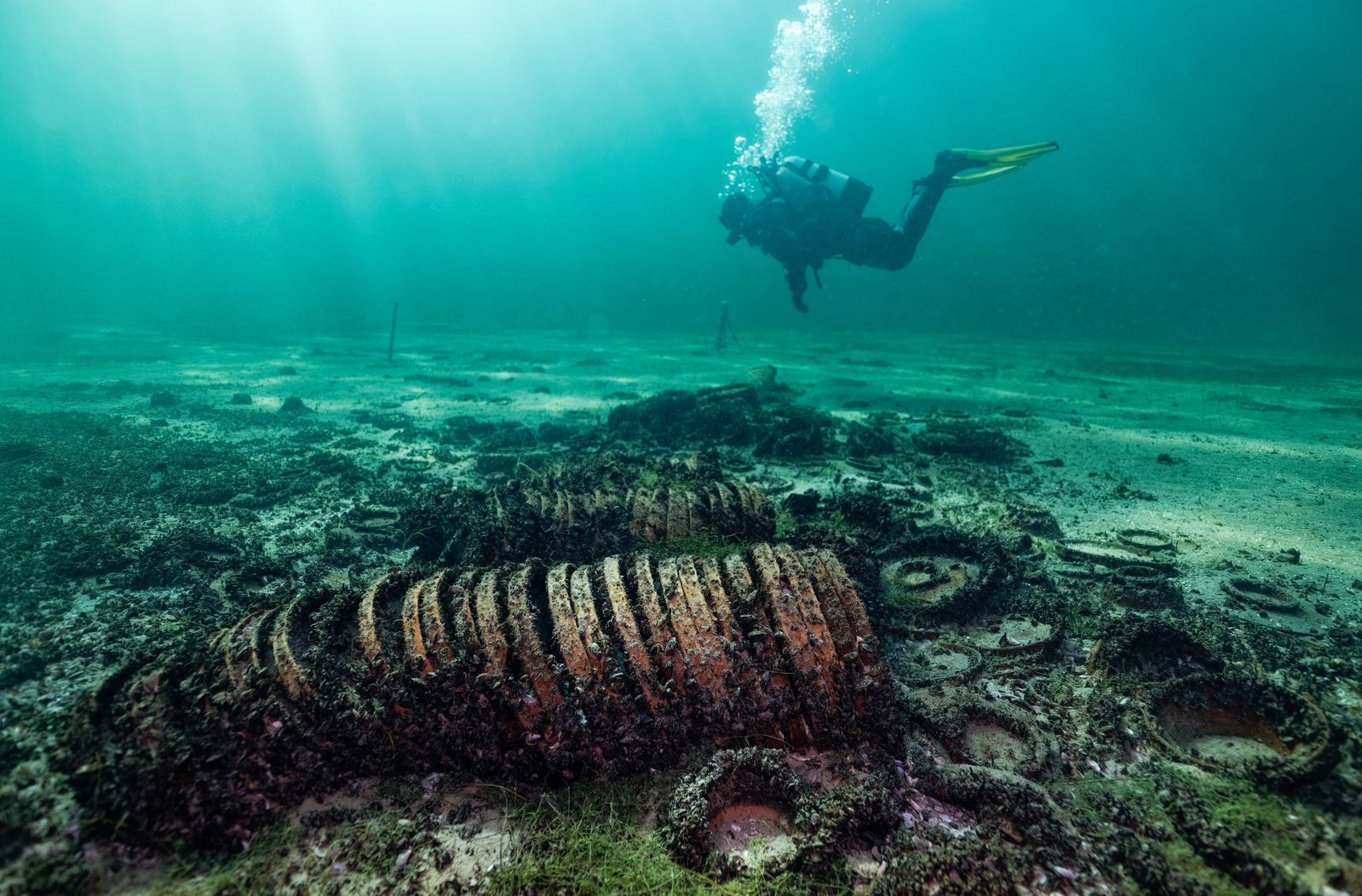
Divers recovered weapons, tools, pieces of horse-drawn chariots, ceramic plates, platters and goblets. One archaeologist surmises that the loss would have been “immense” at the time
:focal(4190x2738:4191x2739)/https://tf-cmsv2-smithsonianmag-media.s3.amazonaws.com/filer_public/47/7a/477a113c-e89c-4f98-bd17-a59cd86cd774/oct_4926.jpg)
Divers have recovered 1,200 artifacts from the site.
Octopus Foundation
Roughly 2,000 years ago, an ancient Roman ship sailed across a large lake in what is now Switzerland, transporting supplies ranging from olive oil to chariot wheels. For some unknown reason, the vessel scattered its cargo across the lakebed.
That’s the scenario archaeologists believe played out, based on their recent discoveries in Lake Neuchâtel, an 84-square-mile body of water at the base of the Jura Mountains in the northwest part of the country. The experts still haven’t located the ship, but they’ve discovered hundreds of artifacts that offer a window into ancient Roman life, according to a statement from the Canton of Neuchâtel.
“At the time, the loss must have been immense,” notes a statement from the Octopus Foundation, a nonprofit collaborating with the Cantonal Archaeology Office of Neuchâtel and the Archaeological Service of the State of Fribourg on the project. “But today, this accidental shipwreck will allow numerous archaeologists and historians to better understand the world in which the Helvetii lived, at the heart of the Roman Empire.”
Did you know? The ancient history of La Tène
The shore of Lake Neuchâtel is home to a significant archaeological site known as La Tène, where ancient Celts encountered cultural ideas and practices from the Greeks and the Etruscans.
Découverte d’une exceptionnelle cargaison romaine échouée au fond du lac de Neuchâtel

Archaeologists first spotted the artifacts in November 2024, while using a drone to monitor the condition of the lakebed and search for submerged heritage. Since then, they’ve completed exploratory dives and artifact recovery missions.
The cargo is in good condition, but researchers are concerned it may become damaged or destroyed by erosion, boat anchors, vandals and looters. As a precautionary measure, they decided to bring the most vulnerable pieces up from the depths.
Archaeologists discovered ceramics that appear to have been made on the Swiss Plateau. Octopus Foundation/https://tf-cmsv2-smithsonianmag-media.s3.amazonaws.com/filer_public/8f/1d/8f1db506-19d4-4004-8a4c-6f251a7bf2d6/oct_4847.jpg)
In an email, Julien Pfyffer, founder and president of the Octopus Foundation, tells Smithsonian magazine that the collaborators have finished the underwater research phase, which resulted in the recovery of 1,200 artifacts. Once researchers have had a chance to study and conserve the objects, they’ll likely go on display at the Laténium archaeology museum, reports Divernet’s Steve Weinman.
Archaeologists often find artifacts buried underground. Many of these items were “used, sold, broken, trashed or buried with the dead,” Pfyffer tells Artnet’s Vittoria Benzine. “Here, the accident is providing us brand new objects that very probably will become a reference for [this] specific time period.”
Divers recovered two swords, including one that’s still sheathed in its scabbard. Octopus Foundation/https://tf-cmsv2-smithsonianmag-media.s3.amazonaws.com/filer_public/b8/f1/b8f114ff-433b-4da4-b0f3-0d34861a181d/oct_9575.jpg)
Divers retrieved ceramic plates, platters and goblets that appear to have been produced somewhere on the Swiss Plateau. Other highlights include fragments of jugs known as amphorae, which were likely used for transporting olive oil and wine. The team found two swords, including one that’s still sheathed in its scabbard, as well as metal tools, pieces of harnesses and horse-drawn chariots (including a set of wheels), a pickax, a belt buckle and a wicker basket.
Based on the mix of artifacts, archaeologists believe the vessel may have been a civilian merchant ship with a military escort on board. They speculate that the ship was transporting equipment to Roman soldiers stationed at the Vindonissa camp along the Aare River between 16 and 45 C.E. These men were part of the 13th Legion, which was sent to Vindonissa—now the town of Windisch—to “prevent Germanic tribes from advancing south onto the Helvetian plateau to seize control of the Alpine passes,” per the Octopus Foundation.
If that’s the case, the vessels likely departed from Eburodunum, an ancient port at the southern end of the lake that is now called Yverdon-les-Bains, then sailed northward across what the ancient Romans called “Lacus Eburodunensis,” according to Divernet.
Artifacts appear to include a set of well-preserved wheels. Octopus Foundation/https://tf-cmsv2-smithsonianmag-media.s3.amazonaws.com/filer_public/13/2f/132f977d-c824-4998-be8d-8712e11b2ccf/oct_7860.jpg)
Archaeologists theorize that the cargo sank as the ship approached the entrance to the Thielle Canal, which connects Lake Neuchâtel to Lake Biel—possibly as a result of a strong, unexpected gust of wind. The vessel might have escaped unscathed or sunk elsewhere.
That theory aligns well with the suspected age of the wreck. Dendrochronological dating of a wooden plank found among the cargo suggests the cargo dates back to at least 17 C.E., per the Octopus Foundation. The researchers also found a fibula, a type of brooch that wasn’t used in ancient Rome until the reign of Tiberius, between 14 and 37 C.E.
The location of the ship remains a mystery. However, Pfyffer is choosing to take an optimistic view of what might have happened two millennia ago.
“Maybe,” he tells Artnet, “relieved by the heavy weight of the cargo, the sailors and Roman soldiers saved their boat.”