


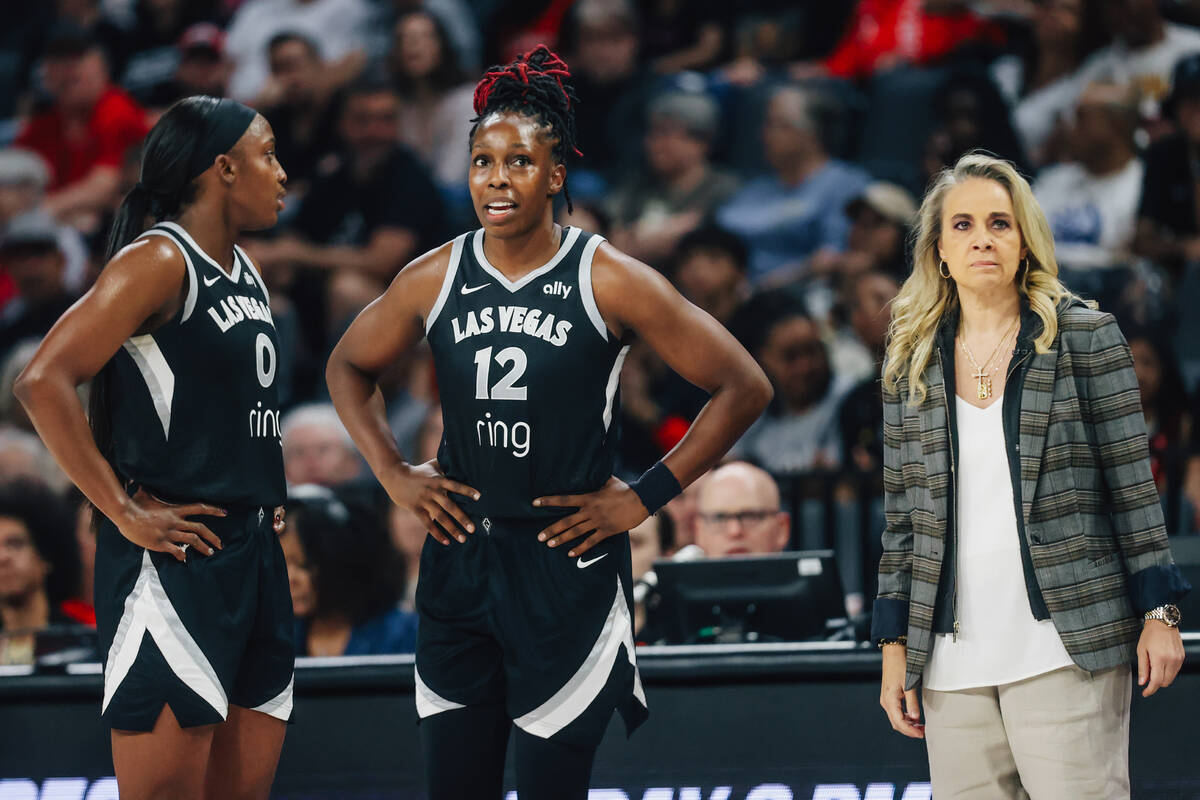
The Las Vegas Aces are taking a more selective approach to their roster building this year, and even fans have taken notice.
“Do the Aces have the smallest training camp roster?” one user posted on X.com on Saturday, the eve of training camps opening around the league.
“Nope, (we’re) the biggest,” guard Chennedy Carter replied, adding a sleeping emoji.
nope we the biggest 😴
— H O L L Y W O O D 🛬 (@ChennedyCarter) April 18, 2026
The response was a perfect illustration of the group that the Aces’ front office — led by president and general manager Nikki Fargas, along with head coach Becky Hammon — have assembled to attempt a second set of back-to-back WNBA championships.
The 13-player roster may look like a small group on paper, but it’s certainly not a weak one.
Four-time MVP A’ja Wilson headlines eight returners that will come back together at the Aces’ Henderson headquarters on Sunday after a fast and furious free agency period spurred by the league’s new collective bargaining agreement.
In addition to retaining the key players from its third WNBA title run in four years, the Aces added players like Carter, three-time Australian Olympian Stephanie Talbot and two-time WNBA All-Defense honoree Brianna Turner. They’ll be joined by rookies Janiah Barker and Jordan Obi, whom the Aces selected in last week’s WNBA Draft.
So, even with just 11 players boasting professional experience, the Aces’ training camp roster is likely the most decorated in the league.
Combined, the group has 20 WNBA titles, 24 All-Star nods, seven All-Rookie Team appearances, 14 All-WNBA honors and seven WNBA All-Defensive Team awards. Not to mention eight Olympic gold medals between five players.
Winning takes sacrifice
Securing a powerhouse group doesn’t come cheap under the new CBA, which increased salaries thanks to a revenue sharing model and $7 million salary cap (up from $1.5 million in 2025).
After years of team-friendly deals, Wilson signed a historic three-year, nearly $5 million supermax deal to stay with the Aces. Meanwhile, guard Jackie Young inked a one-year, standard max $1.19 million contract and Gray agreed to a three-year deal worth around a million a year.
With the core rightfully cashing in, plenty of the Aces’ role players took pay cuts.
Carter, Cheyenne Parker-Tyus, Brianna Turner and Kierstan Bell are all on training camp contracts — which is just jargon for a one-year, unprotected contract at the applicable minimum based on a player’s years of service.
For Parker-Tyus, who was a 2023 WNBA All-Star and once the highest paid player on the Atlanta Dream, the money isn’t the focus.
“I’m thankful,” Parker-Tyus told the Review-Journal after she re-signed. “I want to win. And I know what it takes, I know it means sacrifice. I’m willing to do that.”
After the WNBA draft, Fargas was asked what she and the Aces front office had to say to get players to sign for less than they might earn elsewhere.
“The conversations are really about the culture,” Fargas said. “This is a special place, and we want each of these women to feel valued. We want their voices to be heard, while coach (Becky Hammon) is also pushing them to be the best on the court.”
Fargas went on to say Aces’ state-of-the-art facilities and fervent fan base helps players want to be part of the organization without much convincing.
Like icing on top of the cake, the Aces’ big-ticket players make a sales pitch without even opening their mouths.
“I look at NaLyssa Smith, who is going to be a really good post player in this league – she’s playing alongside A’ja Wilson. And iron sharpens iron,” Fargas said. “That’s only going to improve her game. Then when you have a player like Chelsea Gray, another great leader, Jackie Young, Jewell Lloyd; I mean, these are Olympians. They pour into them. They make them feel like they’re part of this team.”
That said, Fargas doesn’t take anyone on the team’s roster for granted.
“That speaks volumes to the character of the young ladies who decided to come back and said let’s go get another championship,” she said.
Development spots are biggest question
Last offseason, the Aces entered training camp with 17 players and had to make a lot of cuts to get to their final roster.
During that process, Hammon lamented the difficulty of developing players with the league’s small roster size of 12.
In almost a direct answer to her plea, the WNBA created two new “development spots.” The biggest question facing the Aces roster entering training camp is how they’ll use those openings.
Development players must have three or less years of experience. They will earn a $750 weekly stipend and be paid the prorated minimum salary if they are activated for games, which will come out to around $6,000 per appearance.
Otherwise, development players will be a regular part of the team. They can be activated for up to 12 games and even get converted to a standard contract.
Teams will still be able to sign hardship players when faced with injury, giving the entire league much much more flexibility.
Contact Callie Fin at cfin@reviewjournal.com. Follow @Callie__Fin on X.