


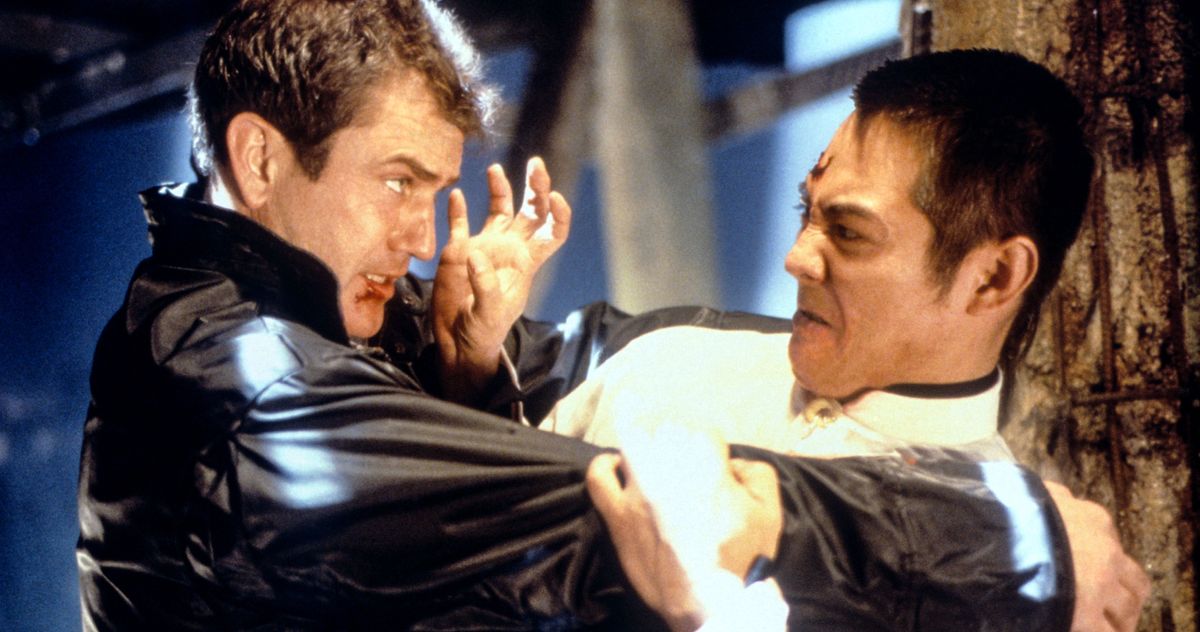
The author opposite Mel Gibson in Lethal Weapon 4.
Photo: Warner Bros./Everett Collection
Lethal Weapon 4 marked the shift in my film career from Hong Kong to Hollywood. Right off the bat, Hollywood gave me many opportunities to practice nonattachment. Before filming even began, the studio played hardball with the contract negotiation. First, they offered me a million dollars. I said I’d think about it. The next day, they said $750,000. I said I’d think about it and discussed it with my girlfriend. The next day, they offered $500,000. I thought, Oh, I am starting to understand. This is the American game.
I was also making a large cultural transition. In Asia, I was a big star. Directors and studios wanted to make me happy. But in America, nobody cared what I wanted. In the late ’90s and early aughts, there were very few roles for Asian actors. I knew I would have to work doubly hard just to prove what I could do. To begin with, I didn’t speak the language. I had to study English like a child, sitting with my flash cards and reciting “A is for apple, B is for boy.”
There was also a shift in the kind of character I was expected to play. In Asia, I had pretty much always played the hero. Most of my best‑known characters were highly ethical, like Wong Fei‑hung from Once Upon a Time in China and Chen Zhen from Fist of Legend. But in Lethal Weapon 4, I was going to play the villain, a ruthless and cruel Triad gangster named Wah Sing Ku who even punches out a pregnant woman. As terrible as my character is in the film, the original script portrayed him as infinitely worse. When I first received the script, my girlfriend and I had a huge fight. Even though she’d encouraged me to take the role, she was horrified by the part when she saw it.
“Why are you doing this?” she asked me. “You’ll destroy your career and destroy your life. I don’t want you to do it.”
I didn’t like the role any more than she did, but I understood this was my chance to break into a new market, and I knew I had to prove myself. Because my identity no longer rested solely on my film career, I wasn’t worried that playing a villain would ruin my life. Making a film in America was quite different from making one in Hong Kong. The Hong Kong film industry in the ’90s was like a family business: There were not that many people involved, and each participant had a lot of input. The business proposition was quite straightforward. If a buyer heard I was going to be in a film, no matter what it was, they would buy it for the Asian market. Then they’d ask, “What’s next? Let me buy that, too.” Then they wanted to know what I was making after that. In this way, I’d make three movies in a row. The production was homegrown and streamlined. We’d find a story, decide on the cast and crew, and make the movie.
But in America, there were so many people involved. Suddenly I needed a lawyer, a manager, an agent, and a publicity team. Every decision had to be green-lit by countless gatekeepers at the studio; every change had to pass through a lengthy chain of command. This was a giant corporation with a business mind-set. Even if one artist or performer had a creative vision, the studio had final cut. It was not possible to have the same feeling of control I felt in Hong Kong.
Lethal Weapon 4 proved to be hugely successful. The studios did audience tests on the film, and I scored just under Mel Gibson — among both men and women. The head of a big studio called me into his office and told me, “Okay, Jet, you’re bankable. We’re going to give you $25 million. Go kick some guys’ asses and make a shitburger that will make us all money.”
From there, I made a series of successful American action movies. I kicked guys’ asses and made us all money. Within a year, I was back to playing the hero. Life is movement. I broke into the market just as I intended to. Still, I knew that no matter how hard I tried, I could never reach the top of the American movie business. My practice kept me sane during that time. If I had tried to cling to my previous fame or the filmmaking process, I would have caused myself infinitely more suffering. My newfound mind-set allowed me to keep my focus on what really mattered.
The whole time I was on set for Lethal Weapon 4, I was practicing. When I was in the makeup chair, I used my headphones to listen to Buddhist teachings. When I was standing around waiting to shoot, I flicked my beads and recited my mantras. I learned just enough English to deliver my lines and answer journalists’ questions during interviews. I spent much more time practicing than I ever spent working on any movie.
Then life itself gave me a sharp teaching on the unavoidability of loss. In 1999, I remarried, and by April 2000, my third daughter was born. Just as this new life entered the world, another was preparing to leave. In July, I learned that my mother was critically ill with cancer. I was filming in Paris at the time, and I left my job and flew back to Beijing to visit her. I wanted a guide to help prepare me to lose my mother, and I returned to the text that had been my first entryway to Buddhism: The Tibetan Book of Living and Dying. I took a copy with me to study on the plane. I had studied Buddhism for about three years by that time, but now I wondered if I could put it to use.
When I returned home, my mother was about to die. My relatives and friends were reluctant to leave her. The Tibetan Book of Living and Dying instructs us to create peace at the end of life and to invite the dying person to leave peacefully. However, these are all theories. In reality, at this moment, my relatives and my mother’s friends were all surrounding her bed crying and tending to her. How could I dare to invite her spirit to leave her body in front of all these people who wouldn’t understand?
I took the doctor aside and asked him, “If all methods of treatment are exhausted, how much longer can my mother live?”
The doctor replied, “A week at most.”
I discussed my mother’s condition with my eldest sister. We agreed that it didn’t matter whether my mother left a week earlier or a week later. The most important thing to me was that her death would not be too painful. We agreed to inform the doctor that he should avoid excessive measures to prolong her life.
As my mother went into her final decline, I was acutely aware of the truth that all things arise and pass away, and I wanted to give her a peaceful send‑off. I asked everyone to leave so that I could be alone with my mother for a while. At this time, I said to her:
“When you’re gone, I will take care of things. You can go without worries. With me at home, my brothers and sisters will have no worries about food and housing for the rest of their lives. Your grandchildren can also get a good education to set them up for a good life. I will ensure all their basic needs are met.”
My mother didn’t speak. We sat together in silence, just breathing. The room became very still as I held her hand, feeling her soft pulse in mine. It seemed as if a long, long time had passed. When you are with someone at the end of their life, you can feel the proximity of the vastness they will soon return to.
Finally my mother looked at me and said, “It’s just a matter of breath.”
A few hours later, my mother died.
Her final words sum up the transience, fragility, and beauty of a human life: “It’s just a matter of breath.”
From BEYOND LIFE AND DEATH by Jet Li, published by Tarcher, an imprint of Penguin Publishing Group, a division of Penguin Random House, LLC. Copyright © 2026 by Jet Li.

Want to be emailed about sales and other updates to your saved products?
Success! You’ll get an email when something you’ve saved goes on sale.
Yes