



Alabama filed an emergency appeal at the US Supreme Court on Friday asking the justices to allow the state to revert to a congressional map with one majority-Black district, setting up a potentially thorny question for the high court as the justices have openly sparred over whether partisanship has played a role in its redistricting decisions.
State officials rushed up to the court late Friday asking it to halt a lower court ruling that has blocked it from using a map it enacted in 2023. It did so based on a blockbuster decision last week on Louisiana’s congressional map that severely weakened the scope of the landmark Voting Rights Act of 1965.
The appeal, which is seeking an answer by May 14, came hours after Alabama Gov. Kay Ivey signed legislation allowing for new US House primaries if courts allow the state to use different congressional districts in this year’s elections.
“Alabama’s case mirrors Louisiana’s, and they should end the same way: with this year’s elections run with districts based on lawful policy goals, not race,” the state told the Supreme Court in its emergency appeal.
The court’s ruling in the Louisiana case said that voters challenging a potentially discriminatory map must demonstrate a “strong inference” of racial motivation in order to bring a successful Voting Rights Act challenge.
Voting rights groups and legal experts have said that may be an impossibly high hurdle to clear. Alabama is one of the GOP-led states that instantly moved to redistrict.
Alabama’s appeal puts the conservative justices in an awkward position.
Writing for the 6-3 conservative majority, Justice Samuel Alito stressed that the Louisiana case did not overturn a decision from just three years throwing out an earlier version of Alabama’s map that also included just one Black majority district. The court’s liberals, led by Justice Elena Kagan, argued in dissent that the court’s ruling last week did exactly that.
“Now, Alabama is basically asking the court to prove that Justice Kagan’s dissent was correct when it argued otherwise. That puts the court, but especially Chief Justice Roberts and Justice Kavanaugh … in a pretty sticky wicket,” said Steve Vladeck, CNN Supreme Court analyst and professor at Georgetown University Law Center.
The new appeal also comes days after Alito and liberal Justice Ketanji Brown Jackson traded barbs over how quickly Louisiana could redraw its map. Jackson accused the court of rolling over its “principles” in pursuit of influencing the November election. Alito fired back, calling that “insulting.” The conservative justice said Jackson’s dissent raised “trivial” and “baseless” arguments.
Yet, on Wednesday, Chief Justice John Roberts lamented what he framed as a widespread misunderstanding of the Supreme Court’s work, pushing back on criticism that many of the court’s highest-profile cases wind up with conservative outcomes.
“People think we’re making policy decisions,” Roberts told a conference of attorneys and judges in Hershey, Pennsylvania, when asked what he felt Americans most misunderstood about the institution he has led for more than two decades.
“I think they view us as truly political actors,” Roberts said, “which I don’t think is an accurate understanding of what we do.”
But, Vladeck said, “in the same week that the chief justice publicly tried to disassociate from charges that the court is behaving politically, here’s Alabama asking it to do exactly that.”
Several southern states are moving quickly to redraw their maps in light of the Supreme Court’s decision, seeking to eke out an advantage for Republicans in this year’s midterm elections.
Tennessee enacted new congressional districts Thursday that carve up a Democratic-held, Black-majority district in Memphis. The state Democratic Party sued on Friday, seeking to prevent the districts from being used until after this year’s elections because of the tight time frame.
The move came the same day that the Virginia Supreme Court dealt a major setback to Democrats by overturning a redistricting plan that could have helped them win as many as four additional House seats. Meanwhile, Republican lawmakers in Louisiana and South Carolina also presented congressional redistricting plans that faced staunch opposition from civil rights activists and Democrats.
Since President Donald Trump prodded Texas to redraw its congressional districts last summer, Republicans think they could gain as many as 14 seats from new districts in several states while Democrats think they could gain up to six seats. But the parties may not get everything they sought, because the gerrymandering could backfire in some highly competitive districts.
“This is just Jim Crow 2.0” Rep. Bennie Thompson reacts to Voting Rights ruling

In Alabama, the new law would let the state move back its primary if federal courts allow it to use its previous map. An earlier version of the map was reviewed by the Supreme Court in 2023, and the justices required the state to try again. The state did so, but its new map also included only one Black-majority district.
The state voted in 2024 on a court-drawn map that included two districts where Black voters had an opportunity to select a candidate of their choice.
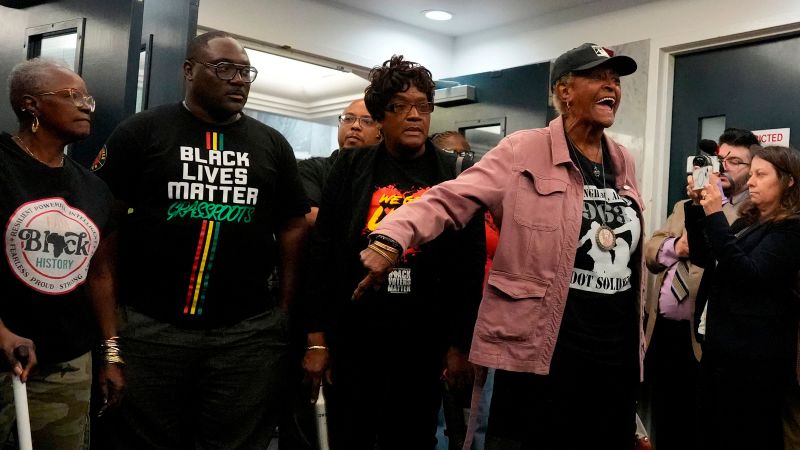
Demonstrators outside the Alabama statehouse on Friday shouted “fight for democracy” and “down with White supremacy.”
“I was out there in 1965 marching for the right to vote, and now we are back here in 2026 doing the same thing,” said advocate Betty White Boynton.
Republican state Sen. Greg Albritton said the special primary would happen only if the courts agree to lift an injunction that put a court-selected map in place until after the 2030 Census.
“Should there be no court order issued, then this bill would have no effect,” Albritton said.
The court order required a second district where Black voters are the majority or close to it, resulting in the 2024 election of Democratic Rep. Shomari Figures, who is Black. If a court lifts the injunction, Republican officials want to put in place a map lawmakers drew in 2023 — which was rejected by a federal court — that could allow them to reclaim Figures’ district.
Senate Minority Leader Bobby Singleton, a Black Democrat, said Republicans are aiming to strip representation from Black voters in an effort to get another Republican to Congress.
“We have just only been voting since 1965, and you are now trying to take that voice away from us,” Singleton said.
The high court has asked for a response to Alabama’s petition by Monday at 5 p.m. ET.
This story has been updated with additional reporting.
The Associated Press contributed to this report.