



By Gerald Bourguet
Coming off a 45-win season and unexpected trip to the playoffs, the Phoenix Suns have two options heading into another important offseason. They can choose to keep their new core intact, hoping that another year of continuity and internal growth will yield better results with more injury luck, or they can try to upgrade the roster wherever they can without sacrificing too much of the core that helped build their newfound identity.
If exit interviews with owner Mat Ishbia and general manager Brian Gregory were any indication, the Suns will largely look to run it back next season.
“I think our continuity is gonna be a big positive for us,” Gregory said. “It’ll be the first time since I’ve been here, coach is coming back, staff’s coming back, players are coming back. We’re able to get into gym with them in two weeks instead of in July.”
The Suns won’t be hanging up on trade offers, but unlike in years past, they may not be as active in seeking out deals. Taken at face value, their focus appears to be supplementing this core, not tweaking it.
“Do we take calls about opportunistic trades and ideas? Of course we do,” Ishbia said. “However, our massive, massive lean is, I like this team. I like where we’re going. I like the direction of the organization. I like the culture that we’ve built. I like the identity that we have. And we’re not gonna do anything silly to mess that up.
“We’re gonna continue to lean in on that, and I think the fans will be proud of that. And we’re gonna continue to get better and we’re gonna build something special for years to come here in Phoenix. And I think this was the foundational first year.”
Continuity obviously starts with navigating new deals for the Suns’ own free agents who played meaningful roles in their success. Namely, Collin Gillespie and Jordan Goodwin will be unrestricted free agents that Phoenix intends to re-sign, while Mark Williams faces a trickier situation as a restricted free agent.
There is a case to be made for more calculated, bigger swings to upgrade this roster. It seems hypocritical to criticize the Suns for their bold and shortsighted “all-in” moves over the last two years, and then turn back around and demand a more aggressive approach the minute they establish a new culture and identity…but that first-round sweep against the Oklahoma City Thunder showed how far this group still has to go.
Whether the Suns plan on making bigger moves or decide to bank on continuity and internal development, they’ll still have to make decisions about their own free agents first and foremost. In either scenario, Collin Gillespie is someone they’ll want to bring back on a new deal.
Over the next few weeks, we’ll take a look at the case for re-signing (or not re-signing) each one of Phoenix’s three main free agents. Today, we start with Gillespie, who is coming off a career season and should be Phoenix’s top priority this summer.
The Suns’ cap situation
Heading into next season, the Suns already have eight players under contract: Devin Booker, Jalen Green, Dillon Brooks, Grayson Allen, Royce O’Neale, Khaman Maluach, Ryan Dunn and Rasheer Fleming. If you include the non-guaranteed deals and team options for players that would make sense to return, three more are added to that tally with Haywood Highsmith, Jamaree Bouyea and Oso Ighodaro.
Between those 11 players, Phoenix already has approximately $162.5 million on the books. Unfortunately, they also have the dead money for Bradley Beal, Nassir Little and EJ Liddell to worry about. That extra $23.2 million bumps them up to $185.7 million total salary.
For reference, the NBA’s salary cap for next season is $165 million, which means the Suns will be operating as an over-the-cap team. Thankfully, they can go over the cap to re-sign Gillespie because they possess his Early Bird rights, which allows them to re-sign their own free agents to a higher amount without regard to the salary cap. (This is the case with Jordan Goodwin as well.)
What they’ll need to consider is the luxury tax at $200.5 million and the first apron at $209.1 million. Mat Ishbia never blinked while staring down astronomical luxury tax bills when he thought his team was worth the investment, but if the Suns dive back into the tax next season after ducking it this year, they’ll be subject to the repeater tax again.
Fortunately, that’s an Ishbia problem, and the Suns owner has never minced words about how fans couldn’t care less about their favorite team’s tax bill. So if this organization truly is all aboard the Continuity Express, they may not have any choice but to dive back into the tax, since re-signing just one or two of their key agents could quickly push them back over that $200.5 million threshold.
Remember, the Suns are only operating with $14.8 million of space beneath that luxury tax line. Re-signing Gillespie and Goodwin and then filling out their two remaining roster spots would likely be enough to push Phoenix back into tax territory.
A look at Collin Gillespie’s breakout season
Make no mistake about it: Collin Gillespie is expected to be the Suns’ top priority to retain this summer, and he’s more than earned his payday with this team. For Gillespie’s part, he’s equally invested in a return to the Valley.
“Yeah, it hasn’t changed,” Gillespie said during exit interviews. “I still want to be here, and the front office knows that, everybody knows that in the building. So I’m sure we’ll figure it out when that time comes.”
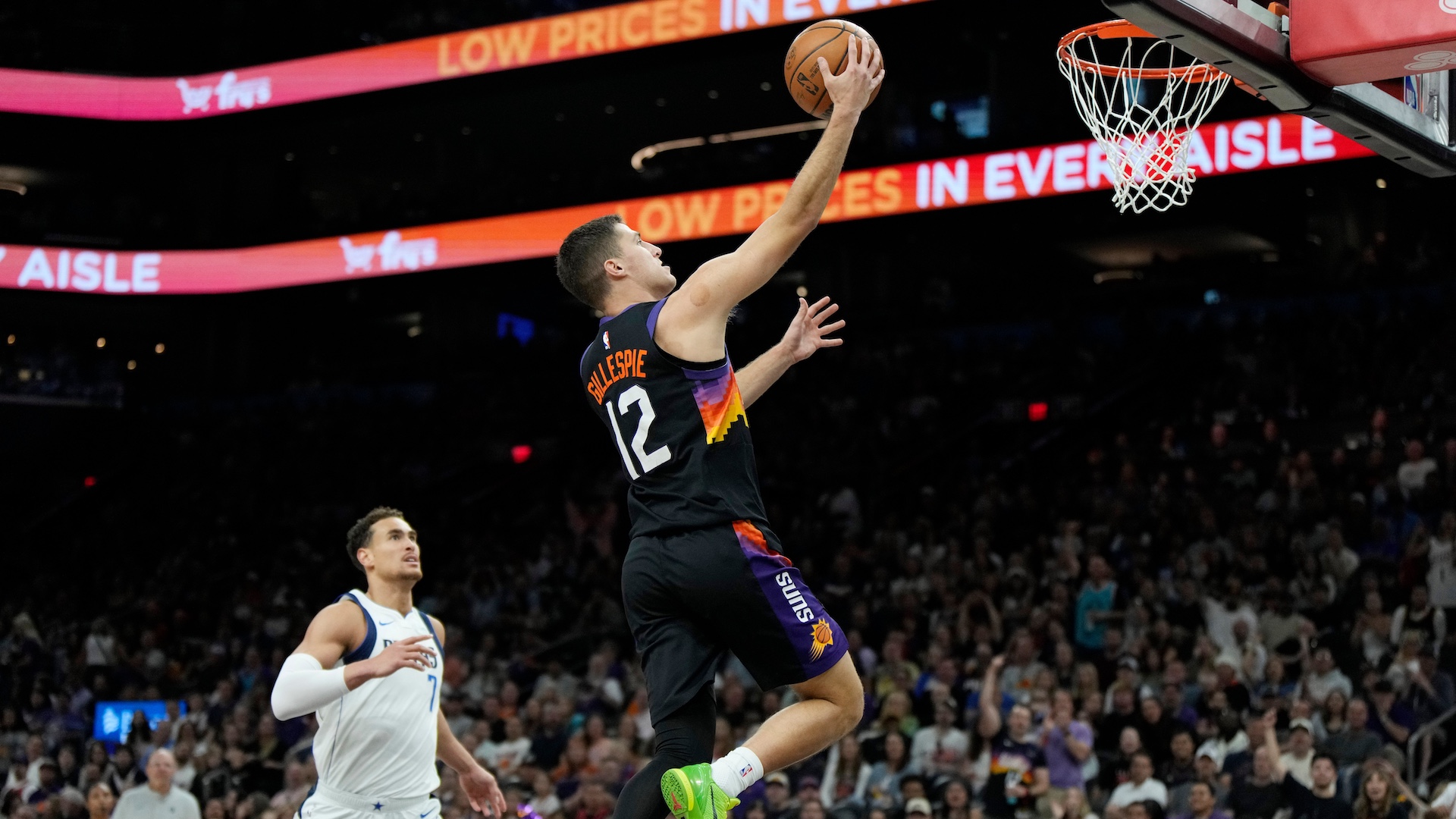
It makes sense that both Gillespie and the Suns want to get a deal done, since the 26-year-old enjoyed a breakout year in his first season as a legitimate NBA rotation player in Phoenix. Gillespie averaged 12.7 points, 4.6 assists, 4.1 rebounds and 1.2 steals per game, all of which were career highs.
Despite a massive uptick in minutes and shot attempts, he also remained the 40 percent 3-point sniper he’s been since his days shooting on a Fisher Price hoop. Gillespie canned 40.1 percent of his triples on a career-high 7.2 attempts per game, and he even broke the Suns’ franchise record for made 3-pointers in a single season (232), surpassing Quentin Richardson’s previous record (226).
The only players in the entire NBA who made more 3s than Collin Gillespie this season were Kon Knueppel, LaMelo Ball, Luka Doncic, Nickeil Alexander-Walker, Jamal Murray and Donte DiVincenzo. Among those six players, everyone but Murray attempted at least 50 more 3s than Gillespie.
The young Villanova product also played 2,282 minutes over 80 games — a significant increase for a guy who had only logged a grand total of 687 minutes in 57 games over the first three years of his career combined.
Near the tail-end of Phoenix’s disastrous 2024-25 campaign, Gillespie came on strong late in the season, but it was hard to tell how much of that was him being legitimately good, and how much was him standing out on a lifeless roster by the virtue of simply trying. Given his first legitimate shot at rotation minutes on a standard contract, Gillespie definitively proved that he belongs.
Gillespie actually started in 58 of his 80 appearances this season, and the Suns’ most-used lineup — Gillespie, Devin Booker, Dillon Brooks, Royce O’Neale and Mark Williams — boasted a +10.4 Net Rating. Their second-most used lineup — Gillespie, Booker, Jalen Green, O’Neale and Oso Ighodaro — also boasted a +10.4 Net Rating.
Whether Collin Gillespie is the ideal backcourt partner for Booker is debatable. He was a great complement for Book before Green returned to the lineup, and on the season, lineups with Booker and Gillespie in them posted a +7.0 Net Rating. Gillespie’s shooting makes him a terrific spot-up threat off the ball, and his ability to handle the rock and facilitate allowed Booker to operate off the ball a bit too — something that carries more weight for a franchise that needs to build properly around its star player.
However, as much as Gillespie scraps on the defensive end, he’s still a tad undersized at 6-foot-1, which can make him a target for mismatches. He doesn’t possess overwhelming athleticism on either end, and despite the “wiggle” he has when getting into the lane, he still needs to work on creating separation. Gillespie also shot just 51.4 percent at the rim, due to that lack of size, bounce and ability to create space from his defender.
Gillespie may have saved the Suns some money after hitting a bit of a wall over the last six weeks of the season, which coincided with Jalen Green returning from his hamstring injuries to rejoin the starting lineup. From March onward, Gillespie’s numbers dipped to 10.1 points per game on 36.9 percent shooting overall, including 34 percent from 3.
Whether that was a byproduct of adjusting to Green’s presence or simply dealing with that fatigue of playing more minutes than he ever had in a season, Gillespie will need to find a way to be more productive with fewer touches and opportunities (assuming Green stays healthier next season).
With all that being said, Gillespie proved that at the very least, he’s a high-end backup. Assuming the Suns’ main trio of Booker, Brooks and Green is back again next year, the Suns need to add more size to their starting lineup, which means Gillespie may make more sense as one of the first subs off the bench. But even if he’s not ideally suited to be the fifth starter on a legitimate contender, Gillespie showed he can produce as an occasional spot starter and natural backcourt partner for Booker.
So how much will Collin Gillespie’s next contract be worth?
In terms of contract value, if the Suns re-sign Gillespie, his deal must be for a minimum of two years, not including any options. Thanks to those Early Bird rights, he’s eligible for a contract worth up to four years and $67 million, which would come with a starting salary of about $14.9 million in his first season.
It’s hard to see him getting that full amount, which would immediately push Phoenix into the luxury tax. However, something in the $10-12 million annual range feels like a fair deal for both sides. Gillespie has understandably pushed back on the T.J. McConnell comparisons, but something like McConnell’s four-year, $45 million extension seems fitting for both parties. Adjusting for the league’s increasing salary cap since McConnell signed his deal, maybe Gillespie’s payday stretches to the $50 million range over four years.
Anything in the $7-9 million annual range would be a bargain for a high-end backup who can double as a capable starter in a pinch, especially since Gillespie did average 13.3 points and 4.7 assists per game on 40.4 percent shooting from 3 as a starter. If injuries flare up, or if the Booker-Green-Brooks trio tanks without the appropriate size around them and Jordan Ott looks for a more drastic change of pace by demoting Green to a sixth man role, the Suns can rest easy knowing Gillespie can immediately come in and give them solid minutes as a spot starter.
After a breakout season in his first year as a fully-rostered NBA rotation player, Collin Gillespie has earned the first payday of his professional career. He flourished with this group under Jordan Ott, and assuming he can continue to stay healthy, he has a good chance to build on that. All of that has undoubtedly fed Gillespie’s sense of loyalty to the organization and his desire to return to the Valley, and the feeling is mutual with the Suns, given how he was one of the first to embody the grit and hustle that Phoenix wanted their new culture to revolve around.
Granted, his numbers might not look as impressive if he’s moved to a full-time bench role, but the impact should still be there, and that’s more than worth the $9-13 million annual salary that Collin Gillespie is likely to command with a pay raise this summer.