



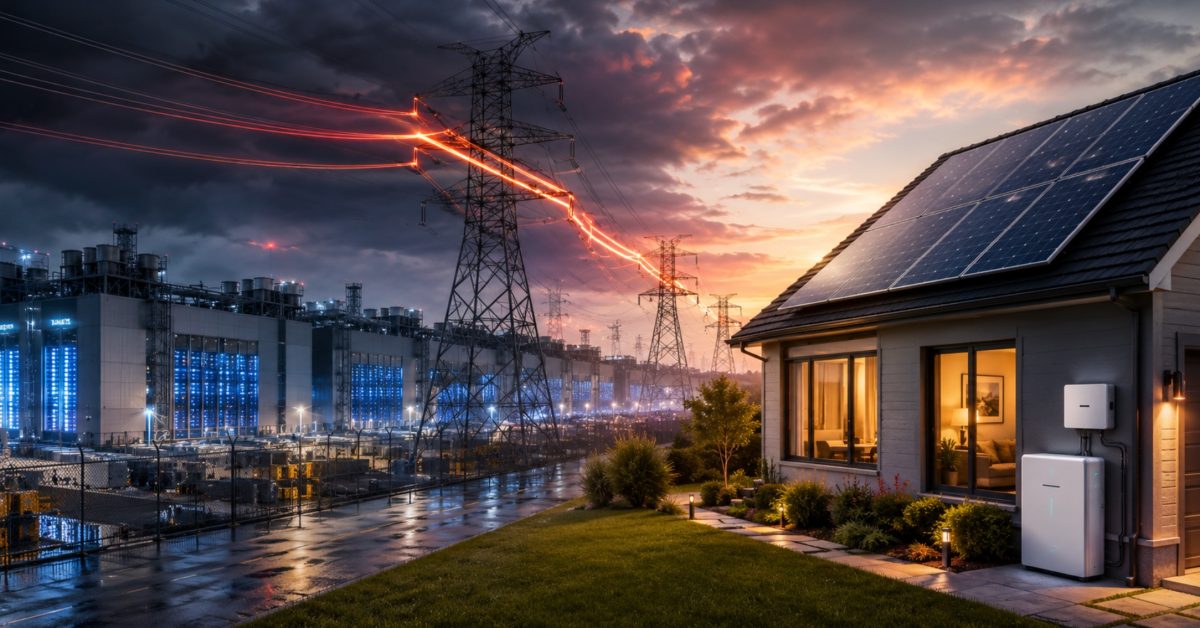
A Nevada utility just told 49,000 Lake Tahoe residents that it’s redirecting 75% of their electricity supply to data centers — and they have less than a year to find a new power source. It’s one of the starkest examples yet of the AI boom’s impact on everyday Americans.
The case is extreme, but the pattern is not. Across the country, data center electricity demand is reshaping the grid, driving up rates, and pushing a growing number of homeowners toward solar and battery systems — not as complementary power, but as essential infrastructure.
Data centers are eating the grid
NV Energy, the Nevada utility that has supplied the bulk of Lake Tahoe’s electricity for decades, told Liberty Utilities — the small California company that services the region — that it will stop providing power after May 2027. The reason: NV Energy needs the capacity for data centers being built by Google, Apple, and Microsoft around the Tahoe-Reno Industrial Center east of Reno, according to Fortune.
The numbers are staggering. Data centers consumed 22% of Nevada’s electricity in 2024, and that share could rise to 35% by 2030. Twelve data center projects in Northern Nevada alone could drive 5,900 megawatts of new demand by 2033, according to Desert Research Institute analysis of NV Energy’s resource plan. In NV Energy’s own 2024 filing, about 75% of major-project load growth is attributed to data centers.
This isn’t just a Nevada problem. AI data centers are expected to triple their share of US electricity consumption, from 4.4% in 2023 to 12% by 2028. Data centers drove half of all US electricity demand growth last year. In Virginia, they already consume more than one in four kilowatt-hours generated in the state.
The downstream impact on residential customers is direct. Dominion Energy in Virginia proposed its first base-rate increase since 1992 — adding about $8.51 per month in 2026 — driven in large part by infrastructure needed to serve data center load. The national average residential electricity rate hit 17.45 cents per kWh in January 2026, a 9.5% increase year-over-year, far outpacing regular inflation.
Google spent $4.75 billion last year chasing power for its AI data centers. That money is competing directly with residential customers for the same grid capacity.
Homeowners are responding with solar and batteries
The residential solar market took a hit when Congress eliminated the 30% federal tax credit for customer-owned systems at the end of 2025. Installations are expected to decline 18% in 2026, according to SEIA. But underneath that headline number, something interesting is happening: the motivation for going solar is shifting from incentives to infrastructure.
Rising rates and grid reliability concerns are replacing tax credits as the primary driver of residential solar adoption. Markets like Texas, Arizona, and parts of the Southeast — not traditional solar strongholds — are seeing increased interest in solar-plus-storage systems driven by reliability concerns and extreme weather, not just high electricity prices.
The shift is measurable. Third-party ownership models (leases and power purchase agreements), which still qualify for the commercial investment tax credit through 2027, are projected to grow 25% in 2026 and capture up to 69% of residential installations, up from roughly 45% in 2025. Homeowners aren’t waiting for incentives to come back — they’re finding new ways to get solar on their roofs.
Batteries are becoming the centerpiece of the home energy equation. As net metering policies evolve and time-of-use rates become more complex, a battery that can store cheap solar energy and deploy it during peak hours is increasingly essential. California utility customers alone are adding roughly 8,000 new home batteries per month — about 100 MW of new storage capacity.
Municipal programs are accelerating the trend. Ann Arbor, Michigan, recently became the first US city to directly deploy solar and battery systems on 150 homes through its city-owned utility. Vermont’s Green Mountain Power is offering home batteries at little to no upfront cost. These programs signal that utilities themselves recognize the value of distributed energy.
The Lake Tahoe case is a warning
What makes the Lake Tahoe situation so instructive is the jurisdictional mess. Liberty Utilities is a California-regulated company, but its grid sits inside NV Energy’s balancing authority. California regulators can’t order Nevada to keep the lights on. Building a direct connection to California’s grid would cost hundreds of millions of dollars.
Liberty has asked California regulators to authorize an emergency procurement of replacement power before the May 2027 deadline. But as one Lake Tahoe resident and energy policy expert told Fortune: 49,000 customers competing in the Western electricity market against major utilities and data center operators have zero leverage.
That dynamic — small residential customers losing out to massive industrial electricity buyers — is exactly what’s driving the broader shift to distributed solar and storage. When the grid becomes unreliable or unaffordable because of data center demand, the homeowners who have solar panels and a battery in the garage are the ones with options.
Electrek’s Take
We’ve been covering the surge in home solar and battery adoption for a while now, and the Lake Tahoe story crystallizes why this trend has legs beyond tax incentives.
The fundamental problem is that data centers need enormous amounts of electricity, and the infrastructure to deliver it is being built — or redirected — at the expense of residential customers.
For the most part, the story has been about the added demand putting pressure on residential prices, but when a utility tells 49,000 people that their power is being rerouted to serve Google and Apple, things are getting more serious and urgent. That’s a reason to put solar panels on your roof.
The residential solar industry is going through a painful transition after losing the federal tax credit. Installations might drop this year. But the underlying demand drivers — rising rates, grid strain from data centers and electrification, and the falling cost of solar and batteries — are all getting stronger, not weaker. Long-term retail rate inflation, falling equipment costs, and expanding grid services opportunities will continue to push adoption even without government incentives.
The market is shifting from one where homeowners asked “Should I install solar?” to one where they ask “How do I make solar and storage work for my home?” That’s a fundamental maturation, and stories like Lake Tahoe are only going to accelerate it.
As data centers put mounting pressure on the grid and electricity rates climb, solar and batteries are becoming essential home infrastructure — not a luxury. With lease and PPA options, you can go solar with zero upfront cost and start saving immediately. If you want to find the best deal, check out EnergySage. It’s a free service with hundreds of pre-vetted installers competing for your business, so you save 20 to 30% compared to going it alone. No sales calls until you pick an installer. Get your free quotes here.


FTC: We use income earning auto affiliate links. More.