



ST. PAUL, Minn. — In 2007, Brent Burns was 22 years old and already five years into his pro career and the most interesting player on the Minnesota Wild.
I had been begging him for two years to let me write a personality profile on him. Much to my surprise, I exhausted him into submission. One December day, he relented and invited me to his home in Woodbury, Minn.
That alone fascinated me. Why on Earth was he living five miles from the Wisconsin border and west of the Wild’s home rink in St. Paul when most of his married teammates were living in the western suburbs and all of his single teammates were living in Minneapolis?
I showed up at a 3,800-square-foot home and again wondered, “Why so big?”
Then I found out.
Besides racing bikes, guitars, a ping-pong table, a pool table, a movie room and a library full of books, his house was like “Animal Kingdom” and what I would dub in my piece as “The Burnzie Zoo.”
I knocked on the door, and photojournalist Liz Flores and I were greeted by Burns’ extremely friendly and energetic 1-year-old huskies, Zeus and Maia.
In the living room was a gigantic aviary with a blue, yellow and green macaw named Eragon and a loud parrot named Hedwig. He took us down to the basement, where we met his dozen or so snakes. He had so many, there is a legend that one day he got a knock on the door from the Woodbury police department or the DEA or some other agency. His electricity bill was so high, law enforcement was convinced he was running a meth lab or something.
Turns out it was because of the heaters to keep his snakes alive. (Burns has never confirmed or denied this story, by the way.)
“Want to feed my shark?” Burns asked me.
“Your what?”
“My shark,” Burns said.
We went back upstairs and there in a guest bedroom was a giant saltwater aquarium with a dozen colorful tropical fish and Bryce, his 2 ½-foot brown, black-dotted horn shark. I wanted no part of feeding Bryce, so Burns put his hand in and poured in hundreds of defrosted silverside minnows.
Bryce, usually docile, went to town. Burns told me the only animal to watch out for in the aquarium was the lionfish.
“You get stung by him, your hand will go numb for a week,” he said.
“Try six months, hon,” Burns’ then-girlfriend, Susan, said.
Burns joked that then-Wild coach Jacques Lemaire probably wouldn’t be happy with him if that happened.
Not long after, Brent and Susan, who were married in 2009, moved into a 9,000-square-foot home a few miles away on the Lake Elmo Park Reserve. He invited me over for another profile, and I learned that the “Burnzie Zoo” was ever-expanding. He needed more room for his dogs, cats, lizards, birds, fish, snakes and other animals.
Plus, he and Susan were starting a family.
It was here, as Burns would watch the deer, coyotes and foxes roaming in his backyard, that he’d dream of one day owning a large-animal, big-game, big-cat ranch — such as the one he now owns and lives at during the offseason in Texas.
But buying a house that large was also proof positive that Burns thought he’d be in Minnesota forever.
“I remember I’d take the kids over to the zoo, and they loved playing with all the animals,” retired NHLer Brian Rolston said this week. “He just loved everything in Minnesota. I remember he got the ‘WILD’ tattoo on his back. We gave him so much s—. I was like, ‘Burnzie, you ain’t going to be here forever, buddy.’
“But that was Burnzie. He was just a young kid, and your whole life you dream of making the NHL, and you go to that first team, and you think that’ll be the end-all be-all. And when you get traded from that team, it stinks a lot because you think you’re leaving your family there and you don’t understand the business of it.”
Sure enough, one year from free agency, Burns was traded to the San Jose Sharks along with a second-round pick for top prospect Charlie Coyle, young goal scorer Devin Setoguchi and a first-rounder the Wild used on forward Zack Phillips.
That was 15 years ago.
A few days ago, on the morning of Game 2 of the Wild’s second-round series against the Colorado Avalanche, I was walking with Burns, who signed a one-year deal with Colorado before the season, to his car as he left Ball Arena.
“Fifteen years is an incredible career for most guys,” I told him. “Aren’t you amazed that 15 years after being traded from the Wild, you’re still churning as a 22-year NHLer, have played over 1,500 games and more than 1,000 in a row? And now you’re playing your original team for the first time in a playoff series?
“Like, who would have thunk?”
Burns thought for a moment.
“I didn’t even think of that because I’m always so in the moment,” Burns said in brown camouflage fatigues and with his signature gigantic military duffle bag over his right shoulder. “I guess you can say I’ve come full circle.”
Burns, a 2003 first-round pick and now the NHL’s oldest player, is almost certainly already a future Hall of Famer. But winning his first Stanley Cup — after previously making the Final with the Sharks in 2016 — would certainly cement that case.
This past season, Burns passed Bobby Orr for the seventh-most goals among defensemen in NHL history (273), although the first of those actually came as a winger before Lemaire and assistant coach Mike Ramsey turned him into a defenseman (proof being that it was assisted by defensemen Willie Mitchell and Brad Bombardir), as did the 22 scored in 2013-14, when the Sharks moved him back.
His 945 points rank 11th among blueliners in NHL history. And before you ask, yes, the NHL told The Athletic it considers all of those goals and points from a defenseman regardless of temporary position shifts.
This season, he was second among Avs defensemen with 12 goals, third with 35 points and first with five game-winners. The 12 goals were the second-most ever by a defenseman in his 40s (Nicklas Lidstrom scored 16 in 2010-11). His 35 points were the fourth-most by a defenseman in his 40s behind Lidstrom, Ray Bourque and Chris Chelios.
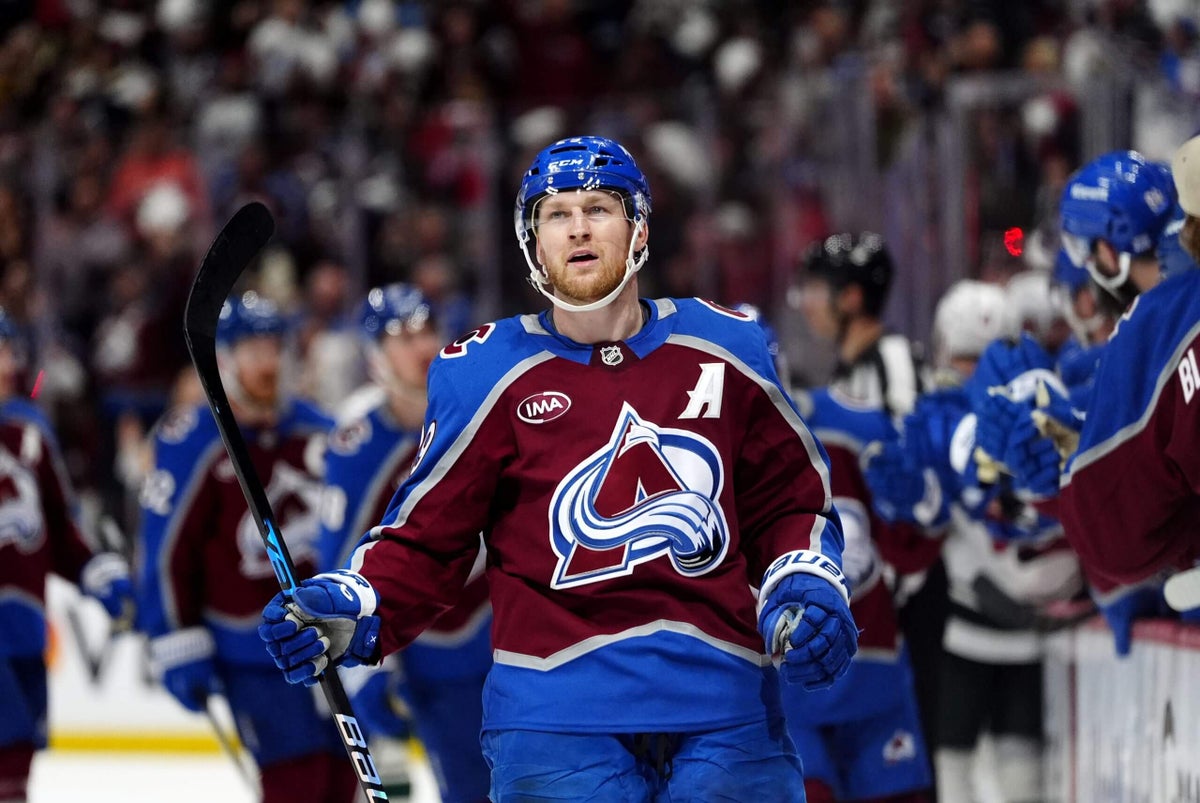
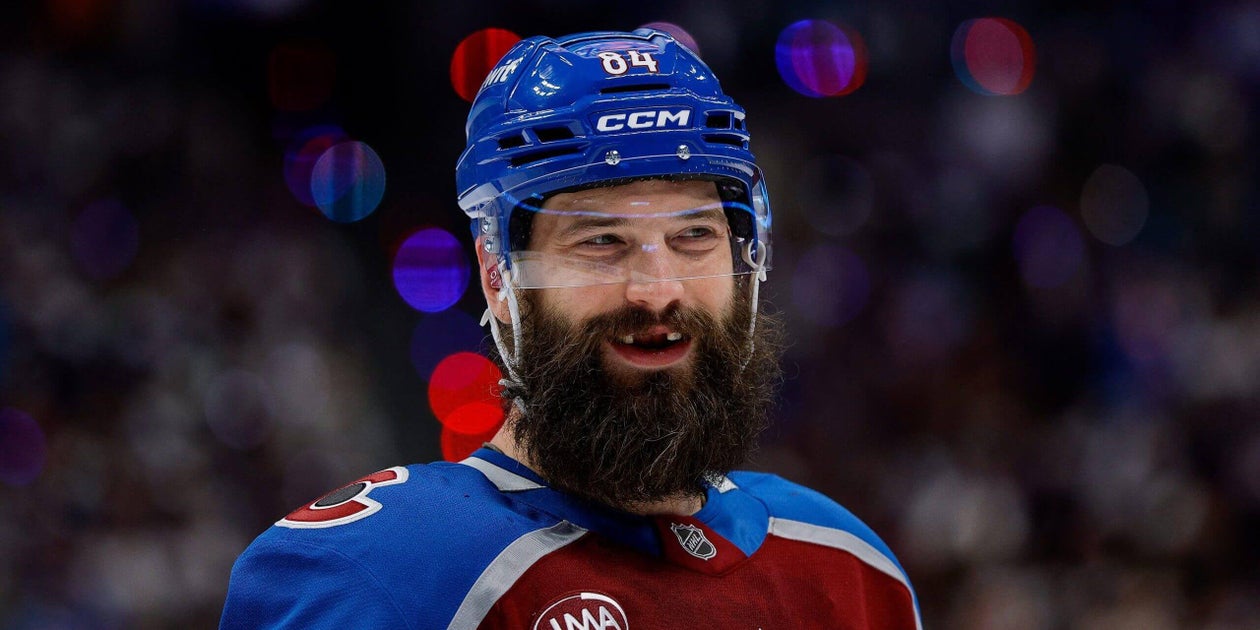
Now, Burns is no longer that young, innocent, bubbly kid with highlights in his hair, one missing tooth and only four tattoos who played seven seasons for the Wild, starting as a teenager. Today, the father of three has several missing teeth, a full beard with sprinkles of gray and the general look of a Viking from yesteryear, which is why his two episodes as a guest star on the show “Vikings” were so apropos. He’s got slicked back hair, having gotten rid of the bun he had in San Jose when he won the Norris in 2017 and part of his time with Carolina. And after getting his first tattoo at age 11, he’s now got tattoos absolutely everywhere. You can no longer tell his back once said, “WILD.”
He has played 1,579 regular-season games, the 14th-most in history and the third-most without having won a Cup (behind only former Sharks teammates Patrick Marleau and Joe Thornton). Bourque played the 13th-most games in NHL history (1,612), and like Burns hopes to do, fulfilled his Cup dream in Colorado in 2001.
If Burns wins a Cup, who knows if he calls it a career like Bourque did. This is a hockey lifer who has spent his entire life at a rink. His mom went into labor with him at one.
Burns ended the season with 1,007 consecutive games, only 58 in a row from passing Phil Kessel’s record NHL “Ironman” streak. Perhaps that’s incentive enough to play one more year, Cup or not.
“I think he could play forever,” Wild general manager Bill Guerin said. “It’s incredible.”
Burns won’t say — or doesn’t know — what’s next.
“I don’t think like that,” he said. “I just worry about the now, playing, doing my routines.”
“Even when I was young, I wasn’t really aware of the way he took care of his body, but looking back at it now, he’s been like that for his entire career,” said Wild captain Jared Spurgeon, who was a Wild rookie during Burns’ final year in Minnesota. “That’s how you play 1,000 games straight. It’s remarkable.”
Chuck Fletcher was the Wild GM who traded Burns. He, too, is amazed that Burns has played so many games and so many games in a row. When Fletcher first arrived in Minnesota in 2009, there were concerns about Burns’ health. He was coming off a season in which he missed 23 games with head and shoulder injuries. He then missed 35 games with a concussion during Fletcher’s first year as GM.
But since 2013, the only time Burns came close to missing a game was when a cheetah at the Columbus Zoo mistook his cashmere sweater as prey and took a huge chunk out of his side.
“To play that long and to overcome what he did early in his career, in particular in terms of the injuries and to have the run he’s had, it’s just amazing,” Fletcher said. “Just being available all the time after what he went through early in his career is just a real credit to him.
“But it’s not surprising in the sense that he always took care of himself. His summer training sessions were legendary. I remember talking to him about what he did in the summer, and he told me all his bike rides and how he would do it, and he would get Derek Boogaard to join him for some of them. But he was just a maniacal bike rider, but just the way he trained off the ice. And obviously a great athlete.”
Fletcher was asked to give The Athletic a history lesson on the rationale behind the trade, which came a year before unrestricted free agency and a year before Fletcher signed Zach Parise and Ryan Suter to 13-year, $98 million contracts.
“We were an older team, looking back at (Martin) Havlat, (Andrew) Brunette, (Owen) Nolan, (Eric) Belanger, (Antti) Miettinen. Even (Niklas Backstrom) was, I think, right around 30 or 31. And we were an aging team that hadn’t made the playoffs for two years. Going back to the summer of 2010, we made a conscious decision that, whatever you want to call it, we had to rebuild. We had to find some young prospects. We didn’t have a lot coming at the time. We had (Marco) Scandella and really not a lot. We still had (Matthew) Hackett and (Erik) Haula and (Darcy) Kuemper from the ’09 draft that we thought were good prospects. And then 2010, we drafted (Mikael) Granlund. We had three second-round picks that year. (Jason) Zucker and (Johan) Larsson were able to play, and Zuck’s still having a tremendous career, and we had signed Spurgeon.
“And so going into ’11, we had another draft, and one of the big conversations was, ‘We’re not a Stanley Cup-contending team. We have to have a massive influx of young talent into our team here to rebuild a young core and to try to become a good team for a long time.’ At the time, Burnzie had a year left on his contract before he was going to be a UFA, and is that the time you want to start to commit dollars? Are we ready to get into that? And so there were a lot of factors at the time, and the opportunity to get multiple young assets and to continue to push that rebuild, if you will, and to keep the cap sheet lean as well, was the decision we made.”
Before Fletcher got to Minnesota, Doug Risebrough had trouble getting Marian Gaborik signed with Burns’ same agent, Ron Salcer. But Fletcher said he flew to California a couple of times to meet with Salcer about Burns and they had great dialogue. So it really had nothing to do with how much it would cost to sign Burns or the fact that the Wild were hoping to at least go after Parise the next summer. It was more about accelerating the rebuild.
“But typically when you acquire multiple young assets for one proven, quality, star player, it’s … it’s a tough trade to win, let’s put it that way,” Fletcher said.
Still, trading Burns did clear the books to make a splash with Parise and Suter the next year, and the Wild did make the playoffs starting in 2012-13 and during the remaining of Fletcher’s six seasons.
“But I’ve been gone eight years and Burnzie’s still playing 15 years later,” Fletcher said. “Those are tough trades to make when you trade Brent Burns, but just where we were in the arc of our rebuilding phase — at that point in time, it just made sense.
“I’m proud of the career he has had. It’s just love of the game, and he has a great personality. He loves people, just loves to be in the locker room. Going through that San Jose team at that time, they had a great team and a lot of great players, and they just seemed to be a group that loved to play together. And so I’m sure he learned a lot from the players when he was traded there, but he’s just a person that loves life and loves hockey, and again, just the way he trains and prepares for every season, he’s a physical freak.”
And that’s exactly why Avs GM Chris MacFarland signed Burns this season.
“Besides being a great player for all these years, his personality is contagious,” MacFarland said. “There’s never a bad day. He’s always got a smile on his face. And I think that resonates with all the players. He’s a hard guy to be around and not smile. That’s a big part of what he’s brought to our team.”
Rolston is 53 now and can’t believe his three 30-goal seasons in Minnesota came alongside Burns, a guy only 12 years younger and still playing.
“When you play a long time, I don’t care how gifted you are, you have to really put in the work,” Rolston said. “I played with him at a very young age. I knew he was special. Anybody that can go from forward to defense at 18, 19, and be as good as he was in Minnesota, you just know there’s something special about him.
“But I think the most impressive thing is that he’s obviously matured over the years and learned and worked hard on his body to be able to play like this. I mean, the consecutive games is ridiculous, actually. But make no mistake, he’s put the work in, because you can’t survive if you don’t.”

Brian Rolston remembers Brent Burns as a happy-go-lucky teammate. (Scott A. Schneider / Getty Images)
Rolston thinks being coached by Lemaire so early in his career did wonders for Burns. And then getting traded to San Jose and playing with Thornton, who Rolston says is like Burns’ clone personality-wise.
“They’re both happy-go-lucky, and there’s something to that, too,” Rolston said. “You’re gonna go through hard times in the National League, but when you’re almost aloof, you get through those hard times easier. Burnzie’s got that mentality.”
Burns’ hair may have changed. The beard may have grown and the tattoos spread. But from the “Burnzie Zoo” to 1,000 straight games, Burns hasn’t stopped being exactly who he was in Minnesota 15 years later — a hockey-loving free spirit who turned joy and hard work into one of the greatest careers of his generation.
“It’s impossible to have this career if you don’t love it,” MacFarland said. “Every day he comes to the rink, whether it’s game day or a practice day or an off day, to just see him in the gym, he’s got his routine down. He’s got his idiosyncrasies down. But I think at the end of the day, he just loves hockey.
“Hockey’s been good to him, and obviously he’s been great for the game.”