



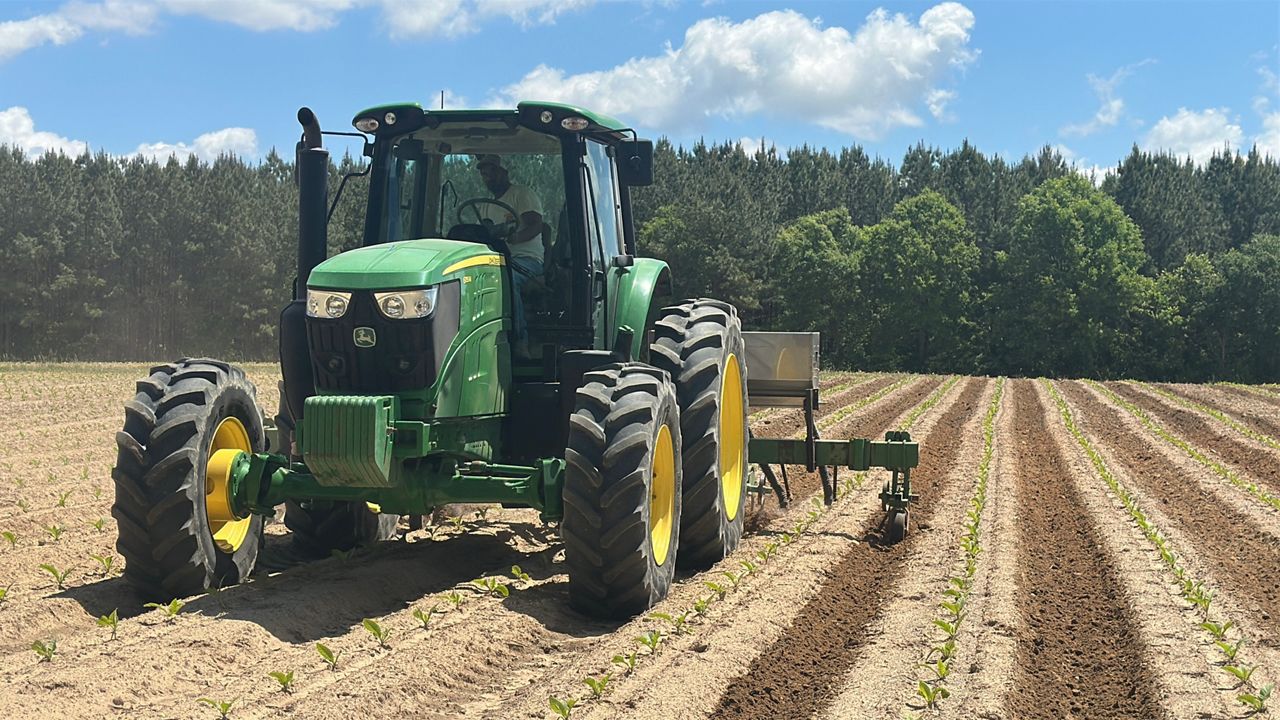
North Carolina tobacco farmers are closely monitoring the meeting between President Donald Trump and Chinese President Xi Jinping.
Farmers are already feeling the impacts of the war in Iran, when it comes to oil, gas, diesel and fertilizer.
The North Carolina Department of Agriculture recorded that China has purchased over $228 million worth of North Carolina tobacco annually in 2023, 2024 and 2025.
Year after year, tobacco plants go into the ground.
Each spring, Matt Grissom has the same goal: to plant and harvest a healthy crop.
“When I finished 2025, I was already working on planning for ’26. It’s a 365-day-a-year process,” Grissom said.
As if making a buck off the land wasn’t hard enough, there are now geopolitical factors at play, including the Iran War and Strait of Hormuz closure. Both have global impact and are choking supply chains and sending the prices of fertilizer and jet fuel up.
“We’re confident that the administration is working to resolve this trade negotiation,” Grissom said.
Grissom said his fellow North Carolina tobacco growers are watching President Trump’s summit with the Chinese president.
He said a good exchange between these superpowers over common concerns in the Middle East could create the right conditions for China to buy more North Carolina tobacco.
A year ago, farmers talked about the impacts tobacco farmers were feeling from international tariffs, impacting the volume of tobacco purchased by China.
“For North Carolina tobacco, I mean, we really depend on this a lot,” Grissom said. “So for ’26, it could open up a lot more volume of tobacco and more pounds. If we could get China to come back and buy tobacco, because our domestic market content continues to decline anywhere from 12 to 14% year over year.”
DTN, a private company that tracks international agricultural markets, puts urea, used in nitrogen-based fertilizer, at $865 a ton. That is a 55% higher price since February.
“But once the war started, they just skyrocketed. I mean, just unexpectedly. I mean, I went three weeks and couldn’t even get a price on fertilizer. They wouldn’t sell it. They wouldn’t give a price on it because it was changing that fast,” Grissom said.
Grissom is also an independent retailer of fertilizer, which means he’s seeing the problem from multiple sides.
Even outside the closure of the Strait of Hormuz and Iran War, Grissom said fewer farmers are farming more land, which equates to fewer people buying products.
Costs for diesel are still up. The global inventory is down, and Grissom said his profit margins are looking thin.
“With the price and the volatility of it, right now we are just buying it as needed,” Grissom said.
There’s also the impact of drought in the state.
Grissom said, despite any pitfalls, he wouldn’t have it any other way.
“I think probably what keeps myself personally and most everybody I know doing this is just the love. I absolutely love what I do every day. I mean, it’s what gets me up in the morning. It’s what I think about when I go to bed at night,” Grissom said.