



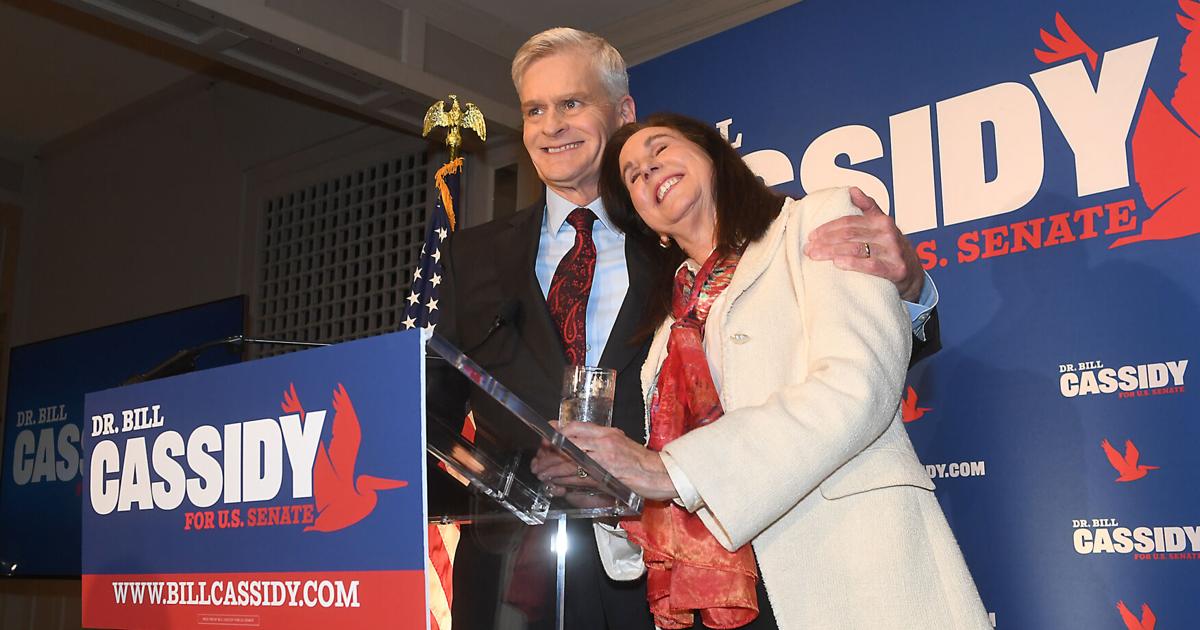
In retrospect, U.S. Sen. Bill Cassidy sealed his defeat for reelection on Feb. 13, 2021.
That’s the day he voted to convict then-former President Donald Trump on impeachment charges that Trump incited the assault by his supporters on the Capitol five weeks earlier – just after Cassidy had won reelection with Trump’s endorsement.
Trump felt deceived, got U.S. Rep. Julia Letlow to jump into the Senate race in January this year with his endorsement and exacted retribution Saturday night when Cassidy finished third in the Republican Senate primary.
Letlow and state Treasurer John Fleming finished first and second and advance to the June 27 runoff. Cassidy’s reelection campaign is done. He will serve out the final six months of his Senate term.
“Cassidy’s political career is over,” Ed Chervenak, a political scientist at the University of New Orleans, said on Sunday.
Still, as Democratic political strategist James Carville noted, “Two terms in the Senate is nothing to sneeze at.”
Breaking down the loss
In his final race, Cassidy had to run in a closed Republican primary created by Gov. Jeff Landry that seemed designed to hamstring Cassidy. Under the new rules, registered Democrats who had traditionally voted for Republicans could not vote for him unless they changed their party registration to no-party or Republican.
Throughout the campaign, Cassidy touted his ability to work with Trump conservatives, saying that the president had signed four pieces of his legislation into law and noting that Robert F. Kennedy Jr. wouldn’t have been confirmed as health secretary without his support. At the same time, Cassidy appealed to moderates by saying he knew how to work with Democrats to deliver money for Louisiana. But many moderate Republicans and Democrats saw the vote to confirm Kennedy as a sell-out to Trump since Cassidy is so at odds with Kennedy’s skepticism of vaccines.
In trying to thread the needle between the two camps of voters, Cassidy fell short, winning only 24.8% of the vote, compared to 44.8% for Letlow and 28.2% for Fleming. Mark Spencer, who called himself a “Guns and Bible conservative,” won 2% of the vote.
Conservatives didn’t think he was conservative enough.
“Cassidy betrayed Trump,” said a voter named Judy on Saturday outside a polling station at a New Orleans fire house. “I voted for Letlow.”
Cassidy openly appealed to Democrats to switch their registration. But only 7,488 Democrats did so after Feb. 1. That was 1.8% of the 401,118 people who voted in the Republican primary.
“Bill obviously got caught in a vise trying to appeal to Trump voters when it was pretty apparent that he was not supported by Trump and trying to appease more moderate voters who were upset by his vote for Kennedy. That created the scenario that played out yesterday, that he didn’t make the cut,” said Jay Dardenne, who preceded Cassidy in the state Senate.
Cassidy didn’t respond to an interview request.
John Couvillon, a Baton Rouge pollster who conducted surveys for Fleming, said Cassidy performed well in moderate Republican parishes: East Baton Rouge, Jefferson and Orleans.
But Letlow smoked him on the Interstate 12 corridor and in the parishes along Interstate 10 west of Baton Rouge.
“The more the Republican the region, the worse-off Cassidy did,” Chervenak said.
20 years in politics, undone by one vote
Cassidy, 68, is a Baton Rouge native who earned undergraduate and medical school degrees from LSU and became a liver specialist at the capital city’s charity hospital.
He won election to the state Senate in 2006 and then climbed the political ladder by winning three terms in the U.S. House, then Senate victories in 2014 and 2020.
Throughout his 12 years in the Senate, Cassidy has been known as a policy wonk who would rather study how to reduce health care costs than analyze how to play the political angles to ensure that he benefited from a big decision.
Reflective of that, Cassidy preferred to be known as “Dr. Cassidy” than “Sen. Cassidy.”
To be sure, he could take the steps needed to win an election.
He pounded then-Sen. Mary Landrieu, a Democrat, in the 2014 election for having voted for President Barack Obama’s Affordable Care Act five years earlier.
But as Couvillon noted, Cassidy received his comeuppance this year from Letlow for his 2021 vote to convict Trump.
“It was the one vote that people would not forget in a Republican primary contest,” Couvillon said.
Immediately after that vote, Cassidy said he had grown angry at how Trump “lied” about claiming he had won the 2020 election against Biden. The senator added that the evidence showed clearly that Trump had incited the attack on the Capitol.
Cassidy immediately faced blowback in Louisiana as the state Republican Party censured him. But, he told reporters, he thought that time would heal the political wounds by 2026.
“He had a comfortable six years ahead of him,” Dardenne said. “It was almost like he decided, ‘I’m going to do what I really believe.’ He didn’t think Trump would win a second term. That was obviously a miscalculation.”
Trying to win his way back
After Trump returned to the White House in 2025, Cassidy did everything he could to get back into the president’s good graces, to have a good working relationship with the White House and to get things done for Louisiana, according to people close to him.
Cassidy tried to convince voters in Louisiana that he was succeeding.
Cassidy’s Senate office even sent out press releases when he merely appeared at events with Trump.
By the beginning of 2026, however, private polls showed that many more voters viewed him negatively than positively. That’s typically a death knell in political races.
A key date that came and went was Jan. 14. That was the deadline for Cassidy to register as a political independent, which would have enabled him to bypass the party primaries and run in the November general election against the Republican and Democratic candidates.
Trump endorsed Letlow on Jan. 17. Cassidy was stuck running as a Republican.
“That was not coincidental timing,” Dardenne said, noting that Cassidy said at the time that he thought Trump would steer clear of his race.
As the qualifying period approached in February, Cassidy’s chances looked so iffy in political circles that speculation abounded that he would forgo his reelection.
“Unless you’re God’s perfect idiot, the result was predictable,” U.S. Sen. John Kennedy said on Sunday. “Everybody knew a year ago that Bill was in trouble. The president endorsing Congresswoman Letlow was the icing on the cake. I respect him for running anyway.”
On election night at Boudreaux’s Catering in Baton Rouge, the hordes of people who had been with Cassidy on his triumphal nights in 2014 and 2020 were gone.
Only four elected officials were spotted: Senate President Cameron Henry, R-Metairie; Rep. Foy Gadberry, R-West Monroe; Laura Ventrella, R-Greenwell Springs; and Randy Delatte, Livingston Parish’s president.
Food on a buffet table was mostly uneaten.
A bartender offering glasses of celebratory champagne from “Team Cassidy” was asked if she had many takers.
“Only a few,” she said. “Only a few.”