



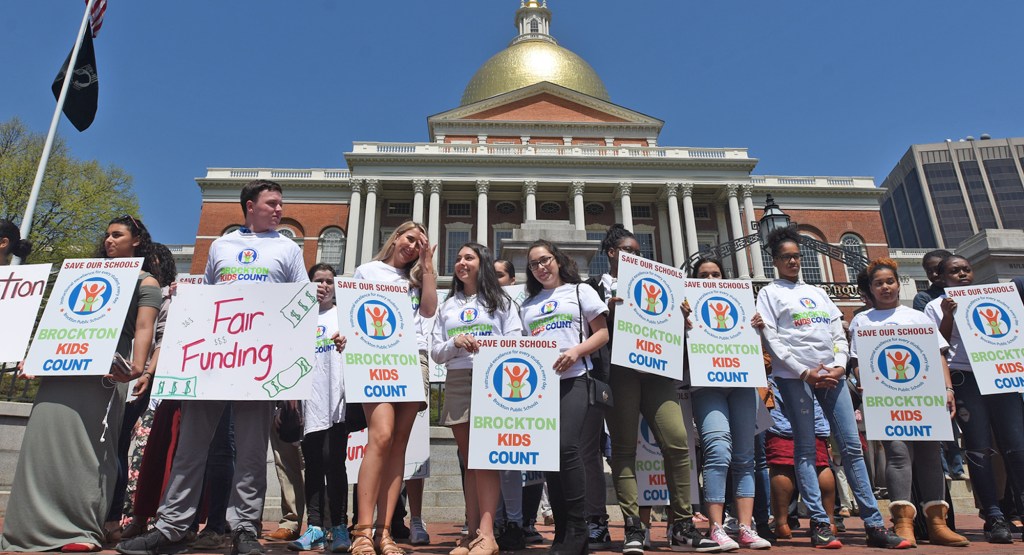
Budget constraints are set to hit Massachusetts schools and educators hard in the coming year, with teachers warning well over 1,000 positions are currently sitting on the chopping block at schools across the state.
“1,400 educators will not be in the classroom or in schools supporting our kids,” said MTA President Max Page. “That’s what we’re facing. And that’s probably an incomplete number. So it’s really terrible at this moment, when kids need more support, to hear that communities are having to make these terrible choices.”
Across about 70 school districts, including Boston Public Schools, budgets have proposed about 1,410 cuts to educator and staff jobs, according to data collected by the MTA from districts’ locals and BPS.
Boston alone has proposed slashing 568 positions in a budget proposal passed by the local school committee in March, resulting in slashes to currently vacant positions but also including hundreds of layoffs. The BPS budget is currently before the City Council for approval.
Other communities set to be hit hard include Brockton at 83 proposed cuts, Framingham at 81, Methuen at 70, Mendon-Upton at 70, and Marshfield at about 63.
The MTA broke the proposed slashes into teachers, education support professionals and administrators — though many were unspecified — showing 919 set to hit teachers and 182 set to hit the support professionals.
Page cited a combination of federal funding cuts, skyrocketing health care costs, diminishing enrollment and more behind the budget constraints, while local teachers cited local investment issues as well.
The Massachusetts Executive Office of Education cited the state’s increased investment in education in recent years, which includes a $1.6 billion increase in Chapter 70 investment since the Healey administration came into office.
“The Governor’s FY27 budget proposal includes historic support for K-12 education, with record levels of Chapter 70 funding and significant investments to help districts meet rising costs and better serve students,” an EOE spokesperson said. “We remain committed to ensuring that every student in Massachusetts has access to a high-quality public education and that our schools have the resources they need to succeed.”
The state Board of Elementary and Secondary Education cited enrollment trends constraining districts’ financial resources at the April meeting examining the legislature’s proposed $7.66 billion, representing “all education aid accounts funded at their historically highest levels.” Across the state, officials said, 236 districts are seeing decreasing enrollment, while only 81 are increasing.
Christine Mulroney, president of the Framingham Teachers Association, said the district is down around 800 students in the year.
The cuts the community is facing are “absolutely unprecedented,” she said.
“The other issue is Framingham has over relied on that Chapter 70 money to fund the schools and hasn’t really kept up with its local contribution to the schools,” said Mulroney. “So because that gap between the funding and the local contribution was getting greater when student enrollment dropped, that caused a huge gap. A $15 million gap. Which, it’s hard to find $15 million to cut.”
Her biggest concern is for “our vulnerable students,” Mulroney said.
“We have many (autism spectrum disorder programs) that require a lot of staff, and our ESL students,” said Mulroney. “Those two populations in particular, we always want to see those areas improve. They will improve if we staff for success in those areas instead of just staffing for compliance; we can’t just staff the bare minimum. And so I have significant concerns about the potential loss.”
Kara Blatt, co-president of the Methuen Education Association, said the city is in an “education crisis” hitting safety, on-time learning and other issues.
The schools are looking at “almost an automatic 60 cuts, 37 classroom teaching positions, which would be one in every grade level, first through eighth, for four schools,” Blatt said, and hits to guidance counselors, special education and more. The proposal is coming at a time the district has already faced hefty layoffs, she added.
“We’re just fractured and broken and can’t do what other districts have been doing,” said Blatt. “You’ve got other districts that might be laying off, but we have already laid off literacy tutors, math tutors. All these other things that other towns right now might be trimming. We’ve trimmed over the last 10 to five years, so we’re down to the bone and see these devastating cuts.”
The uncertainty is “impacting the morale a lot,” and teachers are “trying our best to support each other and get us through the year and keep as many of our colleagues as we can,” Blatt said.
In Mansfield, Page said, during a town meeting they were discussing the need to focus on literacy.
“But they were laying off a number of reading specialists and librarians, along with cutting back on their arts programs, which we know are essential to young person’s development,” said Page. “So it just, it just makes no sense. The heart of it is that we don’t have the funds needed to maintain the best public education system in the country, even though we have the resources in this state.”
Page said the MTA will be asking the state education board to be “much more vocal and active in the budget debate” ongoing in the Legislature at the May meeting on Tuesday. The union is also advocating for the legislature to create a commission to look at the school funding formula, Page said, noting that the Student Opportunity Act has “helped improve things” over the last seven years but the state is due to reevaluate.
“We haven’t had a funding commission in the state since 2015 or 2014 I think,” said Page. “The point is, it’s been more than a decade where we have not looked at how is money raised, how many money distributed, etc., in our public schools.”
Page noted that two proposed ballot initiatives to cut the income tax and cap tax collection would remove an estimated $7 billion out of annual state budget, arguing “deep cuts would happen everywhere.”
“Massachusetts is wealthier than it has ever been, and yet somehow we’re not able to afford keep classroom teachers and paraprofessionals and reading specialists and librarians and mental health professionals in our schools,” said Page. “There’s something that’s deeply wrong with that, and it’s got to change.”