



Flags across the country are set to be lowered to half‑staff nationwide for Memorial Day, with governors already issuing orders ahead of the federal observance and the White House expected to follow with an official presidential proclamation.
The annual nationwide observance honors members of the U.S. Armed Forces who died while serving, with a long‑standing and specific flag protocol that applies across all states.
Memorial Day, observed on Monday, May 25 this year, is one of a limited number of dates when flags are lowered across the entire country under established federal tradition.
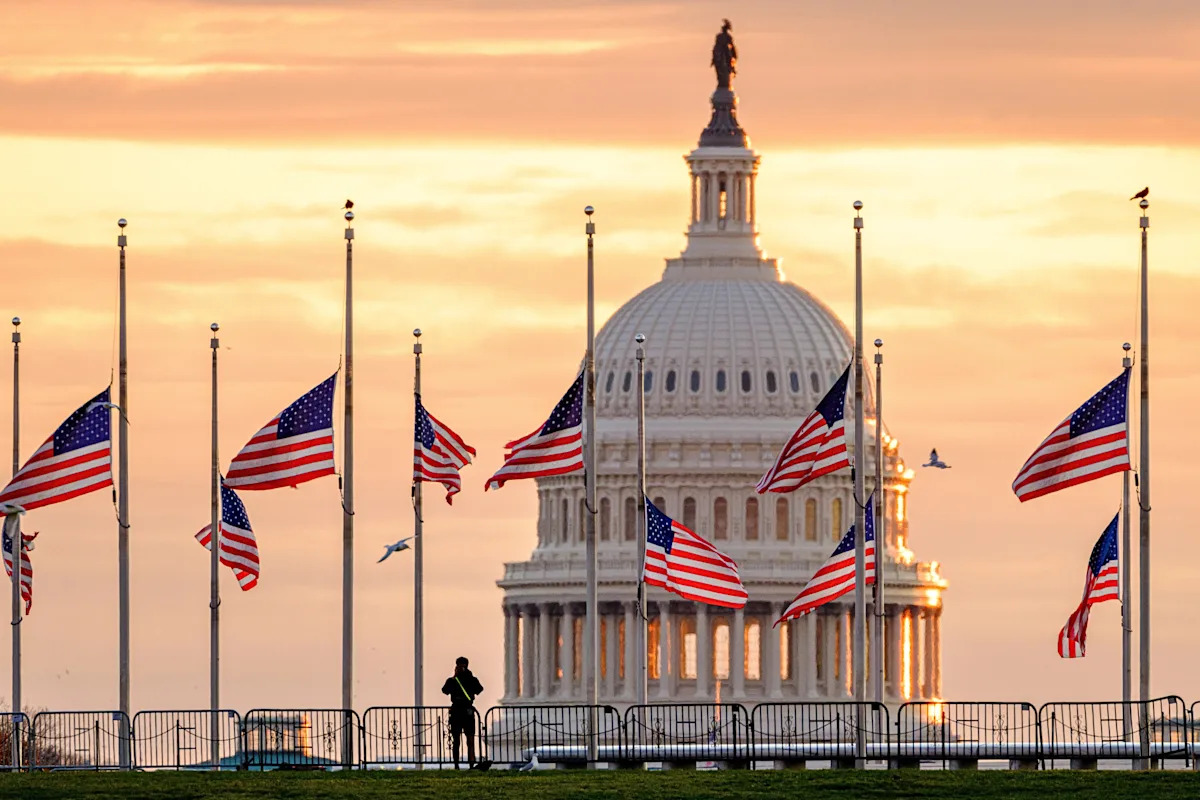
U.S. flags on the National Mall fly at half-staff at daybreak with the U.S. Capitol in the background in honor of the passing of former U.S. President Jimmy Carter on December 30, 2024, in Washington, DC.
How to Fly Flags at Half‑Staff on Memorial Day
Unlike other periods of national mourning, Memorial Day features a distinct flag etiquette. According to official guidelines from the U.S. Department of Veterans Affairs (VA), compliance requires adherence to a specific timeline:
-
Sunrise to Midday: The flag must be flown at half-staff from sunrise until precisely noon.
-
The Midday Transition: At noon, the flag is to be raised briskly to full-staff for the remainder of the day.
-
The Symbolism: This shift marks the formal transition from mourning the fallen to honoring the enduring legacy of those who served.
The VA notes that half-staff observances are generally reserved for periods when “the whole nation is in mourning,” typically enacted via executive orders from the president or state governors.
While the practice dates back through centuries of maritime and military tradition, consistent domestic standards were formalized in 1954. President Dwight D. Eisenhower issued a presidential proclamation establishing the uniform guidelines that continue to govern federal half-staff observances today. Notably, Memorial Day is the only federal holiday that mandates the flag be flown at half-staff for only a partial day.
Protocol Note: The U.S. Flag Code dictates that when positioning a flag at half-staff, it must first be hoisted momentarily to the peak of the staff before being lowered to the half-staff position. The same procedure applies before lowering the flag at the conclusion of the day—a technical requirement that is frequently overlooked but essential to proper etiquette.
Why Memorial Day Protocol Is Different
Memorial Day is unique because it synthesizes mourning and tribute into a singular, coordinated observance.
The morning half-staff positioning symbolizes collective grief and remembrance for the fallen. Conversely, elevating the flag to full-staff at noon represents the nation’s resolve to safeguard the freedom secured by their sacrifice. This dual protocol represents one of the most symbolic and widely recognized uses of the American flag throughout the year.
How to Take Part
Officials across the country are encouraging individuals, businesses, and institutions to lower their flags in line with official guidance.
Members of the public can participate by observing the timeline—lowering flags in the morning and raising them again at noon—or by taking part in local memorial events and ceremonies.
Even simple acts, such as visiting a memorial or pausing at noon, are widely seen as meaningful ways to mark the day.

The U.S. flags at the White House are flown at half-staff on August 27, 2025, in Washington, D.C.
A Shared National Moment
While the nationwide observance is formalized through an upcoming presidential proclamation applying to all federal buildings and grounds, state executives have already begun mobilizing local compliance.
In statements released this week, governors emphasized the unifying nature of the holiday:
-
North Carolina Governor Josh Stein: “On Memorial Day, we remember with deep gratitude those patriots who died in defense of our freedom… The heroes who throughout our history paid the ultimate price… have our respect and appreciation.”
-
Connecticut Governor Ned Lamont: “On Memorial Day, we mourn and pay tribute to the heroes of the U.S. military whose lives were taken in the line of duty, and we keep in our hearts and prayers their spouses and families for the many sacrifices they have made over the course of their loved ones’ service on behalf of our nation.”
While individual half-staff orders are typically responsive to localized tragedies or the passing of specific dignitaries, Memorial Day serves as a collective, nationwide act of remembrance. From small municipalities to major metropolitan areas, the synchronized movement of the flag offers a powerful, visual expression of shared national identity and gratitude.

A member of the U.S. Army 3rd Infantry Regiment walks past the Tomb of the Unknown Soldier at Arlington National Cemetery after a changing of the guard ceremony on Memorial Day on May 26, 2025, in Washington, DC.
The Meaning Behind Memorial Day
Established as a federal holiday on the last Monday of May, Memorial Day is dedicated exclusively to honoring U.S. military personnel who died while serving in the Armed Forces.
Originally designated as “Decoration Day” in the wake of the American Civil War, the observance evolved over the subsequent century into a unified national day of remembrance. Today, it stands as a solemn commemoration of the human cost of military service, marked across the country by civic parades, memorial services, and grave-decoration ceremonies at national cemeteries.
Related Articles
Source link
See more: https://theglobaltrack.com/
https://corinthiames.com.br/