



As negotiations over the war in Iran hang by a thread, a notorious Iranian commander sanctioned by the US and wanted by Interpol is helping to craft Tehran’s next moves.
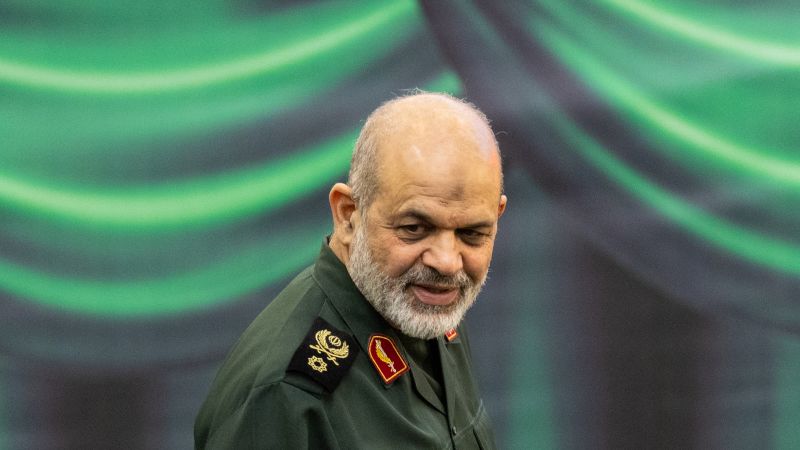
Brig. Gen. Ahmad Vahidi, commander-in-chief of Iran’s Islamic Revolutionary Guard Corps (IRGC), assumed the role after his predecessor, Mohammad Pakpour, was killed in US-Israeli strikes on February 28 – the first day of the war.
Sanctioned by the US over his role in cracking down on domestic protests and wanted by Interpol for alleged involvement in a bombing in Argentina three decades ago, Vahidi is one of the fiercest opponents of compromise with Washington and, experts say, is even more radical than Pakpour.
“He is influential, but (he is) part of a system,” said Ali Vaez, Iran project director at the International Crisis Group. “Decisions are made in a consensual manner and undoubtedly Vahidi has a very loud voice in the room.”
Vahidi’s rise to become one of Iran’s top decision-makers shows that US and Israeli efforts to decapitate the country’s leadership have not produced a more moderate ruling echelon. Under Vahidi’s leadership, the IRGC has effectively choked traffic at the world’s most important oil checkpoint, while Tehran’s demands from Washington now exceed those made in previous negotiations.
Vahidi is a “very dominant” and “radical” man who is deeply committed to the principles of the Islamic Revolution, Danny Citrinowicz, former head of the Iran branch of Israel’s military intelligence, told CNN.
“You cannot agree on something without passing (it by) him,” Citrinowicz said. “He is among the people saying if we don’t get what we want, if Trump wants to go back to war, welcome.”
US President Donald Trump said he was on the verge of striking Iran again this week, threatening to reignite the war unless Tehran agrees to a deal. He later said he was willing to wait to see whether talks progressed but warned that “the clock is ticking.”.
“We’re in the final stages of Iran. We’ll see what happens,” Trump told reporters on Wednesday morning about efforts to secure a deal.
“We’ll either have a deal or we’re going to do some things that are a little bit nasty,” he went on. “But hopefully that won’t happen.”
Vahidi warned on Wednesday that “if any further aggression is committed against the soil of Iran, that fire whose promise was previously given and remained confined within the framework of a limited regional war, this time will erupt into flames and transcend every border and domain.”
“You will receive devastating blows,” he said on X, according to Iranian media.
The commander is not often seen in public, but on Thursday, images of Vahidi meeting Pakistan’s interior minister circulated in media outlets. Iranian media debunked the images, saying Vahidi did not meet the Pakistani official, and that the picture dates back to 2024.
While officials like Mohammad Bagher Ghalibaf, the parliament speaker, and foreign minister Abbas Araghchi are typically seen as the public faces of Iran and its negotiations with the US, Vahidi is likely advocating for some of Iran’s most hardline policies from behind the scenes, some experts say.
Iran has so far refused to accept any proposal that in its eyes would amount to capitulation. After weeks of exchanging proposals, Iran’s latest offer did not show significant concessions on critical sticking points, according to a person familiar with the matter, who said issues of nuclear enrichment remain central to the impasse.
Experts say that since the Iran war began, Tehran has been led by a small clique of IRGC pedigree who emerged from the rubble of the Iran-Iraq war in the 1980s. Vahidi is a key player among them.
He became “a very important actor but within the systemic limitations the Islamic Republic has,” Vaez said, adding that he has particular clout when the country is at war.
How much of an obstacle he may be to reaching a deal with the US remains unclear.
In April, the Institute for the Study of War (ISW) in Washington, DC, said that “Vahidi’s apparent willingness to scrap US-Iran talks indicates that Vahidi is prepared to resume the war if needed.” But Vaez said there has so far been no evidence that Vahidi is an obstacle.
Born in 1958 in Shiraz, Vahidi’s ideology was shaped by war and confrontation with the West. He joined the establishment at its inception following the Iranian Revolution in 1979 and was appointed deputy chief of intelligence in 1981.
Before that, he studied electronics and industrial engineering, according to Iranian media.

“He was shaped by the IRGC,” Citrinowicz said, which the US has designated a Foreign Terrorist Organization.
He is wanted by Interpol over his alleged role in the 1994 bombing of a Jewish community center in Buenos Aires, Argentina, which killed 85 people. He is also reported to have had contacts with Israelis in the 1980s during the “Iran-Contra affair,” the Israeli-backed, US scheme to sell weapons to Iran and then use proceeds to fund anti-communist rebels, known as the Contras, in Nicaragua.
He was Iran’s first commander of the Quds Force, an elite unit of the IRGC, and assumed several roles over the years, including deputy chief of the IRGC and the Iranian army, defense minister, and interior minister.
In 2022, Vahidi was sanctioned by the US Department of the Treasury’s Office of Foreign Assets Control for the violent crackdown against protesters in the wake of the death of 22-year-old Mahsa Amini, who was arrested by morality police for allegedly flouting Iran’s Islamic dress code and died in custody.
“Vahidi has warned Iranian women that the government’s security forces will penalize those ‘breaking rules’ in reference to hijab compliance,” the US Treasury said, adding that he has explicitly threatened protesters and defended brutal actions in suppressing ongoing protests.
An ominous cloud hangs over Vahidi, as several of his predecessors were assassinated by the US and Israel – including Qasem Soleimani, the former commander of the Quds Force.
“He is a wanted man,” Citrinowicz said. “He is a guy to be reckoned with.”
Source link
More: https://theglobaltrack.com/
https://corinthiames.com.br/