




Toplines
US President Donald Trump stated that US arms sales to Taiwan were under consideration and suggested that they could be used as a “negotiating chip” with the PRC while cautioning Taiwan against seeking independence. The PRC could exploit these statements to gain leverage over the United States and decrease Taiwanese faith in the United States. Trump cautioned Taiwan against “seeking independence” and urged Taiwan to “cool down” tensions with the PRC during a May 15 interview.[1] Taiwanese President William Lai Ching-te has maintained that Taiwan does not need to declare formal independence because it already sees itself as a sovereign nation.[2] Taiwan’s Mainland Affairs Council (MAC) reiterated this idea on May 18 and emphasized that Taiwan seeks to maintain the status quo across the Taiwan Strait.[3] The PRC consistently presents Lai and the ruling Democratic Progressive Party (DPP) as “independence activists” that “provoke” PRC aggression.
Taiwanese Presidential Office Spokesperson Karen Kuo stated on May 16 that US law stipulates arms sales to Taiwan. Kuo’s statement referred to the Taiwan Relations Act (TRA), which governs the unofficial diplomatic relationship between Taiwan and the United States.[4] The TRA states that the United States “shall make available to Taiwan such defense articles and defense services in such quantity as may be necessary to enable Taiwan to maintain a sufficient self-defense capacity as determined by the President and the Congress.”[5] The US’s Taiwan policy is also based on an additional “Six Assurances” to Taiwan. One of these Assurances states that the United States has “not agreed to consult with the PRC on arms sales to Taiwan,” placing Trump’s comments in contradiction with the spirit of US policy.[6]
Acting Secretary of the US Navy Hung Cao stated on May 21 that the United States paused a 14 billion US dollar weapons purchase to Taiwan to ensure sufficient munitions for US operations in the Middle East. Hung’s statement follows reporting that the PRC could be delaying approval of talks with US Under Secretary of Defense for Policy Elbridge Colby.[7] US President Trump stated on May 20 that he would speak with Taiwanese President Lai, which may have influenced the PRC’s actions.[8] No sitting US President has spoken directly with a Taiwanese President since 1979, in keeping with the US policy of “strategic ambiguity” toward Taiwan.[9] The PRC cancelled an earlier set of talks with the United States discussing diplomatic exchanges with Colby over a Taiwan arms sale package announced in December 2025.[10] The PRC makes consistent statements opposing US arms sales to Taiwan and linking these arms sales to “independence” and “separatist” movements, despite Taiwan’s stated policy of maintaining the status quo.[11] Official US statements regarding the pausing of arms sales to Taiwan do not mention the PRC. The PRC will likely seek to use this development to decrease Taiwanese faith in the United States and will likely seek to influence future US arms sales to Taiwan.
Note: A version of this text appeared in the May 20 Russian Offensive Campaign Assessment update.
CCP Secretary General Xi Jinping met with Russian President Vladimir Putin on May 20 but the two failed to reach an agreement on the Power of Siberia-2 pipeline. The PRC and Russia affirmed strong bilateral relations, but the two signed only comparatively minor bilateral agreements during Putin’s official visit. PRC Ministry of Foreign Affairs (MFA) spokesperson Guo Jiakun during a May 19 press conference did not confirm whether the timing of the meeting – one week after Xi met with US President Donald Trump – held any significance.[12] Putin and Xi held a joint press conference on May 20 in which the leaders praised deep relations between Russia and the PRC and how Russia and the PRC actively cooperate in energy, noting that Russia is one of the PRC’s largest oil suppliers.[13] Kremlin Presidential Aide Yuriy Ushakov stated that Russia and China reached agreements on energy projects and “something else very important,” but did not specify what it was. The parties notably failed to reach an agreement on the construction of the Power of Siberia-2 (PS-2) pipeline.[14] The pipeline would deliver natural gas from Russia’s Yamal Peninsula to the PRC, boosting Russian sales following Europe’s attempts to divest from Russian gas.[15]
PRC rhetoric expressed positive views of the Russia-PRC partnership.[16] Putin and Xi signed a joint statement on further strengthening their comprehensive partnership and strategic interaction, and on deepening good-neighborly friendship and cooperation, about 40 intergovernmental, interagency, and corporate documents, mainly aimed at deepening economic cooperation, as well as a joint declaration on the Establishment of a Multipolar World and a New Type of International Relations.[17]The PRC MFA announced that it is extending its visa-free policy for Russian passport holders traveling to the PRC through December 31, 2027.[18] The PRC has provided forms of support to Russia throughout its war in Ukraine. Reuters reported that the PRC secretly trained approximately 200 Russian soldiers who deployed to Ukraine, citing European intelligence agencies and documents that Reuters obtained.[19] The PRC portrays itself as a neutral actor and mediator in Russia’s war in Ukraine but actively benefits from the war’s continuation. PRC Foreign Minister Wang Yi said in July 2025 that the PRC did not want Russia to lose the war.[20] Xi and Putin have met nine times since the outbreak of the war in 2022.[21]
The agreements signed during Xi and Putin’s meeting were relatively minor in comparison to the Kremlin’s hopes that Putin’s visit would culminate in a signed deal on the PS-2, however, illustrating the PRC’s pragmatic approach to relations with Russia. Russia and the PRC have been in disagreement about the PS-2 since at least 2024, as Russia faces a more immediate need for the pipeline to substitute for income from exports lost since Russia’s full-scale invasion of Ukraine in 2022, and the PRC is using its upper hand to extract concessions from Russia on the issue.[22] Ushakov highlighted on May 18 the PS-2 pipeline as one of the priority items for Putin’s official visit to the PRC, and Putin’s failure to secure a signed agreement demonstrates the current limits of PRC-Russia cooperation.[23]
Key Takeaways
- US-Taiwan relations: US President Donald Trump stated that US arms sales to Taiwan were under consideration and suggested that they could be used as a “negotiating chip” with the PRC while cautioning Taiwan against seeking independence. The United States announced a pause of a 14 billion US dollar arms sale to Taiwan on May 21. The PRC will likely seek to exploit US statements and policy to decrease Taiwanese faith in US support.
- PRC-Russia relations: CCP Secretary General Xi Jinping met with Russian President Vladimir Putin on May 20. Xi and Putin signaled continued strong bilateral relations, but they failed to reach an agreement on the Power of Siberia-2 pipeline, a key priority for Russia.
Cross-Strait Relations
Taiwan
The World Health Organization (WHO) rejected Taiwan’s participation in the World Health Assembly (WHA) for the tenth consecutive year.[24] The PRC routinely pushes to exclude Taiwan from international organizations to diplomatically isolate Taiwan and falsely represent Taiwan on the global stage. Spokespeople from the United States State Department and the European External Action Service expressed support for Taiwan’s participation in the WHA.[25] PRC MFA spokesperson Guo Jiakun stated that this rejection “fully demonstrates that the international community’s support for the one-China principle is unbreakable, and the authority of UN General Assembly Resolution 2758 is beyond question.”[26] The PRC MFA claimed that Taiwan had no right to participate in the WHA without PRC central government permission.[27] This statement is inaccurate, however, as the WHA does allow non-state entities to join as observers. Guo’s statement is intended to suggest PRC control over Taiwan and deny Taiwanese sovereignty by denying its right to participate in international forums.
Taiwan was invited to the WHA as an observer under the name “Chinese Taipei” from 2009 to 2016 under Ma Ying-jeou’s presidency.[28] Ma was a member of the opposition Kuomintang (KMT), and a cornerstone of his administration’s policy was developing closer ties with the PRC in accordance with the “1992 consensus,” under which Taiwan and the PRC agree that they belong to “one China” but with differing interpretations of what “China” means.[29] The ruling Democratic Progressive Party‘s (DPP) platform is focused on removing PRC influence in Taiwan, and PRC statements regularly accuse the DPP of promoting “separatism” and “Taiwan independence.” The DPP has ruled Taiwan since 2016 and the PRC has blocked DPP-ruled Taiwan’s participation in the WHA to suppress Taiwan’s international representation and punish Taiwanese support for the DPP.
The Taiwanese government is working to develop alternate methods to fund weapons procurement and domestic defense industrial development following the passage of a reduced Special Defense Budget. Taiwan passed the Special Defense Budget amounting to 780 billion New Taiwan Dollars (NTD) (approximately 25 million US dollars) on May 8 after significant negotiations between the ruling DPP and the opposition KMT and Taiwan People’s Party (TPP).[30] The Lai administration initially proposed a 1.25 trillion NTD special defense budget. The final version of the Special Defense Budget notably omits funding for domestic or Taiwan-US joint arms development entirely. This will affect a plethora of critical defense procurements, such as drones, counter-drone systems, anti-ballistic missiles, and unmanned vehicles.[31] Moving drone procurements into Taiwan’s regular budget delays funding until 2027 at minimum, and will delay Taiwan’s indigenous drone industry’s development and impede its asymmetric defense capacity.[32] Other defense systems affected by the Special Defense Budget cuts include the “Strong Bow” anti-ballistic missile essential to Taiwan’s “T-Dome” integrated air-and-missile defense system.[33] An unnamed US defense official stated on the condition of anonymity that “it was disappointing” that “some… stuff… that we believe still needs to be funded” was cut from the budget.[34] The individual said they would “like to see the rest of the original proposed package funded.”[35]
Taiwanese Premier Cho Jung-tai stated that he is considering submitting another supplementary budget bill, increasing the general budget in 2027, or raising the Ministry of National Defense’s (MND) annual budget to address gaps in the Special Defense Budget.[36] Taiwanese Defense Minister Wellington Koo voiced support for those options and stated that the MND is considering which method would be best for funding unmanned aerial vehicles.[37] The Taiwanese Cabinet has since passed a portion of the ‘first wave’ of already approved arms purchases funded through the Special Defense Budget, which appropriates 294 billion NTD to purchase US arms.[38] The LY is scheduled to expedite its review of the cabinet’s proposed budget before the May 31 deadline to purchase US HIMARS.[39]
The PRC allowed the first group of Shanghai tourists to visit Kinmen and Matsu as part of its efforts to frame increased cross-strait exchanges as an economic opportunity for Taiwan. PRC state-owned tabloid Global Times reported on May 13 that Shanghai tourists had arrived in Kinmen, as part of the “gradual recovery” of cross-strait tourism.[40] The Shanghai Municipal Administration of Culture and Tourism announced on April 29 that Shanghai residents can visit Kinmen and Matsu on group or individual tours.[41] This announcement is in accordance with the PRC’s ten policy measures to promote cross-strait relations announced on April 12, at the end of KMT Chairwoman Cheng Li-wun’s visit to the PRC.[42] The ten measures included a variety of economic measures to connect Taiwan and the PRC through trade, infrastructure, and tourism.
The PRC presents these expanded cross-strait economic ties as a “win-win situation” for both sides of the Strait and will continue to criticize any efforts by the Taiwanese government to decrease cross-strait exchanges as “unreasonable” and a sign that the DPP is not acting in the best interests of the Taiwanese people.[43] Increased PRC-Taiwan economic ties present additional opportunities for PRC economic coercion targeting Taiwanese firms and industry. This carries additional risks for the offshore islands of Kinmen and Matsu given their geographic proximity to the PRC and existing economic ties with the PRC.
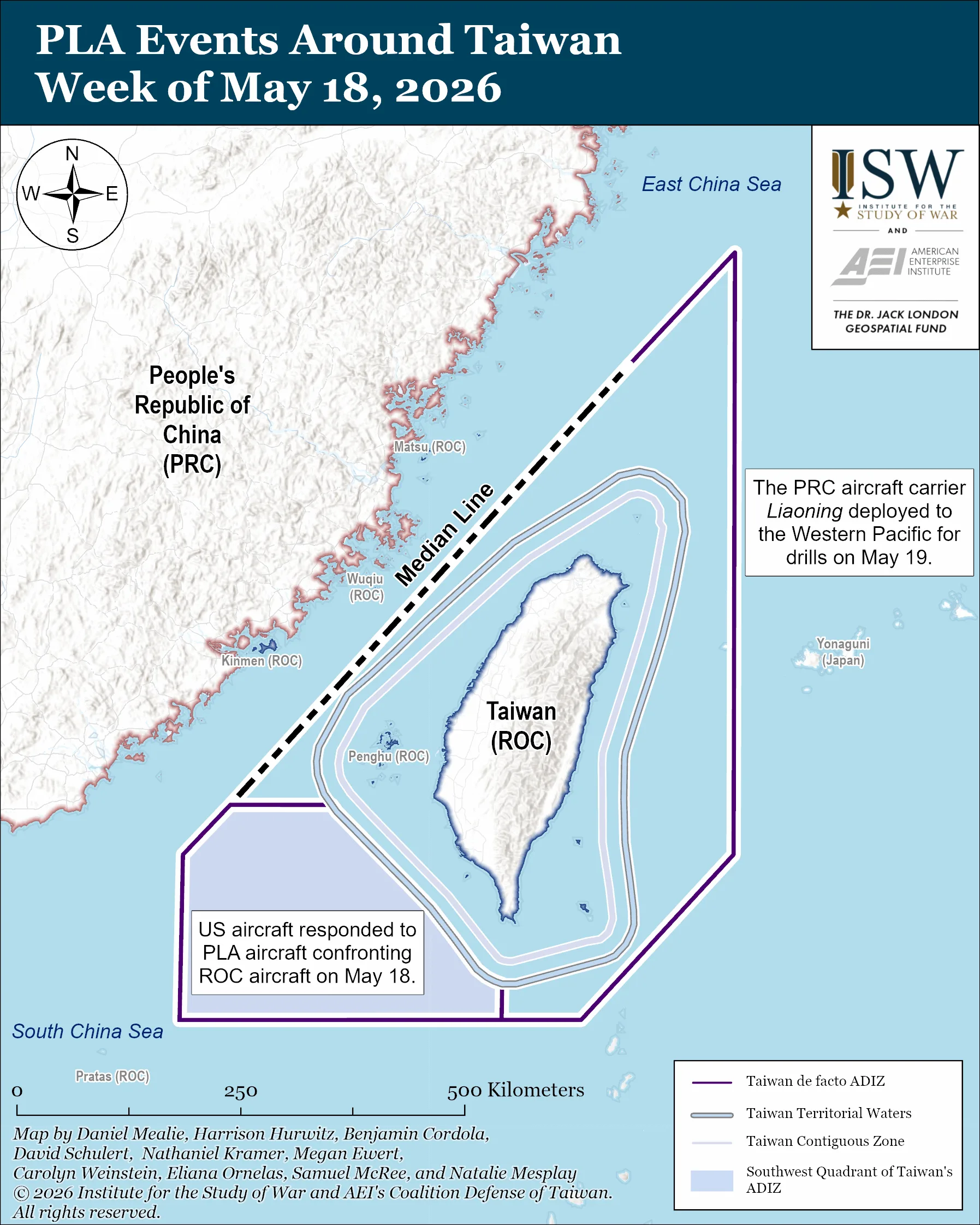
A United States Air Force (USAF) aircraft issued as many as nine messages reaffirming the right for aircraft to operate in international airspace in response to warnings sent from PLA aircraft to Taiwanese aircraft. A PLA Navy Air Force (PLANAF) aircraft initially issued three consecutive radio warnings in Chinese to a Taiwanese aircraft operating in Taiwan’s Southwestern Air Defense Identification Zone (ADIZ) on May 18. The PLANAF claimed the Taiwanese aircraft was endangering flight safety and demanded that the aircraft maintain a safe distance.[44] A nearby USAF aircraft replied to the warning multiple times in English, stating that all aircraft have the lawful right to operate in international airspace.[45] Similar confrontations between US and PRC aircraft have occurred in the Yellow Sea on February 18 and around Taiwan’s Southwestern ADIZ on May 4, 2025.[46] The published radio exchange does not indicate whether the US aircraft’s response was coordinated with the Taiwanese aircraft’s reception of the initial PRC warnings.[47]
A consistent US aerial presence over the Taiwan Strait may act as a deterrent limiting PLA gray zone activities and may require Taiwan to expend fewer resources responding to PLA ADIZ incursions. Publicly available recordings of such confrontations may also increase Taiwanese trust in the United States as a reliable security partner in deterring PRC aerial harassment.
China
The PLA deployed the aircraft carrier Liaoning and a carrier task group to the Western Pacific to conduct live-fire drills. A PLAN social media account said that the drills would involve training on long-range tactical flights, live firing, support and cover, and integrated search and rescue, to test and enhance realistic combat capabilities.[48] PRC state-owned tabloid Global Times quoted “military affairs expert” Zhang Junshe, who said that the Liaoning’s far-seas deployments have become routine and are meant to strengthen capabilities for both offshore defense and long-distance power projection.[49] The PRC would likely position aircraft carriers east of Taiwan to block US and allied intervention from the Pacific Ocean while it blockades or invades Taiwan.[50] Liaoning previously drilled in the Western Pacific in December 2025.[51] Liaoning became the first PRC aircraft carrier in June 2025 to sail east of Guam, a key US strategic base in the Pacific, while carrying out drills simultaneously with its fellow aircraft carrier Shandong. Liaoning and Shandong separately participated in two of the PLA’s Joint Sword series blockade exercises around Taiwan in 2023 and 2024, respectively, and operated southeast of Taiwan, launching dozens of fighter jets and helicopters.[52]
Taiwan’s MAC warned that the PRC is converting hundreds of old fighter jets into drones and deploying them to air bases near Taiwan. The PRC may use these drones to directly attack targets in Taiwan and elsewhere or as decoys to overwhelm Taiwan’s air defenses. The MAC said that the PRC converted around 500 J-6 fighter jets into pilotless drones and already deployed at least 200 of them to six bases in Fujian and Guangdong, provinces bordering the Taiwan Strait.[53] The MAC cited data from the Mitchell Institute for Aerospace Studies, which used satellite imagery to identify the converted drones.[54] The J-6 fighter jet is an old model based on 1950s-era Soviet jets. The PLA has converted J-6s into drones, called J-6Ws, since at least 2013, but first publicly displayed such a drone at the Changchun Air Show in September 2025.[55] Mitchell Institute senior fellow J. Michael Dahm assessed that the J-6W drones would likely be used to directly fly into targets, similar to cruise missiles.[56] The drones can attack in large numbers to overwhelm air defenses, forcing Taiwan and other targeted countries to expend munitions shooting them down even if they do not carry a payload.
The PRC’s fleet of J-6W and other drone capabilities illustrate the importance of Taiwan developing its own domestic drone program and integrated air defense system. Taiwan’s legislature recently passed a 25 million US Dollar special defense budget that funded procurements from the United States but excluded funding for domestically-produced defenses.
Northeast Asia
Japan
Japan is continuing to engage in coalition-building and defense innovation efforts alongside the United States and regional partner nations. These efforts, which the PRC criticizes in an ongoing pressure campaign, supplement legislation aimed at increasing Japan’s defense budget. Japan’s Liberal Democratic Party (LDP) submitted a proposal requesting that the Japanese government raise defense spending to 5 percent of its GDP.[57] LDP draft proposals requested the early deployment of high-energy weapons and interceptor drones, reflecting the LDP’s efforts to bolster defense.[58] The Japanese government may also place early warning radar on Iwo Jima, the Ogasawara Islands, and Chichijima, a move that could strengthen Japanese threat detection.[59] These proposed reforms reflect Japan’s efforts to revise its three key security documents, a cornerstone of Japanese Prime Minister Sanae Takaichi’s defense leadership. These documents include the National Security Strategy, the Defense Buildup Program, and the National Defense Strategy.[60]
Japan has similarly taken steps to boost defense research and innovation. Japan requested to participate in the Defence Innovation Accelerator for the North Atlantic (DIANA), a NATO program that supports defense startup companies. NATO Assistant Secretary General for defense industry, innovation and armaments Tarja Jaakkola confirmed this news on May 15 and expressed that the participation of Japan – a NATO non-member state – could prove mutually beneficial for both Japan and NATO.[61] Japan’s outreach to NATO comes as the Japanese government attempts to reform the funding process for Japanese defense startups. The Japan Growth Strategy Council’s subcommittee on startups is putting together a proposal to allocate funding to defense tech firms, including possible advanced funding for startups.[62]
Japan’s domestic defense reforms accompany its growing coalition-building efforts with regional partners. Japan plans to deepen information-sharing efforts regarding maritime domain awareness (MDA) with Southeast Asian nations to protect sea lanes critical to trade. Japan plans to do this via private-public partnerships encompassing approximately eight countries by the 2030s.[63] Japan is also making efforts to strengthen its ties with South Korea. Japanese Prime Minister Sanae Takaichi met with South Korean President Lee Jae Myung on May 19 and affirmed cooperative efforts, including security cooperation involving the United States.[64] Japan’s strengthening ties with South Korea accompany similar efforts in the Philippines, where Japan signed a reciprocal access agreement.[65] Japan participated in the Philippines’ Balikatan annual defense exercises alongside US forces in spring 2026.[66] The Japanese Ground Self-Defense Forces similarly engaged in exercises with US troops shortly after Balikatan, establishing a joint coordination center on Miyako Island for the first time.[67]
The PRC has responded to Japan’s remilitarization and coalition-building efforts with a sustained economic and rhetorical pressure campaign. The PRC blames Takaichi for Japan-PRC tensions and demands that Takaichi retract her 2025 comments that a Taiwan contingency could implicate Japan. PRC MFA spokesperson Guo Jiakun reiterated this rhetoric during a May 18 press conference, stating that Japanese “right-wing forces” are disrupting regional peace.[68]
Southeast Asia
Philippines
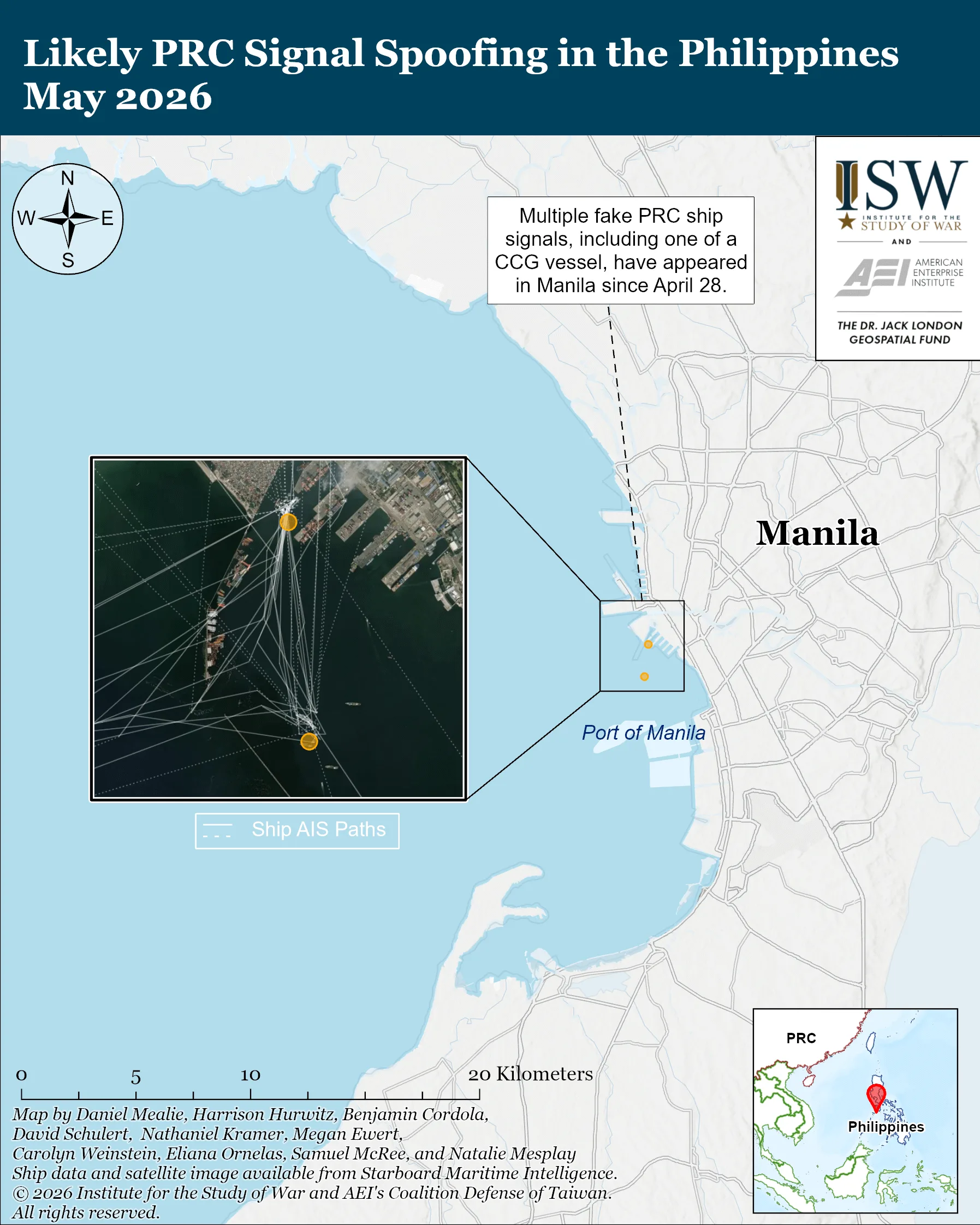
The PRC may be docking boats in Manila to confuse Philippine threat awareness by broadcasting fake ship signals, including one of a China Coast Guard (CCG) vessel. ISW-CDOT previously observed very similar PRC signal spoofing used against Taiwan. Ship-tracking data from Starboard Maritime Intelligence shows that the Automatic Identification System (AIS) signals of at least 13 PRC vessels appeared in Manila harbor since April 28 that appeared to “teleport” between Manila and various locations along the PRC coast. This pattern of movement indicates AIS spoofing, possibly involving boats in multiple locations transmitting the same fake ship identities. Many of the same signals previously appeared in and around the harbor of Tamsui Fisherman’s Wharf, a dock in New Taipei City, Taiwan throughout the last three years.[69] One of the signals is labeled as “China Coast Guard 18602,” one is labeled as a tugboat, and several are labeled as fishing boats. Starboard data shows that spoofed PRC signals have appeared periodically in Manila and other Philippine ports in recent years, but this is the first time Manila has been a “hub” for multiple such signals since December 2024. Philippine authorities reported in December 2024 that one or more PRC dredging vessels working in the Manila harbor were broadcasting fake signals, including the AIS of a CCG ship. [70]
The PRC has used AIS spoofing as a form of cognitive warfare against Taiwan by causing Taiwan’s ship detection technology to detect fake vessels or become overwhelmed with fake data.[71] The PRC can use AIS spoofing to inflate the apparent number of PRC boats in Taiwan-administered waters, disguise the true location of PRC vessels conducting malign activities, intimidate or overwhelm Taiwanese decision-makers, and waste Taiwan’s resources.[72] ISW-CDOT has observed relatively few instances of this tactic used against the Philippines compared to Taiwan, however, despite high China Maritime Militia (CMM) activity around disputed islands in the South China Sea.[73] Reuters reported that the PRC experimented with aerial drones in the South China Sea to broadcast fake aircraft signals since August 2025.[74]
The fake AIS broadcasts from Manila and New Taipei City likely indicate that the PRC has docked at least one boat in those locations that is periodically transmitting the false signals. The PRC’s ability to dock vessels in Philippine and Taiwanese ports to carry out cognitive warfare operations undetected suggests that the PRC could similarly smuggle dual-use or military equipment undetected. Ukraine’s Operation Spiderweb in June 2025, in which Ukraine used seemingly ordinary trucks to launch drone attacks deep inside Russia, shows how countries, including the PRC, could launch a surprise attack from inside the target country’s territory by using drones smuggled on ostensibly commercial trucks or ships.[75] The PRC has experimented with converting a cargo ship into an “arsenal ship” full of drones and missiles hidden in boxes aboard shipping containers.[76]
Philippine President Ferdinand Marcos Jr. stated during a May 18 interview with Japanese media that the Philippines would likely be involved in a Taiwan conflict. Marcos later walked this statement back, possibly due to PRC pressure. Marcos stated that the Philippines would have less of a choice to get involved in a Taiwan scenario than Japan. [77] Marcos stated that such a contingency would involve the Philippines due to its geographic proximity and 200,000 Filipino nationals in Taiwan.
PRC MFA spokesperson Guo Jiakun replied by restating Marcos’ past affirmation of the one-China policy, which states that there is only one China in the world, and stated that Marcos’ reasoning was insufficient for interfering in another country’s “internal affairs” at the May 19 press conference.[78] Marcos later clarified his remarks on May 19, stating that the Philippines will not intervene in the Taiwan issue.[79]
Oceania
The Solomon Islands’ new PRC-skeptical prime minister may seek closer ties with the West but is unlikely to disrupt the PRC’s deep economic and security involvement in the Solomon Islands. The Solomon Islands has been one of the PRC’s closest partners in the South Pacific since it cut ties with Taiwan in 2019. The Solomon Islands legislature removed Prime Minister Jeremiah Manele in a no-confidence vote on May 7.[80] It then elected opposition figure Matthew Wale as Prime Minister on May 15.[81]
Manele was the country’s foreign minister under the previous Prime Minister Manasseh Sogavare when the Solomon Islands severed diplomatic relations with Taiwan in 2019 and signed a controversial security agreement with the PRC in 2022.[82] Manele replaced Sogavare as Prime Minister in 2024 and continued pursuing relatively pro-PRC policies.[83] The Solomon Islands unsuccessfully pushed to strip Taiwan of its “development partner” status in the Pacific Islands Forum (PIF) in 2024, reportedly under PRC pressure.[84] The Solomon Islands hosted the PIF in 2025 and excluded Taiwan, the PRC, and the United States from participating entirely, possibly to exclude Taiwan specifically or avoid a geopolitical confrontation.[85] Newly elected prime minister Wale vocally opposed the Solomon Islands’ 2022 security agreement with the PRC at the time, saying that most Solomon Islanders “do not want China here at all.”[86] A leaked draft of the agreement included language requesting PRC aid in policing the Solomon Islands and granting the PRC access and replenishment rights to Solomon Islands ports, as well as the right to use its armed forces to protect PRC projects and personnel in the Solomon Islands.[87]
Wale may seek to balance the PRC by pursuing stronger ties with Australia and the United States, but he is unlikely to restore his country’s diplomatic relations with Taiwan or significantly curtail PRC influence. Wale notably softened his rhetoric on the PRC in recent years.[88] Wale told the PRC ambassador that he would continue to adhere to the One China Principle and deepen PRC-Solomons cooperation, according to PRC state media.[89] The PRC has entrenched itself in the Solomon Islands through a variety of cooperation programs and investments that may be difficult to undo, however. The PRC has invested hundreds of millions of dollars in infrastructure construction in the Solomon Islands since 2019, signed media partnerships to promulgate PRC-friendly views, and expanded police training partnerships.[90]

[1] https://apnews.com/article/taiwan-trump-arms-68eaac52b871e556aa6bd0509b101a90
[2] https://www.taiwannews.com dot tw/news/6364382; https://www.facebook.com/chingte/
[3] https://www.mac.gov dot tw/News_Content.aspx?n=A0A73CF7630B1B26&sms=B69F3267D6C0F22D&s=6AFADB899313D172
[4] https://apnews.com/article/taiwan-trump-arms-68eaac52b871e556aa6bd0509b101a90
[5] https://www.congress.gov/bill/96th-congress/house-bill/2479
[6] https://www.congress.gov/bill/119th-congress/house-bill/3452/text
[7] https://www.scmp dot com/news/china/diplomacy/article/3354539/us-navy-signals-pause-taiwan-arms-sale-drawing-swift-reaction-beijing; https://www.ft.com/content/aecf40c9-fb61-4958-ae6b-14a471cad680?syn-25a6b1a6=1
[8] https://www.nytimes.com/2026/05/21/world/asia/trump-taiwan-president-call-weapons-sale-china.html
[9] https://www.nytimes.com/2026/05/21/world/asia/trump-taiwan-president-call-weapons-sale-china.html
[10] https://www.ft.com/content/aecf40c9-fb61-4958-ae6b-14a471cad680?syn-25a6b1a6=1
[11] https://www.fmprc.gov dot cn/fyrbt_673021/202605/t20260521_11915149.shtml
[12] https://www.fmprc.gov dot cn/fyrbt_673021/202605/t20260519_11913599.shtml
[13] http://kremlin dot ru/events/president/news/79787
[14] https://t.me/tass_agency/376664 ; https://tass dot ru/politika/27467459
[15] https://www.csis.org/analysis/how-power-siberia-2-deal-could-reshape-global-energy
[16] https://www.fmprc.gov dot cn/zyxw/202605/t20260520_11914686.shtml; https://www.fmprc.gov dot cn/zyxw/202605/t20260520_11914356.shtml
[17] http://kremlin dot ru/events/president/news/79787; http://kremlin dot ru/supplement/6486; http://kremlin dot ru/events/president/news/79787; https://www.fmprc.gov dot cn/zyxw/202605/t20260521_11914944.shtml
[18] https://www.mfa.gov dot cn/web/wjdt_674879/fyrbt_674889/202605/t20260520_11914508.shtml
[19] https://www.reuters.com/business/aerospace-defense/russians-covertly-trained-by-china-return-fight-ukraine-sources-say-2026-05-19/
[20] https://www.scmp dot com/news/china/diplomacy/article/3316875/china-tells-eu-it-cannot-afford-russian-loss-ukraine-war-sources-say
[21] https://www.wsj.com/world/putin-seeks-a-boost-from-xi-in-beijing-as-war-effort-falters-fe1b33d8
[22] https://understandingwar.org/research/russia-ukraine/russian-offensive-campaign-assessment_3-6/
[23] https://t.me/tass_agency/376390 ; https://tass dot ru/ekonomika/27447667
[24] https://www.reuters.com/world/china/who-members-reject-proposal-invite-taiwan-participate-annual-assembly-2026-05-18/
[25] https://www.taipeitimes dot com/News/taiwan/archives/2026/05/15/2003857375
[26] https://www.fmprc dot gov.cn/fyrbt_673021/202605/t20260519_11913599.shtml
[27] https://www.mfa.gov.cn/web/fyrbt_673021/202605/t20260518_11912555.shtml
[28] https://apps.who.int/gb/ebwha/pdf_files/WHA73/Background_on_supplementary_agenda.pdf
[29] https://www.brookings.edu/articles/former-taiwan-president-ma-on-one-china-the-1992-consensus-and-taiwans-future/
[30] https://www.bloomberg.com/news/articles/2026-05-08/taiwan-passes-special-defense-budget-to-better-deter-china
[31] https://focustaiwan dot tw/politics/202605150011
[32] https://thediplomat.com/2026/05/taiwans-special-defense-budget-cut-will-cost-its-drone-capabilities/; https://taiwannews dot com.tw/news/6363814
[33] https://taiwannews dot com.tw/news/6363814
[34] https://reuters.com/business/finance/us-disappointed-taiwans-smaller-defense-budget-official-says-2026-05-10/
[35] https://reuters.com/business/finance/us-disappointed-taiwans-smaller-defense-budget-official-says-2026-05-10/
[36] https://focustaiwan dot tw/politics/202605150011; https://udn dot com/news/story/10930/9504728?from=udn-catelistnews_ch2
[37] https://udn dot com/news/story/10930/9512630?from=udn-catelistnews_ch2
[38] https://www.taiwannews dot com.tw/news/6366410; https://news.ltn dot com.tw/news/politics/breakingnews/5443296
[39] https://www.taiwannews dot com.tw/news/6366410; https://news.ltn dot com.tw/news/politics/breakingnews/5443296
[40] https://www.globaltimes dot cn/page/202605/1360910.shtml
[41] https://www.news dot cn/tw/20260429/5821c421aa034ca8a96b859c31080072/c.html
[42] https://www.gwytb.gov dot cn/m/headline/202604/t20260412_12760113.htm
[43] https://www.gwytb.gov dot cn/xwdt/xwfb/wyly/202605/t20260520_12766738.htm
[44] https://www.taiwannews.com dot tw/news/6364659
[45] https://www.youtube.com/watch?v=hPLFjvVkTPg
[46] https://en.yna.co dot kr/view/AEN20260220003151315; https://def.ltn.com.tw/article/breakingnews/5000363
[47] https://www.taiwannews.com dot tw/news/6364659
[48] https://www.guancha dot cn/military-affairs/2026_05_19_817521.shtml
[49] https://www.globaltimes dot cn/page/202605/1361351.shtml
[50] https://understandingwar.org/research/china-taiwan/china-taiwan-weekly-update-october-18/
[51] https://www.scmp dot com/news/china/military/article/3354115/chinese-aircraft-carrier-kicks-drills-western-pacific-amid-tense-japan-ties
[52] https://understandingwar.org/research/china-taiwan/china-taiwan-weekly-update-october-18/ ; https://chinapower.csis.org/tracking-chinas-april-2023-military-exercises-around-taiwan/
[53] https://www.taiwannews.com dot tw/news/6364427 ; https://www.reuters.com/world/china/china-stations-jets-turned-drones-bases-near-taiwan-strait-report-says-2026-03-27/ ; https://www.mitchellaerospacepower.org/china/china-airpower-map/
[54] https://www.reuters.com/world/china/china-stations-jets-turned-drones-bases-near-taiwan-strait-report-says-2026-03-27/ ; https://www.mitchellaerospacepower.org/china/china-airpower-map/
[55] https://web.archive.org/web/20141205171435/https://foreignpolicy.com/2013/01/08/meet-chinas-new-old-killer-drones/ ; https://www.scmp dot com/news/china/military/article/3326390/pla-turned-soviet-era-fighter-jet-drone-could-be-used-swarm-taiwan
[56] https://www.reuters.com/world/china/china-stations-jets-turned-drones-bases-near-taiwan-strait-report-says-2026-03-27/
[57] https://www.scmp dot com/week-asia/politics/article/3353577/trump-behind-japans-push-radical-military-spending-hike?module=top_story&pgtype=section
[58] https://english.kyodonews.net/articles/-/76243
[59] https://www.yomiuri.co.jp/politics/20260517-GYT1T00178/
[60] https://www.csis.org/analysis/whats-new-japans-three-strategic-documents
[61] https://asia.nikkei.com/editor-s-picks/interview/nato-in-talks-on-japan-joining-defense-startup-accelerator-official
[62] https://asia.nikkei.com/politics/defense/japan-to-support-growth-of-dual-use-tech-startups-with-early-payments
[63] https://asia.nikkei.com/politics/defense/japan-to-bolster-sea-lane-defense-with-southeast-asia-info-sharing-plan
[64] https://www.reuters.com/business/energy/south-korea-japan-agree-boost-energy-cooperation-strengthen-security-ties-2026-05-19/
[65] https://asia.nikkei.com/politics/defense/philippines-and-japan-sign-security-agreement-as-regional-tensions-rise
[66] https://www.pacom.mil/Media/News/News-Articles/Article/4473901/us-philippine-and-japanese-forces-integrate-air-and-missile-defense/;
[67] https://www.taiwannews.com dot tw/news/6365509
[68] https://www.mfa.gov dot cn/web/wjdt_674879/fyrbt_674889/202605/t20260518_11912522.shtml
[69] https://understandingwar.org/research/china-taiwan/china-taiwan-update-february-23-2026/
[70] https://www.marineinsight.com/philippine-coast-guard-accuses-china-of-using-ais-spoofing-to-mislead-authorities/
[71] https://understandingwar.org/research/china-taiwan/china-taiwan-update-february-23-2026/ ; https://understandingwar.org/research/china-taiwan/china-taiwan-weekly-update-october-3-2025/
[72] https://understandingwar.org/wp-content/uploads/2026/03/Silent-Shadows.pdf
[73] https://globalnation.inquirer dot net/258190/pcg-china-using-ais-spoofing-to-mislead-public-and-stir-confusion ; https://maritime-executive.com/article/philippines-accuses-chinese-coast-guard-of-using-dredgers-for-ais-spoofing
[74] https://www.reuters.com/world/china/how-china-is-masking-drone-flights-potential-taiwan-rehearsal-2026-02-26/
[75] https://www.csis.org/analysis/how-ukraines-spider-web-operation-redefines-asymmetric-warfare
[76] https://www.hisutton.com/Chinese-Q-Ship.html
[77] https://www.bloomberg.com/news/articles/2026-05-19/marcos-says-philippines-would-be-involved-in-any-taiwan-conflict?taid=6a0bc8122ec63a00015cb6bb&utm_campaign=trueanthem&utm_content=business&utm_medium=social&utm_source=twitter; https://www.japantimes.co.jp/news/2026/05/19/japan/politics/takaichi-marcos-japan-philippines-taiwan/; https://jen.jiji dot com/jc/i?g=eco&k=2026051801104
[78] https://www.fmprc dot gov.cn/fyrbt_673021/202605/t20260519_11913599.shtml
[79] https://www.taiwannews dot com.tw/news/6365143
[80] https://www.theguardian.com/world/2026/may/08/solomon-islands-new-leader-pm-jeremiah-manele-ousted-no-confidence-vote
[81] https://www.bbc.com/news/articles/cd6p3v8eyglo
[82] https://english.www.gov dot cn/statecouncil/wangyi/201909/21/content_WS5d8612d0c6d0bcf8c4c13cc4.html ; https://solomons dot gov dot sb/solomon-islands-china-security-cooperation-signed/
[83] https://www.npr.org/2024/05/02/1248633417/newly-elected-prime-minister-in-solomon-islands-to-keep-close-china-ties
[84] https://understandingwar.org/research/china-taiwan/china-taiwan-weekly-update-september-6/
[85] https://understandingwar.org/research/china-taiwan/china-taiwan-weekly-update-august-18-2025/
[86] https://www.bbc.com/news/articles/cd6p3v8eyglo
[87] https://x.com/Anne_MarieBrady/status/1506993807421853702
[88] https://www.bbc.com/news/articles/cd6p3v8eyglo
[89] https://english.news dot cn/20260517/6cdb52811f1240c498db841ad42405ba/c.html
[90] https://3gimbals.com/insights/chinese-economic-investments-advance-security-cooperation-in-the-solomon-islands/; https://www.aei.org/china-global-investment-tracker/ ; https://rsf.org/en/china-s-growing-grip-solomon-islands-fragile-media-sector ; https://openresearch-repository.anu.edu.au/server/api/core/bitstreams/57c852cc-b058-4054-a3c2-4cd58bdb4ab3/content; https://www.iiss.org/charting-china/2025/12/global-policing-chinas-police-training-in-solomon-islands/ ; https://understandingwar.org/research/china-taiwan/china-taiwan-weekly-update-september-22-2025/
Source link
More: https://theglobaltrack.com/
https://corinthiames.com.br/