



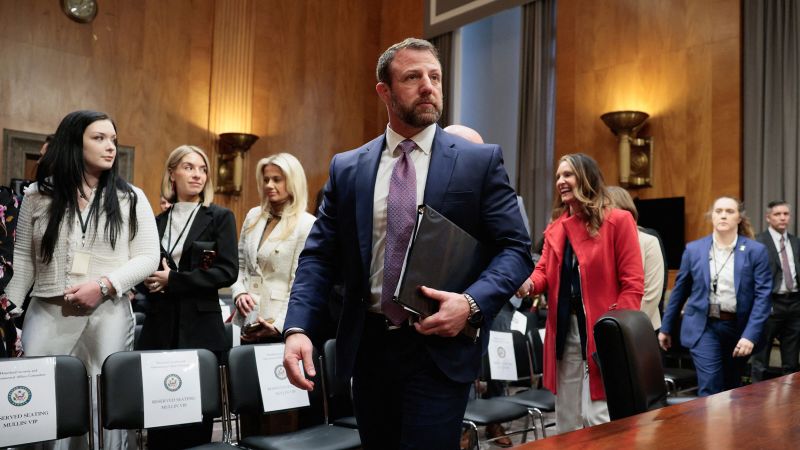
Two months into his new role, Homeland Security Secretary Markwayne Mullin finds himself trying to solve a puzzle: How does he deliver on the deportation mandate expected of him by President Donald Trump, while avoiding some of the same pitfalls that led to the ouster of his predecessor?
The controversial roving immigration patrols targeting blue states and cities have scaled back. But Mullin still lambasts the elected officials leading these areas and their progressive immigration policies, while the White House’s border czar recently vowed “to flood the zone” in such places with immigration agents.
Mullin lent Immigration and Customs Enforcement officers to airports suffering staffing shortages during the Department od Homeland Security shutdown, while also threatening to cut funding for some of those same airports in jurisdictions that refuse to cooperate with federal immigration enforcement.
He is hyping his agency’s involvement in securing dozens of upcoming World Cup matches, but has left open the possibility that some of the officers assigned to secure those matches may arrest immigrants — exacerbating a concern of fans who say they will skip or boycott the events.
He paused efforts to install sprawling migrant detention warehouses early in his tenure, but some of those plans are now reportedly moving forward again in the face of pending litigation.
All told, Mullin’s actions over his first 60 days as a Cabinet secretary show he is trying to straddle the line between the conciliatory and drama-free approach to immigration enforcement he promised lawmakers during his March confirmation hearing and the desire from MAGA hardliners, and the president himself, to deliver on one of the signature issues that propelled Trump back to the White House.
A Department of Homeland Security spokesperson said in a statement that, under Mullin’s leadership, the agency is “laser focused on its mission of making America safe again.”
“DHS continues to arrest the worst of the worst, deliver the most secure border in American history, and stop drugs from pouring into our communities,” the spokesperson said.
Administration officials, meanwhile, have taken steps to emphasize their continued vision for mass deportations, especially in front of conservative audiences who have criticized the administration for not delivering on those promises.
“We’re not giving up,” White House border czar Tom Homan told a group of DHS officials and industry personnel during a conference earlier this month. “President Trump was put into office for one big reason — lot of reasons — but the main reason? Immigration enforcement.”
Mullin has sought to rehabilitate the image of immigration officers under his command who, under the previous secretary, Kristi Noem, faced an onslaught of near-daily negative news about their aggressive immigration pushes in cities like Chicago, Los Angeles and Minneapolis. (Trump, for his part, even floated changing ICE’s name to “NICE” — adding National to the start — but faced pushback from Homan and rank-and-file officers.)
During the DHS shutdown that stretched for 76 days and consumed the first month of Mullin’s tenure, ICE officers were deployed to several airports to help alleviate staffing shortages by working crowd control.
But Mullin has also weighed an idea that would cause staffing shortages at airports in jurisdictions that do not cooperate with the federal government in enforcing immigration laws.
The Atlantic reported last week that Mullin recently told a group of airline and travel executives that he was considering reducing staffing of Customs and Border Protection officers working at airports in so-called sanctuary jurisdictions, including in Portland, New York City and Northern Virginia. Mullin previewed those plans publicly early in his tenure.
“If they’re a sanctuary city, and they’re receiving international flights, and we’re asking them to partner with us at the airport, but once they walk out of the airport they’re not going to enforce immigration policy, maybe we need to have a really hard look at that because we need a focus on cities that want to work with us,” he told Fox News in early April.
A DHS spokesperson did not provide more information about Mullin’s idea to cut staffing, including when it might be implemented. Given that some “sanctuary” jurisdictions are also hosting World Cup matches that could draw tens of thousands of international visitors, any staffing cuts over the summer could quickly become messy.
That idea has faced pushback from within the administration, including from Transportation Secretary Sean Duffy. “We shouldn’t shut down air travel in a state that doesn’t agree with our politics,” Duffy said during a Thursday congressional hearing.

Mullin has heavily promoted his agency’s preparations for the World Cup on social media. It gives the secretary the opportunity to highlight the work of Homeland Security Investigations, the branch of ICE that works cases including human trafficking and counterfeit goods and which has frequently become overshadowed by the agency’s immigration-enforcement arm.
But immigration officers will also have a presence at matches, Mullin told CBS in an interview. While they won’t be focus on “mass” round ups of undocumented immigrants, he left open the possibility that ICE will make arrests.
“We’re not there to go round up mass individuals, but we are always looking for the worst of the worst,” he said. “We’re going to continue to do that.”
Source link
See more: https://theglobaltrack.com/
https://corinthiames.com.br/