



The Dead Sea
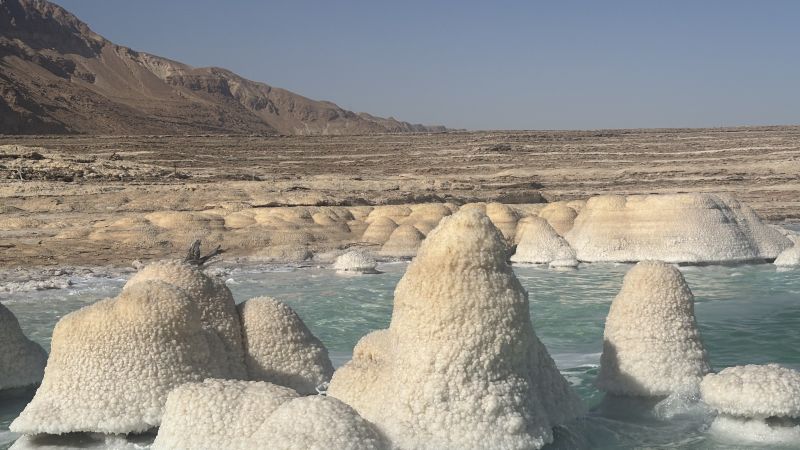
The motorboat cut through the aquamarine water of the Dead Sea, past dazzling-white formations forged from salt crystals. Jake Ben Zaken, the boat captain, pointed to a patch of darker water nearby indicating a sinkhole beneath the seabed. These are both signs of an unfolding ecological disaster, he said.
The Dead Sea sits where Israeli, Jordanian and Palestinian land meet and is a place of extremes. It’s the lowest point on the planet, around 1,400 feet below sea level. It’s also one of the world’s saltiest water bodies, nearly 10 times saltier than the ocean, which makes the water so dense people can float effortlessly on its surface.
But this unique body of water is dying. Every year it recedes around 4 feet, as the impacts of human activities and climate change take a heavy toll. Over the past five decades, its surface area has shrunk by roughly a third. As the water retreats, it’s forging a new landscape of sinkholes and salt-encrusted shorelines that is both strikingly beautiful and a haunting reminder that the Dead Sea’s future hangs in the balance.
Ben Zaken, who runs the company Salty Landscapes from Mitzpe Shalem, a settlement in the West Bank, has been taking people out onto the Dead Sea for more than 12 years. It’s given him a front row seat to the alarming changes.
His boat tours used to start from Mineral Beach, just to the south of Mitzpe Shalem, but he was forced to move when sinkholes closed it in 2015. His current location is safe for now, but the landscape is shifting fast. “Every year we get about seven and a half meters of new shoreline,” Ben Zaken said.
There are multiple plans to save the Dead Sea, but the years tick by and little happens as costs, fraught regional politics and a lack of political urgency stymie action, experts told CNN. Unless something is done, the world risks losing a unique ecosystem, they warned.
“It is a treasure,” said Peleg Gottdiener of EcoPeace Middle East, an organization of Israeli, Jordanian, and Palestinian environmentalists. “There’s nothing like the Dead Sea.”
The Dead Sea’s demise is human-caused.
This landlocked swath of salty water is technically a lake. Water enters from the Jordan River, which starts on the Syria-Lebanon border, flows through the Sea of Galilee in northern Israel, then continues its journey south toward the Dead Sea, with Jordan on one side and Israel and the occupied West Bank on the other.
Over the decades, the Jordan River, and its main tributary the Yarmouk, have shrunk as they’ve been dammed and diverted by Israel, Syria and Jordan to quench the thirst of people, crops and livestock. The river used to transport 1.3 billion cubic meters of water to the Dead Sea; that has fallen to roughly 100 million cubic meters.
The mineral extraction industry is the other major driver of decline.
In the late 1970s, the Dead Sea split into two basins, now separated by a strip of dry land. The deeper northern basin, where Ben Zaken operates his boat tours, is the natural remnant of the sea. The southern basin is artificially maintained, made up of a series of industrial evaporation pools.
Companies on the Israeli and Jordanian sides — the Dead Sea Works and the Arab Potash Company — pump water from the northern basin into the pools. The water evaporates in the sun leaving behind a mineral-rich brine, from which companies extract minerals including potash and magnesium for fertilizers and other industrial uses.
There’s another force at work too: climate change. Droughts are becoming fiercer and more prolonged, and rainfall is rarer. Even without river diversions and industry, there’s evidence climate change impacts would cause the Dead Sea to shrink, albeit far more slowly, said Yael Kiro, a geochemist at the Weizmann Institute of Science, who studies the Dead Sea.
⛅ Get CNN Weather in your inbox
- The forecast is just the beginning. We’ll send you expert coverage and the stories behind the weather — so you always know more than just the number. Sign up for the newsletter
As it shrinks, the Dead Sea is changing. It’s becoming even saltier. Since the 1980s, concentrations of salt in the water have become too high to remain dissolved, said professor Nadav Lensky, director of the Dead Sea Observatory at the Geological Survey of Israel.
This causes the salt to form solid crystals, which drift like snow down to the sea floor, creating natural salt sculptures. Most crystals accumulate as salt layers forming intricate structures that can take many shapes, influenced by water temperature and currents. Some look like chimneys, others like domes or mushrooms.


The retreating water is also changing the landscape in a more dangerous way.
At an entrance to Ein Gedi, a once-popular Dead Sea beach resort now permanently closed, a big yellow sign reads “no entry for pedestrians.” It’s soon clear why. The road toward the shore has been carved up by huge, circular sinkholes.
To get closer to the water means picking your way past the sinkholes and over fallen palm trees. A restaurant, changing rooms and gas station all stand abandoned nearer the shoreline. A set of broken steps leads down to a beach now so far away it’s impossible to see. The resort has an eerie, almost apocalyptic feel.
The sinkholes that closed Ein Gedi, and other Dead Sea beaches, are a direct result of the water’s retreat, Kiro said. Rapidly dropping water levels allow freshwater to seep into the ground, dissolving the ancient layers of salt and creating underground cavities. When these grow too large, the ground above eventually collapses, causing sinkholes to open up suddenly and without warning.
There are now more than 6,000 sinkholes around the Dead Sea and they threaten businesses and residents as well as tourism, which, on the Israeli side, is now almost exclusively in the industrial southern basin. Few tourists will likely realize that they’re bathing in an artificial evaporation pond.

The need to halt the Dead Sea’s decline is urgent, but there is no simple solution.
One idea is to find a new source of water to replenish it. In 2013 Jordan, Israel and the Palestinian Authority signed a memorandum of understanding to explore the idea of pumping water from the Red Sea to the Dead Sea.
The plan involved constructing a desalination plant on the Jordanian coast to produce freshwater and building a pipeline, more than 100 miles long, to bring the salty brine created during desalination to the Dead Sea.
Some environmental experts are concerned that adding water with a different chemical composition could cause algae blooms or the formation of white gypsum crystals in the Dead Sea.
Hazim El-Naser, chairman of the Middle East Water Forum and former Jordanian water minister, said extensive environmental studies have shown up to 600 million cubic meters of seawater could be added “without any problems.” For now, however, the project has stalled due to its multibillion-dollar price tag and the increasing difficulty of forging regional cooperation.
Another idea is to restore the Jordan River by reducing diversion and releasing more water into it — potentially using treated wastewater. But some experts warn the water will simply be removed before it reaches the Dead Sea, such is the need in this parched region. It’s “impossible to take (water) from the people unless you provide an alternative,” El-Naser said.


Others want to target industry. Abdelrahman Tamimi, the general director of the Palestinian Hydrology Group, said companies should stop pumping water to extract minerals. Others say the solution isn’t completely stopping industry — which supports jobs and tax revenues — but cutting its water use.
The Dead Sea Works has extracted minerals from the Dead Sea under a concession agreement since 1961. This comes to an end in 2030, and the draft of the new agreement does include fees for water use.
If people are making money from the Dead Sea’s water, “take some of that money and turn it back to water to make sure that we have the Dead Sea forever,” said Meirav Abadi, legal counsel for the Israel Union for Environmental Defense.
ICL Group, which owns Dead Sea Works, did not respond to CNN’s request for comment but says on its website it withdraws a net total of 160 million cubic meters of water a year from the Dead Sea and that it is “innovating to develop sustainable water management strategies.”
EcoPeace’s Gottdeiner said a big hurdle to any solution is that ultimately “there’s no sense of urgency” at a political level. He and other experts believe it’s probably impossible to restore the Dead Sea to the level it was a few decades ago; the focus instead should be on stabilizing its decline.
Israel’s Ministry of Environmental Protection rejected claims of a lack of urgency. “The ongoing decline of the Dead Sea is a serious environmental issue of national and regional importance,” a spokesperson said, adding “the Ministry continues to advance policy and planning efforts to address the issue.”
For now, those with homes and businesses along its shores must live with uncertainty.
Ben Zaken of Salty Landscapes knows he’s on borrowed time. Every time he shows up at the beach where he starts his boat tours, he scans the sand to see if a sinkhole has appeared. It would put him out of business immediately, he said, and there’s no insurance that will cover what now seems like an inevitability.
Change here doesn’t happen slowly, he said, “it’s a rapid-paced disaster.”
Zeena Saifi and Jeremy Diamond contributed to this report
Source link
More: https://theglobaltrack.com/
https://corinthiames.com.br/