


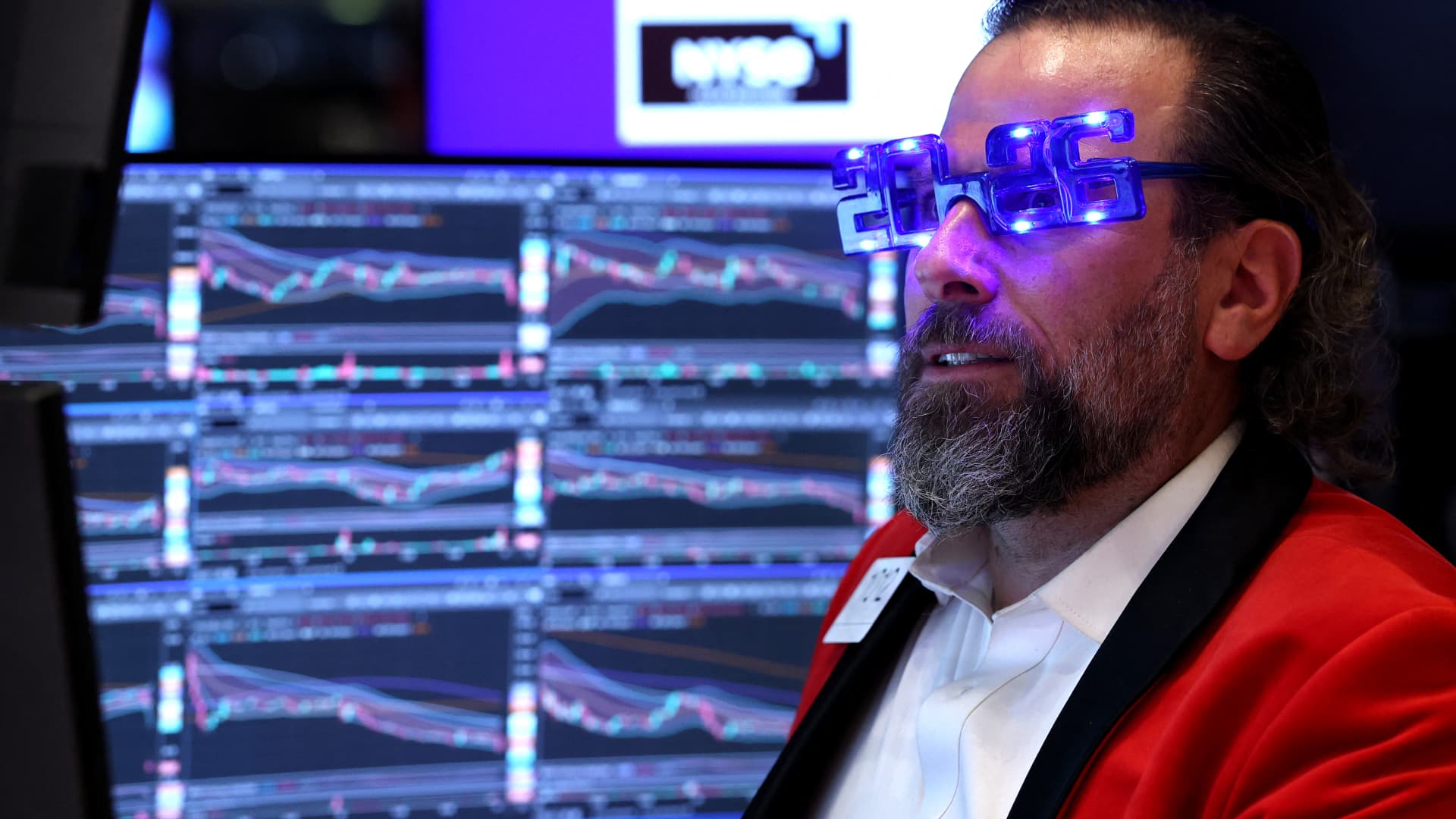
Trader Michael Pistillo wears “2026” glasses as he works on the floor of the New York Stock Exchange (NYSE) at the opening bell in New York on December 31, 2025.
Timothy A. Clary | Afp | Getty Images
The S&P 500 fell on Wednesday, though the index was still gearing up to close out a bumper year.
The broad market S&P 500 dipped 0.2%, as did the Nasdaq Composite. The Dow Jones Industrial Average traded down 121 points, or 0.5%.
Stocks are riding a three-session losing streak, although the declines have been mild and the S&P 500 is still set to lock in a 17% gain for the year, its third straight double-digit annual advance. The Nasdaq Composite has ridden AI enthusiasm to a 21% advance. The Dow is up 13% for 2025, hindered a bit by its lack of tech representation.
That marks an impressive recovery from the rout seen in early April following President Donald Trump’s sweeping tariffs announcement. The S&P 500 was even on the cusp of closing in bear market territory at one point, dropping almost 19% from its February high and closing below 5,000 for the first time since April 2024.
“There were lessons learned on the part of the administration that smarter, more narrow tariffs with a gradual implementation is what the market can absorb,” said Keith Buchanan, senior portfolio manager at Globalt Investments. “The market is now, because of 2025, able to look past any tariff shifts in 2026, banking on the administration remembering those lessons from 2025 and also corporate America being able to adjust on the fly in a way that continues to preserve margins.”
Still, the recent declines are somewhat worrisome given that the final five trading days of the year, and the first two of the next, are a seasonally rewarding stretch — often referred to as the “Santa Claus” rally — that usually gives stocks one last push toward year-end.
The recent profit-taking could also foreshadow some of the volatility ahead. Strategists surveyed by CNBC expect the S&P 500 could post yet another double-digit advance in 2026, but many worry stocks could spend much of the year range-bound as corporate earnings growth catches up to lofty multiples.

S&P 500, YTD performance
Artificial intelligence has been the defining force driving the market for the last three years. In 2023, the S&P 500 surged 24%, after the debut of ChatGPT the prior year unleashed a fervor around the companies most likely to benefit from a technological revolution that harkens back to the dawn of the internet. In 2024, the broad market index rallied another 23%.
The AI narrative fractured somewhat this year, as the rally started to broaden out to other sectors, and even performance among the so-called Magnificent Seven stocks bifurcated. Alphabet was the big winner among the megacaps, up more than 65% year to date, as investors bet the search giant could edge out OpenAI. Amazon was the laggard, gaining more than 5%.
What’s more, many asset classes outside the megacaps started to outperform. Commodities had an especially good year, with gold up more than 64%, and silver higher by more than 143%.
“We’ve seen internals change in a way that indicates us that 2026 could … look very different than 2025, even more so than 2023 and 2024,” Buchanan said. “[The market] is going to be driven more by fundamentals that are less dependent on monetary policy and AI infrastructure buildout.”
As of Tuesday’s close, the Dow and S&P 500 were also on pace to close out a winning month. The 30-stock Dow is up approximately 1% in December, on pace for its eighth winning month in a row — the first such streak going back to 2018. The S&P 500 is up 0.5%, also on track for an eight month win streak. The Nasdaq, however, was last little changed on the month.
— CNBC’s Alex Harring and Chris Hayes contributed to this report.
Source link
See more https://theglobaltrack.com/