
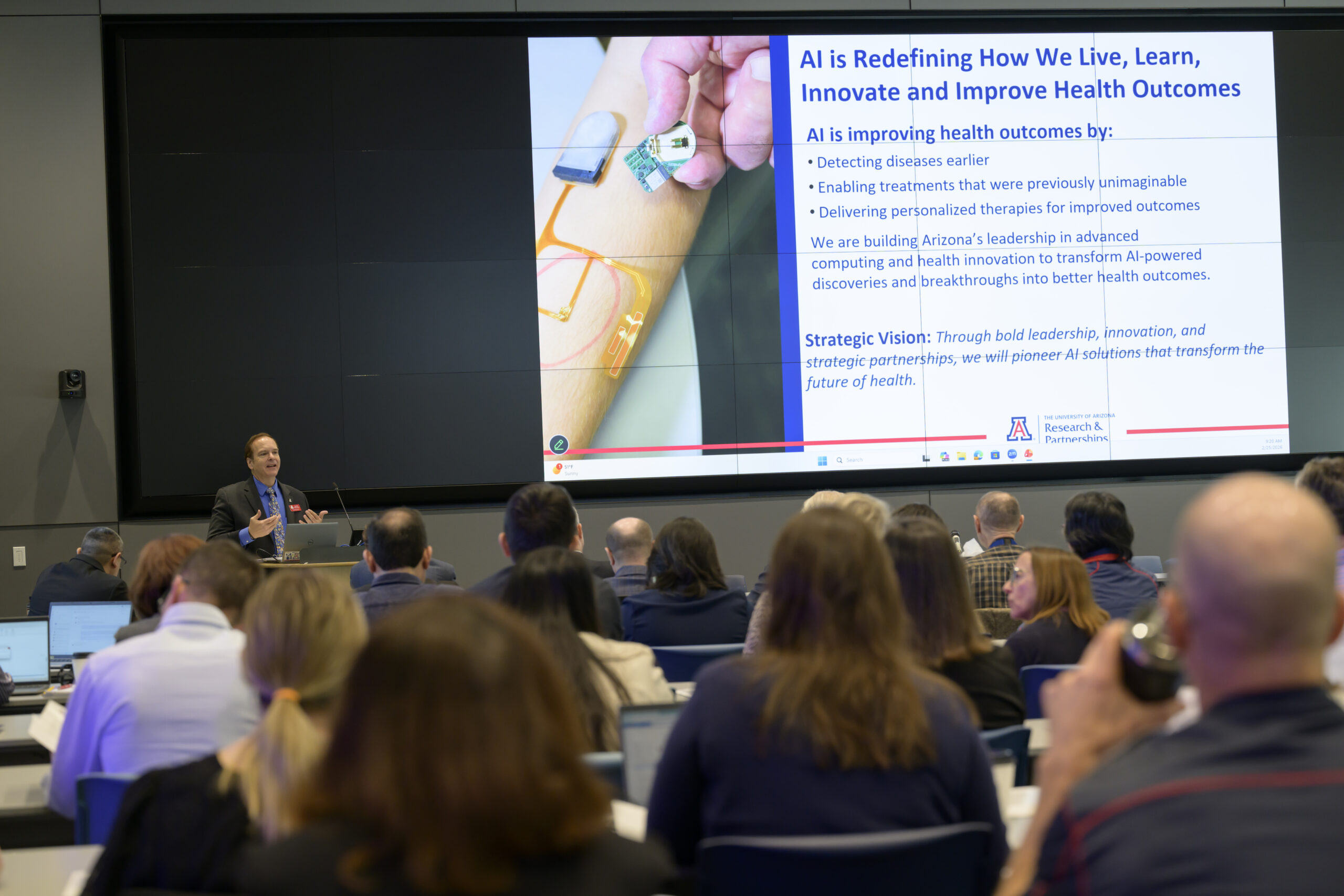
The University of Arizona is defining a new standard for how artificial intelligence integrates into higher education and society. By prioritizing ethics, personal responsibility and societal impact over just technical speed, the U of A is building an ecosystem where integrity and human creativity remain the primary drivers of progress.
This holistic, human-centered approach positions the university as a national example in the responsible adoption of AI technology at a modern research university.
The architect of this strategic effort to integrate AI across research, instruction and operations is David Ebert, the U of A’s inaugural chief AI and data science officer – one of only a few such positions in higher education nationally.
“The rapid evolution of AI requires a new kind of leadership that prioritizes transparency and public trust,” said Ebert, who leads the Office of Responsible Artificial Intelligence, or ORAI. “The challenges AI presents cannot be solved in a vacuum. Our approach ensures that as we accelerate our technical capabilities, we are also deepening our commitment to the judicious application of these tools and the human insight that must guide them. We are building a future where AI serves as a partner in human progress, not a substitute for it.”
Leslie Hawthorne Klingler, U of A Office of Research and Partnerships
The AI integration process has been deliberate and rooted in the campus community. Throughout fall 2025, ORAI staff gathered insights from more than 1,000 employees and students through listening tours, town halls and surveys. Of those participants, over 600 volunteered to help craft the university’s strategic direction. The feedback helped to shape a comprehensive AI roadmap, which will be released this spring to guide responsive AI implementation campus-wide.
“Our strength is the holistic approach,” said Rudy Salcido, associate director for operations and programs for ORAI. “We understand there is demand to have so much of this done already, but we do not want to rush to failure. We are doing this right the first time to instill trust in our campus community and empower everyone to ask questions and take an interest in this incredible effort that is transforming our university.”
The roadmap is envisioned to be continually evolving.
“This framework is designed to balance immediate action with ongoing flexibility to provide direction today, while remaining responsive to technological advances, emerging best practices and evolving campus needs as our collective understanding deepens. We are charting each leg of our journey thoughtfully,” Ebert said.
The U of A approach reflects a broader national priority. In a March 2026 letter to the U.S. Department of Energy, the Association of Public and Land-grant Universities, or APLU, emphasized that public research universities are the “optimal partner” to lead the nation’s AI advancement. Institutions like the U of A are uniquely capable of curating scientific data and developing a “dual-competency” workforce—graduates who are experts in both AI and foundational sciences, according to the APLU.
Empowered instruction
The university’s philosophy is already visible in the classroom, where instructors are using AI in ways that blend foundational learning with emerging tools.
Jennifer Savary, co-director of the Lundgren Retail Collaborative and Terry J. and Tina Lundgren Endowed Chair for Marketing and Retail, routinely consults with industry leaders about the skills they are looking for in graduates. While specific technical requirements may vary, she has found that employers need graduates who are resilient, lifelong learners.
“As educators, we need to consider what we are doing to encourage learning in a world in which it is really, really easy for students to avoid learning and seem to be doing well,” Savary said.
Students in Savary’s class learn in two ways, beginning with analog instruction to ensure they understand basic skills. Once that foundation is established, Savary layers in AI-enabled methods, helping students understand both the core concept and how AI can shape the results.
Melody Buckner, associate vice provost for digital learning and online initiatives, said AI offers the opportunity to spend less time on repetitive tasks and more time focusing on what really matters: mentoring students, guiding their thinking and helping them engage with the material. Buckner recently used AI to help analyze patterns in student assignments and generate feedback for the class.
“After I combined that with my own notes and personalized comments, several students emailed me to say it was the best feedback they’d received in a course,” she said. “That’s where I see the real promise; using AI to help us become better instructors.”
Access for all
To help scale AI integration, ORAI is launching the U of A AI Platform. Built on Amazon Bedrock, the platform will bring a suite of AI tools to all faculty, staff and students across disciplines. The first tool, U of A GenAI, will give users access to several large language models and is expected to roll out campus‑wide by the end of March. As additional tools come online through 2026, the platform will support coursework, administrative workflows and research while maintaining secure and compliant data practices.
Beyond internal tools, the university is participating in the Google AI for Education Accelerator. The program will introduce AI-fluency training to incoming freshmen through the University 101 course, fulfilling the university’s land-grant mission to broaden access to essential modern skills.
Driving specialized research and economic impact
AI is also central to the university’s strategic research priorities, including an AI-driven health innovation focus, that tackle issues critical to society and to the state’s economy. Supported by the Arizona Board of Regents through the Technology and Research Initiative Fund, faculty from the arts, humanities, law and business are working alongside experts in engineering and the health, physical and social sciences to apply AI to medical imaging, precision medicine and expanded health care access, as well as to energy optimization, space exploration and national security.
“Human AI teaming is the engine behind our most critical strategic research initiatives,” Ebert said. “Whether we are using machine learning to optimize water usage in desert agriculture or applying AI to space domain awareness to protect critical infrastructure, our goal is the same: to turn complex data into trustable, actionable solutions. We are proving that Arizona’s path to global leadership in these fields is built on a foundation of responsible, human-centered technology.”
The Arizona Institute for AI and Society provides the technical structure that helps researchers move from concept to measurable outcomes. Part of ORAI, the institute brings together AI engineering expertise, research support and a campus‑wide network of specialists who help teams refine ideas, prototype solutions and pursue interdisciplinary projects.
This collective momentum will take center stage on March 18 at the Arizona AI Leadership Summit. Hosted on main campus, the event will convene voices from Arizona’s three public universities along with Pima Community College and leaders whose work spans research, workforce development, policy and commercialization to explore how AI can be responsibly integrated to advance public benefit across Arizona and beyond.
“We are proud to host this summit at the University of Arizona, where so much of this important work is already happening,” Ebert said. “We are building a future where every member of our community has the fluency to navigate this new era with confidence and integrity and it empowers them for success in the coming decades.”