


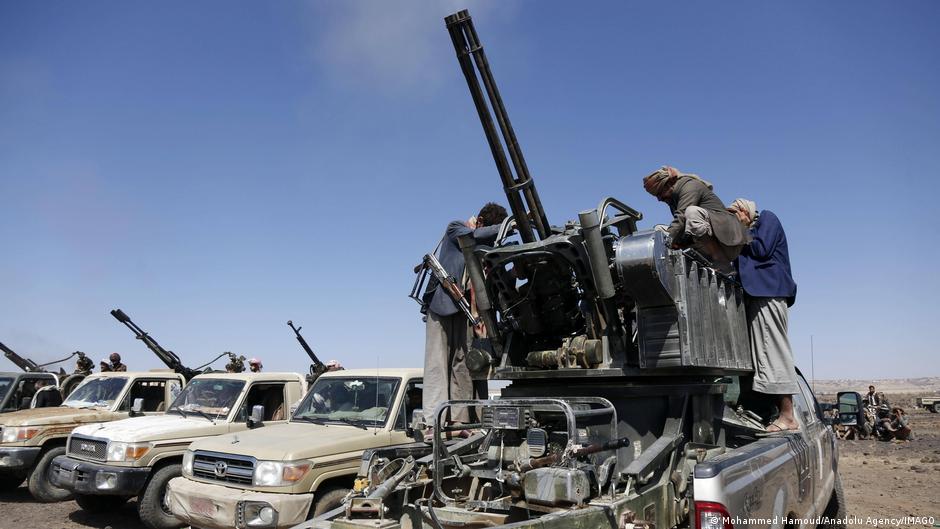
Following Israel’s strike on Iran, it remains to be seen in what way Yemen’s Iran-backed Houthi militia will react. In the past days, they were outspoken in their support for Tehran. As part of the Iran-led “Axis of Resistance” — Iran’s paramilitary proxy groups in the Middle East including Hamas in Gaza, Hezbollah in Lebanon and Shiite militias in Iraq — also the Houthis regard the US and Israel as its enemy.
“Recent remarks from members of Ansar Allah’s political bureau publicly warned the United States against launching military aggression against Iran, stating that such an attack would amount to war and that they are prepared to enter such a war,” Elham Manea, head of the Research Area Middle East and Gulf Studies at the University of Zurich, told DW.
“So, at the level of rhetoric, the signaling is clear: alignment and readiness,” Manea said.
Hisham Al-Omeisy, a Washington-based Yemeni conflict analyst formerly with the US State Department, told DW that the Houthis have been recently bolstering the ranks, redistributing their fighters and missile launchers. “They are beating their chests,” he said.
Entrenched in Yemen
ASaudi-led coalition intervened in 2015 in support of Yemen’s government following the Houthis’ insurgency in 2014. The United Nations reports that more than 150,000 people were killed in the ensuing conflict. In 2022, a truce largely halted the fighting; however, the country remains de facto split.
The Houthis control the north, west and center of Yemen, including the capital. Sanaa. The south and east of the country remain under the control of an internationally recognized government and a faction that calls for secession. However, the situation was further fragmented in December, when secessionists pushed for power. Since then, the government under the newly appointed prime minister, Shaya al-Zindani, has resided in Saudi Arabia’s capital,m Riyadh.
As a consequence of the tensions between the United States and Iran, there have also been visible signs of unease inside Houthi-controlled areas, Manea said. “We have seen tightened internal security measures, arrests within security institutions, increased surveillance of officials, and what appears to be heightened military repositioning, particularly around maritime routes and strategic coastal areas,” she said. In her view, these actions indicate concern that the Houthis themselves could become targets in the event of escalation. “In other words, there is preparation not only for participation, but also for survival,” she said.
What could the Houthis do?
The Houthi group — which was redesignated as a terrorist organization by the United States in January 2024 — acted in support of Palestinians in Gaza during the almost two-year war in Gaza following the Hamas attack on Israel on October 7, 2023. In a bid to show solidarity, the Houthis frequently targeted Israel as well as cargo vessels in the Gulf of Aden and the Red Sea.
“Houthi leaders have recently threatened that, in the event of war, they would resume attacks on commercial shipping,” Luca Nevola, senior Yemen analyst at the US-based research initiative Armed Conflict Location & Event Data project (ACLED), told DW.
One plausible trajectory — based on Houthi capabilities — would be attacks on US military facilities in Gulf countries or maritime assets in strategic waterways, Manea said. “From the Houthi perspective, US bases in the Gulf could be framed as legitimate targets within a broader confrontation with Washington,” she said.
In the event of Israelistrikes, Al-Omeisy said there might be attacks on Tel Aviv as well as attacks on ships. “It would be a desperate attempt to draw some fire away from Iran but it would be quite costly for the Houthis to do that,” he said.
A military response by US forces in the region, as well as by Israel, would also most likely be temporary, like the limited strikes on Yemen by the United States following Houthi attacks on shipping vessels. “The Houthis have tested the tolerance of the Americans in the first bout, and they rely on the fact that the US does not want a long engagement in Yemen,” Al-Omeisy said.
Independent weapons production
The Houthis appear fully equipped for potential strikes. “Their most consequential military asset remains their long-range drone and missile arsenal and, despite several rounds of US and Israeli airstrikes, the group appears to retain long-range strike capabilities,” Nevola said.
In February, an in-depth report by the US-based Century Foundation research organization highlighted the Houthis’ independence from Iran when it comes to arms production. “Weapons, components and raw materials are shipped to the Houthis from multiple sources, taking looping routes on sea and land, sometimes overshooting Yemen and doubling back,” the report states. “When parts finally arrive in Houthi territory on the boats of smugglers or regular tradespeople — some of whom may have no idea they are carrying anything illicit — the Houthis are able to assemble them into a formidable arsenal.”
Peter Salisbury, political analyst and one of the authors posted on X that “inside a decade, the Houthis have transformed from local insurgents to a disruptive global force.”
Fears aggravate humanitarian situation
For Yemenis, who have borne the brunt of years of civil war, ongoing domestic tensions between the Houthis and the Yemeni government, and widespread hunger, the outlook is anything but reassuring.
“We are living through a real famine in Yemen, and any regional escalation will only deepen the hunger crisis and the level of starvation,” Yasser Hussein, a father of four in the city of Taiz, told DW.
Jamal, a public sector employee who has not received his salary for years, told DW that he is less worried about a potential US-Iran escalation than about the worsening living conditions. “What really causes concern is the lack of tangible progress in [political] negotiations, the failure to secure prisoner releases, the currency instability and the irregular payment of public sector salaries,” he said. He asked DW to not publish his last name for fear of future retribution.
Niku Jafarnia, Yemen researcher at Human Rights Watch, told DW that in the past “we’ve witnessed the Houthis increase in human rights violations when the world’s attention is focused on regional conflict.”
If history is an indicator of what could come, Jafarnia said, a “war with Iran could provide yet another cover for the Houthis to carry out widespread abuses against Yemenis.”
Edited by: M Gagnon