



Third-person action-shooters have been around a long time, so it’s relatively rare that we see a wealth of new ideas at play. Pragmata’s greatest feat is successfully introducing a twist on the form, integrating two distinct mechanics – hacking and shooting – that run simultaneously in the midst of a fight. While Capcom’s long-awaited action game has some other problems, that single innovation keeps things interesting, even while some of the surrounding game treads familiar ground.
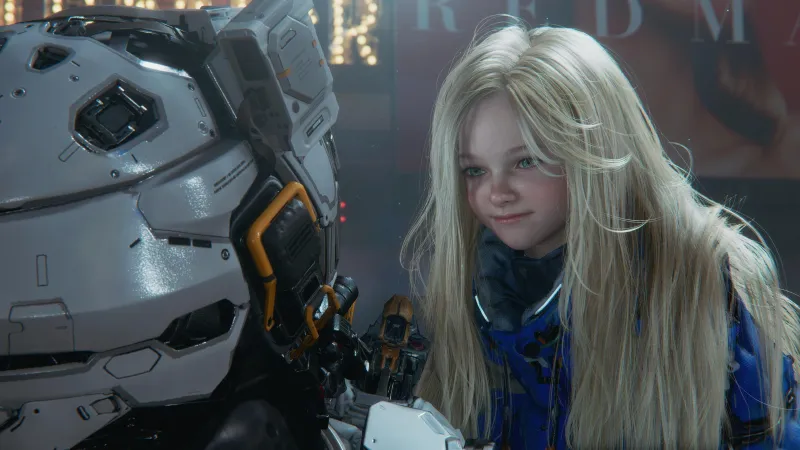
Hugh is a specialist sent to a corporate moonbase where 3D-printed environments, bots, and other objects are researched and built at the direction of a morally questionable and profit-driven company back on Earth. After a disastrous arrival, he’s forced to partner with an uncannily advanced robot he names Diana, who just happens to look like an adorable little girl, complete with all the mannerisms befitting her appearance. With Diana capable of hacking the dangerous robots that hunt them, and Hugh equipped with ever-more devastating weaponry, the two navigate the mysterious moon habitat while blowing up increasingly towering automatons.
Pragmata Video Review:
Despite some early intimations that the story might be trying to say something about the hazards of AI or artificial experiences, Pragmata never really raises any thoughtful questions or draws any conclusions on that score. The scale of theming is smaller and more intimate here; Hugh and Diana make for a memorable partnership, and while the father/daughter dynamics are more than a bit heavy-handed, the emotional hook still lands.
The space station environment is sterile and a little stale after the first few hours, but the setting is saved by the elaborate artificial spaces players move through as the plot unfolds, from a simulacrum of New York City to a holographic ocean shoreline. The juxtaposition of stark lab walls with objects like a 3D-printed forest that looks like the real thing creates an intriguing backdrop for encounters.
Battles play out in tight arena-like spaces where several varieties of robots aim to take you out. Each foe has weak points, different attacks, and ways to protect itself. It’s fun to ferret out those characteristics and build mastery over the different encounters, even if the baseline shooting mechanics feel a little stiff and unwieldy. Diana’s hacking adds much-needed complexity. By aiming at a target, in addition to just blasting away with a gun, you can also use the face buttons to navigate a grid to hack and weaken that foe. Additional power-ups layer more ways to disrupt, delay, and destroy. It all happens in real time, so the challenge of juggling your hack with dodging and shooting foes can be a lot of fun, especially as the game throws more twists into the mix, like unpredictable enemies or grids that glitch as you navigate them.
Pragmata guides players through a mostly linear critical path that risks feeling on rails. As such, I appreciate the way each area of the space station hides numerous hidden rooms, extra combat challenges, minor traversal jumping, and other secrets to discover and aid in progression. Sadly, the in-game map is unhelpful in navigating those spaces, so I often got lost, especially when returning to a zone after passing it, though at least a solid radar ping system helps identify item locations while exploring.
In between battles, Hugh and Diana return to a shelter for character and weapon improvement, along with some extra daddy/daughter bonding moments. The respites are a pleasant change of pace that offers a steady sense of advancement, though I’m not crazy about having to return there every time I want to get my health, ammo, and heal charges back.
The novelty of the dual mechanics starts to wear thin after a time, and some of the battles begin to feel repetitive in the later hours, so it’s a good thing Pragmata doesn’t wear out its welcome; a robust first playthrough hits the credits around 15 hours in and nails a satisfying conclusion. Between some challenging training missions, New Game +, and an extra post-game mode focused on battles and rewards for completionists, Pragmata pads out its offering into something more than just a single run.
Gamers often complain that big publishers refuse to roll the dice on new properties with unique systems; I give Pragmata big props for doing precisely that and experimenting with something unconventional. The story and structure as a whole feel a bit by-the-numbers, but the beautiful futuristic visuals and inventive battle system are solid wins.