
Ohio State answers questions on Ted Carter resignation
Ohio State University officials answer questions about the resignation of President Ted Carter.
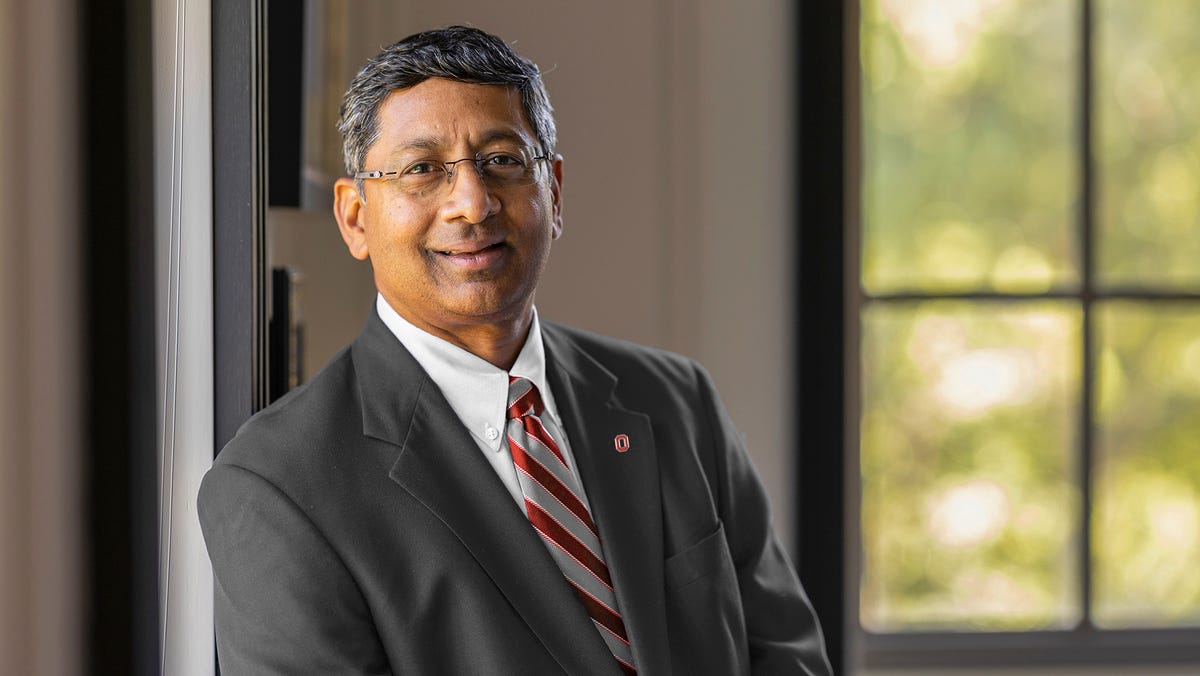
- Provost Ravi V. Bellamkonda will permanently lead Ohio State University following former President Ted Carter’s resignation.
- Carter resigned after admitting to an “inappropriate relationship” with someone seeking state resources for her business.
- Bellamkonda is a bioengineer and neuroscientist who previously served as provost at Emory University and held leadership roles at Duke University and Georgia Tech.
Provost Ravi V. Bellamkonda will lead Ohio State University following former President Ted Carter’s resignation, a university source confirmed March 11.
The expected March 12 decision by the Board of Trustees comes less than a week after Carter disclosed an “inappropriate relationship,” leading to the board accepting his departure.
Just two months away from spring graduation, Bellamkonda is taking on the position permanently.
Bellamkonda began as provost and executive vice president of OSU in 2025 after the university spent nearly a year searching to fill the position. Carter once called Bellamkonda’s position the “most important” hire he was making in his university presidency and called him “everything he was looking for” in a provost.
“I believe deeply in the noble mission of higher education and the excellence of higher education in the United States, especially its impact on research, shaping the future through the education of our students, and our responsibility to engagement in our communities,” Bellamkonda said in a 2024 press release announcing his hire.
Who is Ravi V. Bellamkonda?
In 1989, Bellamkonda had never been on a plane before. But at age 21, he boarded a flight to the United States from India to pursue a Ph.D at Brown University. His career, rooted in neuroscience and bioengineering, has spanned decades, states and several universities.
He was a post-doctoral fellow with the Massachusetts Institute of Technology after earning his Ph.D. In 1995, he started as a professor at Case Western Reserve University in Cleveland, Ohio.
In 2003, he moved on to the Georgia Institute of Technology, where he held several leadership roles, including Wallace H. Coulter Professor and chair of the department of biomedical engineering, as well as associate vice president of research. After 13 years, he became Vinik Dean of Engineering at Duke University and served as president of the American Institute for Medical and Bioengineering until 2021.
Prior to OSU, Bellamkonda had returned to Georgia and served as provost and executive vice president for academic affairs at Emory University, a private university in Atlanta of approximately 16,000 students.
As OSU’s provost, Bellamkonda oversaw the university’s portfolio of programs and initiatives in the Office of Academic Affairs, which supports faculty and student success across its six campuses. The deans of all 15 academic colleges and university libraries report to the provost. The provost also serves as a member of the president’s cabinet.
He is married to his wife, Dr. Lalita Kaligotla, and has two grown children.
What has he done for OSU?
During his tenure at Emory University, Bellamkonda led several initiatives including student experience, faculty recruitment and retention efforts focused on arts and humanistic inquiry, as well as artificial intelligence across areas such as medicine, business and law.
It’s a timely focus, as AI is only increasingly at the forefront of academic conversations around the world.
In his short time as provost, he’s brought that emphasis on integrating AI to OSU. The Office of Academic Affairs is pushing “bold, groundbreaking initiative” ensure “every Ohio State student will graduate being AI fluent,” according to the university. Efforts include embedding AI into undergraduate curriculums, training faculty and AI education partnerships outside the university.
He also launched “Game Changer Scholars” initiative, which is focused on bringing quality and innovative faculty to OSU. The office’s first hire under the initiative was announced March 2.
He has also overseen Ohio State’s record-breaking year for research investment, despite cuts from the federal government.
Why did Carter resign?
The board confronted Carter after an unnamed source told them about the “inappropriate relationship.”
He admitted that he’d “had an inappropriate relationship with someone seeking state resources to support her personal business,” according to a university statement. Carter offered to resign, and the board accepted on March 7, just a little over two years into his time at OSU.
The resignation was made public on March 9.
In the aftermath of the resignation, JobsOhio posted a statement to social media, saying that it was possibly linked to a podcaster at the center of the relationship.
The Callout Podcast, run by Krisanthe Vlachos, hosted Carter multiple times. It focuses on helping veterans finds work in the utilities sector, and its latest episode was sponsored by JobsOhio. A spokesperson for JobsOhio told The Dispatch it “invested” $15,000 per episode as part of a four-episode pilot series, though only one episode was completed.
Carter was a co-host on that episode, alongside JobsOhio President J.P. Nauseef, Vlachos, Carter, Ohio Department of Veterans Services Director John C. Harris and William Butler, president of the National Veterans Memorial and Museum.
Nauseef told The Dispatch that Carter had introduced him to Vlachos in 2025, though he didn’t exactly remember when.
JobsOhio and OSU were also cosponsors with The Callout for a play telling the story of military veterans performed at OSU in January 2025.
Business and consumer issues reporter Samantha Hendrickson can be reached at shendrickson@dispatch.com