


Genomic data provides evidence for a previously unknown wave of migration, with Indigenous groups living in central and southern Mexico spreading into South America and the Caribbean starting around 1,300 years ago
:focal(4340x2439:4341x2440)/https://tf-cmsv2-smithsonianmag-media.s3.amazonaws.com/filer_public/d2/a1/d2a1a486-d979-44f9-ac60-b13a4149bc4b/figura3.png)
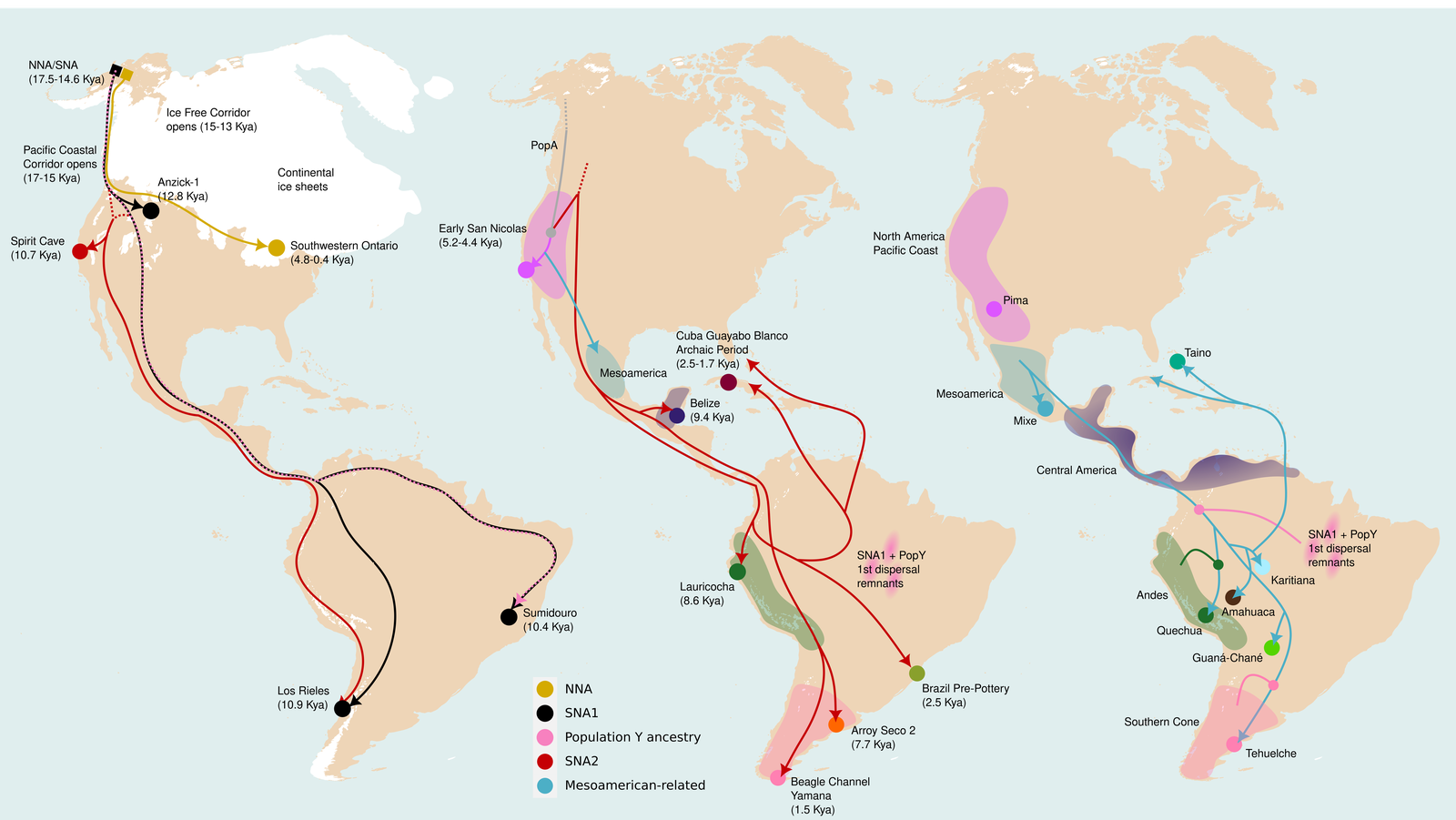
Scientists now think humans settled South America in three waves.
Marcos Araújo Castro e Silva
Human settlement of South America may have been more complex and dynamic than previously thought, new research suggests.
Scientists have long suspected that humans settled South America in two waves—one about 15,000 years ago, followed by another roughly 9,000 years ago. Now, with a new paper published April 22 in the journal Nature, researchers report finding evidence of a third, previously unknown wave. Based on an analysis of genomic data, they suspect Indigenous groups living in central and southern Mexico spread into South America and the Caribbean starting around 1,300 years ago.
This relatively recent migration probably wasn’t spurred by a single event but rather was a “more gradual” process that involved “increasing connectivity and gene flow between Mesoamerica, the Caribbean and South America over time,” study co-author Tábita Hünemeier, a geneticist at Spain’s Institute of Evolutionary Biology, writes in an email to Live Science’s Kristina Killgrove.
Working in partnership with Indigenous communities, scientists sequenced 128 whole genomes from Indigenous individuals representing 45 ethnic groups across eight Latin American countries: Argentina, Bolivia, Brazil, Colombia, Ecuador, Mexico, Paraguay and Peru.
They combined this new data with previously sequenced genomes for a total of 199 contemporary Indigenous individuals from 53 populations and 31 linguistic families. The team also incorporated ancient DNA to provide “the most comprehensive view of Indigenous American genomic diversity and evolutionary history to date,” says study co-author Carlos Eduardo G. Amorim, an evolutionary anthropologist and population geneticist at Arizona State University, in a statement.
This work is important, the scientists say, because Indigenous individuals from the Americas have historically been underrepresented in genomic research. That means scientists haven’t had a complete picture of human genetic variation.
“Genomic data is heavily biased towards populations of European origin because biological samples are mostly obtained from individuals of this ancestry,” says Roderic Guigó, a researcher with the Center for Genomic Regulation who was not involved with the study, in an expert reaction to the paper compiled by the Science Media Center (Spain). “This limits the possibility of applying the advances of genomic medicine universally, since the same mutation can have a different effect depending on the genetic environment, which varies among different human populations.”
Key takeaway: Expanding research
The Indigenous American Genomic Diversity Project is a collaboration among international researchers and Indigenous American communities to create a large DNA database of a population that is underrepresented in genomic research.
By analyzing the Indigenous genomes, researchers were able to identify more than a million genetic variants that have not been found in other populations. In the long run, understanding these unique genetic variations, which likely resulted from Indigenous populations adapting to the diverse environments and conditions of the Americas over time, “could improve medical research and promote more equitable health care,” the study co-authors write in an accompanying research briefing in Nature.
Zooming out, the scientists also found evidence of a genetic bottleneck caused by the European colonization that led to the “widespread extermination” of Indigenous populations over the last 500 years, the researchers write in the paper. Today, the scientists say the genetic diversity of Indigenous Americans is a fraction of what it was before the arrival of Europeans.
The study also replicates a mysterious finding from past research: Some Indigenous Americans have traces of Australasian ancestry, sharing around 2 percent of their DNA with individuals from Australia, New Guinea and the Andaman Islands. This Australasian ancestry, which is often referred to as population Y or the Ypykuéra signal, dates back more than 10,000 years, suggesting that ancient South American populations intermixed with ancient Australasian ancestors.
It’s not clear why these Australasian genes have persisted in some South Americans for so long. But the most likely answer is that they’re somehow advantageous to survival. The researchers found evidence that suggests some of the genes, including those related to fertility and immune response, underwent natural selection, which suggests they’re beneficial. But they say more research needs to be conducted to confirm this theory.
The findings are “not the end of the story,” Cosimo Posth, an archaeogeneticist at the University of Tübingen who was not involved with the research, tells Science’s Lizzie Wade. But they are “a step forward,” he adds.