


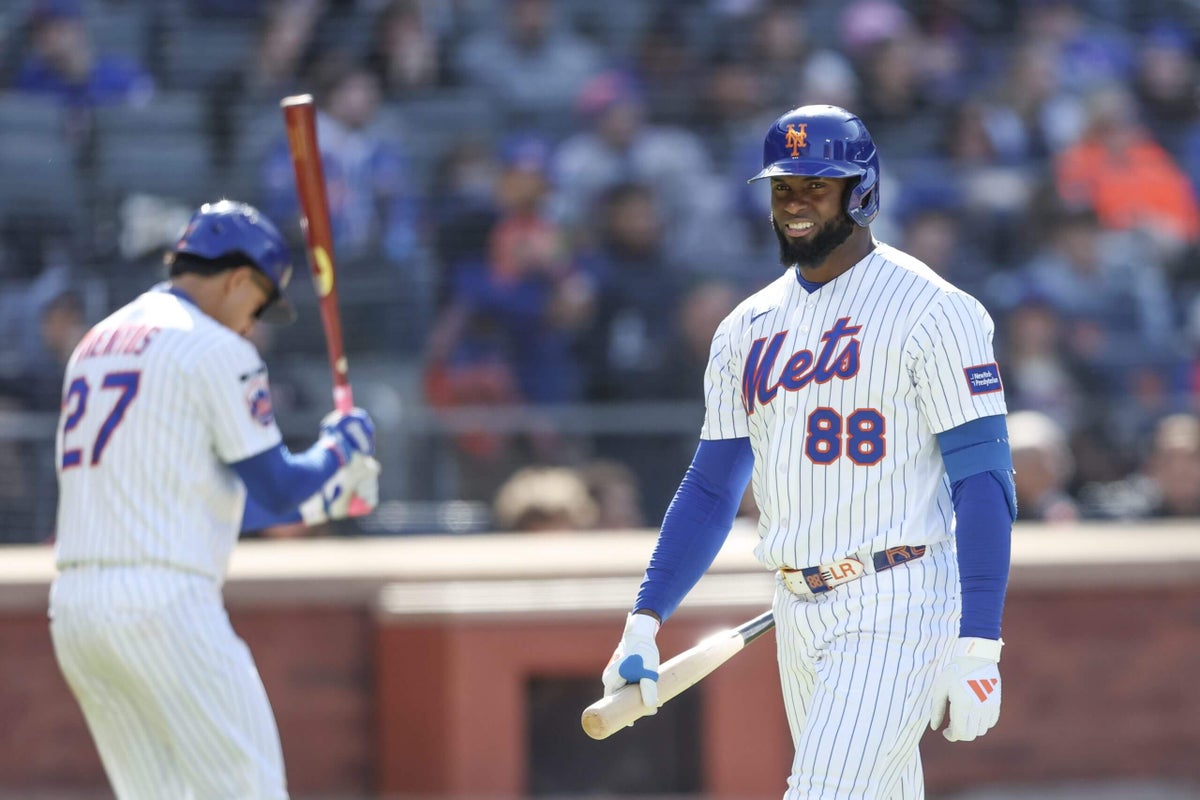
NEW YORK — The mood at Citi Field is one of exasperation. In the stands. In the clubhouse. In the media room, where manager Carlos Mendoza told reporters multiple times on Sunday that “it’s hard to explain.”
That’s because it just gets worse.
The Mets reached a new low point on Sunday, dropping both games of a doubleheader against the Colorado Rockies to reach a season-worst 10 games below .500. The Mets (9-19) scored a total of one run. Already this season, they’ve scored less than two runs in a game 10 times.
After winning a pair of games to break a 12-game skid earlier in the week, the Mets lost all three in their series against the Rockies, a team with a third of New York’s payroll and that last year lost 119 games. It’s another losing streak.
Between Sunday’s losses, Mendoza said the suffering is fixable.
“We gotta do something,” he said.
But what? There’s only so much the Mets can do. From a possible managerial move to another switch in the rotation to doing absolutely anything with the lineup, the changes the Mets could make do not inspire visions of a turnaround. The Mets are bad, and it’s getting harder to see them quickly becoming good.
The most drastic change the Mets could reasonably make is firing Mendoza. The Boston Red Sox showed on Saturday that an underachieving team can make such a decision in April when they parted with Alex Cora, a World Series winner. Mendoza said he considered Cora one of the game’s best managers.
“But, hey,” Mendoza said, “it’s the business, right?”
Mendoza does not have Cora’s resume. The situations are different. But they might end the same way. Before Sunday, the feeling within the team was that Mendoza deserved more time. It’s unknown if anything has changed. Is there a point when owner Steve Cohen and president of baseball operations David Stearns simply have no other choice?
“The only thing I’m worried about is getting the guys going,” Mendoza said. “My job is to find a way to get those guys out of the funk.”
Mendoza would not say whether he has received any assurances from the Mets’ higher-ups. He appears to be in lockstep with the front office. He is also Stearns’ hand-picked guy. His firing would be an admission of failure.
Moving on from Mendoza would be making a change for the sake of making a change. In Major League Baseball, a managerial shakeup tends to be what happens. Stearns, however, has never made such a change during a season in his 10 years as a top executive.
Would firing Mendoza fix the Mets’ problems? It’s hard to see that being the case. The guess here is someone from the inside, like bench coach Kai Correa, or senior vice president Andy Green or special assistant Carlos Beltran would take over. What, exactly, would be different? The Mets’ problem is that their players, particularly most of their hitters, are not performing anywhere close to acceptable levels.
What makes Mendoza’s seat hotter than ever is that this was supposed to be the soft part of the Mets’ schedule. They failed to capitalize. They own baseball’s worst record (along with the Philadelphia Phillies). In franchise history, only the 1981 Mets (8-19-1) had a worse record through the team’s first 28 games of a season.
And this isn’t just any old season for the Mets, either. In spring training, Cohen established making the playoffs — after failing to do so last season — as the baseline goal. The Mets changed their roster. They changed their coaching staff. At a certain point after this kind of start with these kinds of stakes, another change feels inevitable.
They’ve tried changes in the rotation. They haven’t jump-started a turnaround. Time to try another, anyway?
The Mets may have to. For the third straight start, Kodai Senga failed to provide any length. He lasted just 2 2/3 innings. Unlike the previous couple of times, the good thing is that he didn’t allow seven runs. The three he gave up in the second game on Sunday, however, were plenty.
Senga is under contract through 2028 (the Mets hold a club option for 2029) at $14 million each season. Just like last season, he would have to accept a demotion to the minor leagues, per his contract. Would he?
“That warrants a lot of discussion with a lot of different people,” Senga said.
Previously, Senga was too fine and didn’t attack with his best pitches. On Sunday, however, he utilized his fastball and splitter at higher rates than before. He walked three, hit a batter and gave up a home run.
Mendoza stopped short of confirming that asking Senga to accept a minor-league assignment was on the table. He said he had to talk things over with Stearns and assess the next options with Senga.
“But obviously,” Mendoza said, “it’s not good enough.”
The Mets’ other options include starting Sean Manaea or Tobias Myers, both in the bullpen, or calling Jonah Tong (barring an injury, the Mets cannot immediately recall Christian Scott, whom they optioned earlier in the week after a start because their bullpen needed a fresh arm). Manaea wasn’t good enough to break the Mets’ rotation out of camp. Myers is valuable in a hybrid role. And Tong hasn’t looked as sharp in the minors as he did last season.
Doing something about Senga is, of course, necessary. His ERA is 9.00. Just remember, though, the Mets have made other alterations to the rotation. It hasn’t helped much. Even if or when they swap out Senga, how much of a difference can it really make when he pitches once every fifth or sixth day? It’s not as if he’s the only pitcher struggling. And the Mets’ troubles go well beyond pitching.
The Mets are at a loss to explain their struggling lineup.
Mendoza said on multiple occasions, “It’s just not a good showing.”
Everyone outside of Juan Soto is seemingly in a deep funk. The Mets won’t have more information regarding a timetable for Francisco Lindor (calf), who is walking around in a boot, for another three weeks. They are also without Jorge Polanco (Achilles, wrist), who has no definitive timetable, either. The Mets’ lineup in the second game featured five batters with an OPS below .600. Things are bleak.
“We all know what kind of talent we have in that lineup,” Soto said. “It’s just a matter of time that they’re going to wake up and bring the best of themselves.”
Is it? It’s hard to keep believing that line of thinking when the results do not change. The Mets rank last or close to last in nearly every offensive category that matters, including the one that matters most: runs. They score less than anyone else.
This is the Mets’ situation: They need to do something about their lineup, which is dragging them down, but there’s not much they can do easily. Aside from the injuries, this is the roster Stearns put together (there were also two more defensive issues Sunday, with errors from Mark Vientos and Brett Baty, each playing first base in different games).
Where to turn? The Mets don’t even have another hotshot prospect crushing it in Triple A who they can call up to ignite something.
The Mets, however, did make one change: They are designating outfielder Tommy Pham for assignment, league sources said, and adding Austin Slater. Pham went 0 for 13 with seven strikeouts. Slater, who had a full spring training unlike Pham, was recently let go by the Miami Marlins after he produced just a .460 OPS.
They’re going to need more. Making a bigger change, perhaps through a trade of some kind, might present a path for improvement. Stearns has made early trades in the past, most notably acquiring Willy Adames while leading the Milwaukee Brewers in May 2021. But most teams are disinclined to act this early in the season.
Indeed, it remains early for most teams. Not the Mets. For the Mets, it’s getting late. And after a long, brutal weekend, it’s getting worse.
“I’ve never seen anything like this,” Mendoza said.
He isn’t the only one.