



At the time, the news “piqued my interest as to what the policies were relative to single-sex admissions and gender identity at the college,” because Smith receives federal funding, said Sarah Parshall Perry, vice president of the conservative group, Defending Education.
In June 2025, Perry filed a federal civil rights complaint with the US Department of Education that has since morphed into a government investigation probing whether Smith’s admissions policy violates Title IX, the law prohibiting sex discrimination in education programs that receive federal assistance.
The investigation could have implications for other women’s colleges, including Mount Holyoke and Wellesley, which both admit transgender women.
“Title IX contains a single-sex exception that allows colleges to enroll all-male or all-female student bodies — but the exception applies on the basis of biological sex difference, not subjective gender identity,“ the US Education Department’s Civil Rights office said in a statement Monday.
“An all-girls college that enrolls male students professing a female identity would cease to qualify as single sex under Title IX,” the statement said.
A spokesperson for Smith said the school is aware of the investigation and “fully committed to [Smith’s] institutional mission and values, including compliance with civil rights laws,” but “does not comment on pending government investigations.”
Levine, the first openly transgender federal official to be confirmed by the Senate, is a favorite target of Republicans, drawing particularly intense criticism for her opposition to government-imposed restrictions on transgender care for minors, which she has called a health equity issue. The Trump campaign featured her image in ads attacking Kamala Harris on trans rights issues in the 2024 presidential race.
The Defending Education complaint argues Smith discriminates against “biological women” by admitting students whose assigned sex at birth was male but identify as female, while barring students whose assigned sex at birth was female but identify as male.
The US Department of Education did not respond to a Globe request for more information on Tuesday.
Perry, who served as a high-level official in the Department of Education during the first Trump term, said the investigation should encourage Smith to agree to a resolution with the administration.
“Smith College, obviously, is under no obligation to receive federal funding, but once they do, they have to follow federal civil rights law,” she said. “Smith can’t have its cake and eat it, too, by saying, ‘We’ll give lip service to Title IX, but we will violate the spirit, letter, history, and plain text of Title IX at the same [time].’ ”
If Smith wants to keep its current policies, she added, it can rely on private and state funding instead.

Shiwali Patel, senior director of education justice at the National Women’s Law Center, said the probe is proof the Trump administration is more interested in “focusing on fake problems than addressing the actual issues that women and girls are facing in education.” Patel also argued that admissions to private undergraduate colleges are exempt from Title IX’s requirements.
“The Department of Education’s investigation into Smith College is not civil rights enforcement. It’s the weaponization of Title IX and its protections,” she said.
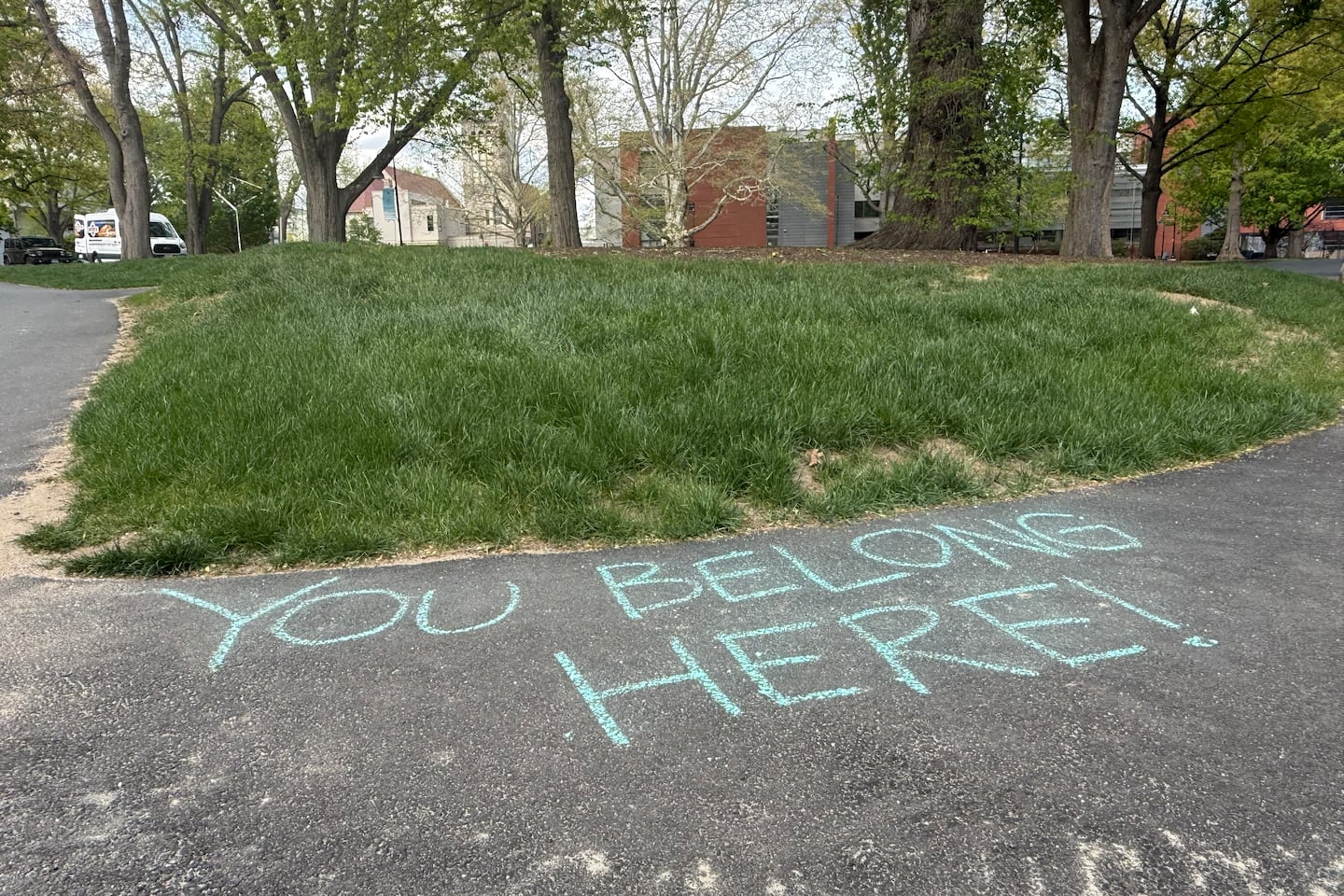
Within hours of the Trump administration’s announcement of the investigation Monday, colorful chalk messages began to appear all over Smith’s campus: “You belong here,” “We love our trans sisters,” “Trans people belong at Smith.”

The college also alerted the campus community about the investigation via an email that shared mental health and other resources.
“We recognize that this development is very difficult for our community,” wrote Alexandra Keller, dean of the college and vice president of campus life.
Margot Audero, a transgender woman in her senior year at Smith, understands her college’s need to be cautious, but she also wants to hear its leaders speak up.
“This does fundamentally change the calculus,” she said. “Smith no longer has the option of staying out of the spotlight. . . . I do think they have the opportunity to loudly state their values.”
The Smith investigation is part of the White House’s broader campaign against transgender rights. On his first day back in office, Trump pledged to “defend women’s rights” by recognizing sex as immutable and binary — biologically male or female — and ordered federal agencies to “ensure grant funds do not promote gender ideology.”
The administration has since pursued a raft of antitrans policies, from blocking federal funding to hospitals that provide gender-affirming care to minors to mandating the removal of transgender personnel from the military. It even changed Levine’s name on her official portrait to her previous name, NPR reported.
The legal and political fight has resurfaced divisions over the difference between sex and gender, along with what it means to be a women’s college today. Both Smith and Wellesley have evolved significantly since first opening their doors around 150 years ago, while Mount Holyoke College, founded in 1837, is the most gender-inclusive of the trio.
Mount Holyoke dubs itself “the leading gender-diverse women’s college” and welcomes everyone but cisgender men (who identify as male, in accordance with their assigned sex at birth). Wellesley admits students who live and consistently identify as women.
Smith currently “considers for admission any applicants who self-identify as women,” including those who are cis, trans, and nonbinary, according to its website. The college changed its admissions policy to include self-identified transgender women in May 2015, amid pushback from some alumnae.
Genny Beemyn, director of the Stonewall Center at the University of Massachusetts Amherst, a resource for the LGBTQ+ community on campus and beyond, wasn’t surprised by the DOE investigation of Smith.
What is surprising is that “it took this long, quite honestly, given the [Trump] administration’s hatred of trans people,” Beemyn said.
As a nonbinary educator who often speaks publicly about transgender issues at schools across the country, Beemyn is receiving far fewer invitations as colleges keep a low profile to avoid the glare of the Trump administration.
Campuses are “scared to do trans events, to have trans speakers, to demonstrate that they support trans rights . . . because they’re so fearful of being targeted, being singled out, being attacked, maybe having federal funds taken away,” Beemyn said, adding that institutions should be careful, but not invisible in the fight.
Beemyn noted that they’ve also heard from transgender students at UMass Amherst and other schools “who are feeling like they don’t have a lot of support because their administrations are not coming forward and saying, ‘We support you.’ And that makes a difference.”

Last fall after Perry filed her complaint, Smith president Sarah Willie-LeBreton told the Globe she hadn’t heard from the DOE and wasn’t prepared to “offer legitimacy” to it by commenting. “Our admissions policies are firmly within the law,” she said at the time, “and we’re very proud of those policies.”
Now that a federal investigation of Smith has been announced, “The proof will be what Smith decides to do in response: if they capitulate, or if they stand up and say, ‘This is something we value, and we are not going to give into the administration,’ ” Beemyn said.
This story has been updated to correct the spelling of the name of Alexandra Keller, dean of the college and vice president of campus life at Smith.
Brooke Hauser can be reached at brooke.hauser@globe.com. Follow her @brookehauser. Tonya Alanez can be reached at tonya.alanez@globe.com. Follow her @talanez.