



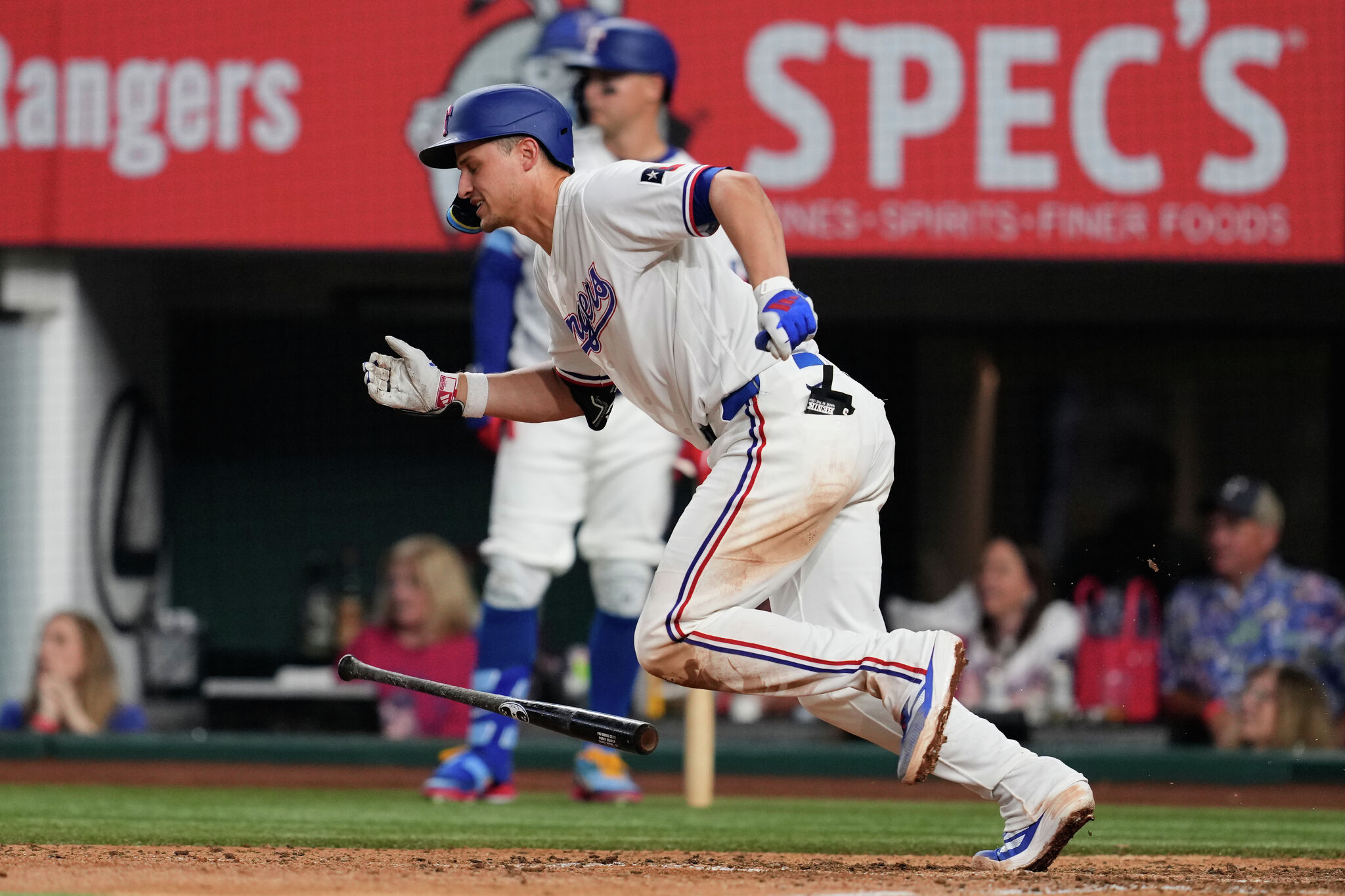
Texas Rangers’ Corey Seager sprints out of the batters box after hitting into a double play in the ninth inning of a baseball game against the New York Yankees Tuesday, April 28, 2026, in Arlington, Texas. (AP Photo/Tony Gutierrez)
DETROIT — Is it way too early to consider postseason odds? Absolutely, but for the sake of perspective, let’s take a gander anyway.

The Rangers have a 48.9% chance to make the playoffs, per FanGraphs, which is the fifth-best in the American League. It’s reflective of the fact that their schedule has been especially hard to start the season and, in the AL, there haven’t been too many teams who’ve run away with anything. The Rangers are 16-18, second in the AL West, but locked into a three-way tie for the third wild card spot.
Article continues below this ad
Does this matter on May 4?
Is it something to keep in mind as we dive into these offensive issues?
Article continues below this ad
Here are five things we learned about the Rangers last week.
Let’s check back in with the offense
We pontificated last week as to whether the offense had meaningfully improved after last year’s nosedive. The answer we arrived upon (“technically yes”) wasn’t incorrect at the time, but after another week in which offensive charts pointed downward, it’s become harder to discern a difference between the past and the present.
The .686 OPS that the Rangers have posted through Sunday’s loss is three percentage points better than the .683 OPS that they posted last season, and to expand further, it’s one percentage point better than the .685 OPS that they posted two years ago when they also missed the playoffs. It’s the fifth-worst in baseball this season. The four teams ranked below them — the Philadelphia Phillies, the Boston Red Sox, the San Francisco Giants and the New York Mets — have built a modern Mount Rushmore of disarray in just over a month’s worth of games.
Article continues below this ad
In the last two weeks, a stretch in which the Rangers have won all of five games, their .625 OPS is the second-worst in baseball. Only the Giants, who’ve lost six consecutive games, three of which were against the also-woeful Phillies, have been worse in that span.
This is the company the Rangers keep.
Or, should we say, this is the company the Rangers have kept.
Okay, but, what’s the biggest issue with the offense?
Look, there’s a manifesto to be written there, but there’s at least one way to meaningfully improve the offense if a certain facet of it is bandaged up.
Article continues below this ad
The Rangers have to hit with runners in scoring position.
Even simpler, they need to strike out less with runners in scoring position, because at least a ball batted into play puts some amount of pressure on an opponent’s defense. The Rangers have hit .238 with runners in scoring position in the last two weeks, a below-average clip, but their strikeout figures in those spots stand out more. Their 80 strikeouts with runners at second or third base are the fourth-most in the league. Their 26% strikeout rate in those situations is the second-highest and a 2% increase over their strikeout rate in all situations combined. The Rangers finished 0 for 5 with runners in scoring position in Sunday’s loss and struck out three times.
“There’s definitely some balls that we’ve hit hard at guys,” first baseman Jake Burger said. “That’s baseball. I think, on the flip side, you don’t see those fall, and we’re kind of aware that we need to score those runs, and as an offense it’s easy to press in those situations. That’s where I think the swing and miss comes in.”
Sorry, we have more to say about the offense, then we’re done
The lineup cannot flourish as it’s designed to if its best hitter is not, well, its best hitter.
Article continues below this ad
Shortstop Corey Seager, off to one of the worst starts in his decorated career, has not been its best hitter.
Seager’s .213 average is the lowest he’s ever posted through the first 33 games of any season. His .725 OPS is the fourth-worst, and while it’s largely propped up by his team-high six home runs, which can’t be overlooked, it’s more than 140 points below his career average. His 37 strikeouts are the second-most on the team behind only Burger and nearly half of them have come with a runner on base ahead of him. It’s been especially noticeable given the fact that the club’s two best offensive performers — right fielder Brandon Nimmo and third baseman Josh Jung — hit in front of and behind him.
Nimmo led Sunday’s game off with a single, but two at-bats later, Seager chased a sweeper out of the zone for a strikeout, and in the at-bat after that, Jung continued his scorcher with a single of his own. Had Seager hit the ball into play, or at least advanced Nimmo to second base, a run likely would’ve scored on Jung’s single and changed the complexion of Sunday’s game early.
Seager’s track record buys him grace, and though it’s under a larger spotlight given the time of year and the collective struggles of the offense, he’s had 166 (no, seriously, 166) 33-game stretches in which he’s posted a .725 OPS or worse as a big leaguer. It even happened three seasons ago, when the Rangers won a World Series, and when Seager finished as the American League MVP runner-up. The 32-year-old has the ability to outperform his slumps and has the support of his coaches, teammates and front office to do so.
Article continues below this ad
It’d just certainly help if it happened sooner rather than later.
Ezequiel Duran has shined wherever needed defensively
Duran, now the team’s go-to utility infielder, has started five career games in right field.
He’s recorded an outfield assist in three of them.
Article continues below this ad
His cannon of an arm helps, as it did in Saturday’s loss when he threw out Tigers second baseman Gleyber Torres at home plate to preserve what was then a tied score in the bottom of the first inning, but his work ethic does, too, if you ask the man who fills out the lineup card each day.
“How good you are at defense is solely based, in my opinion, on makeup and character,” Rangers manager Skip Schumaker said. “If you want to get better at defense, you work at it, and he works and works and works. He works early, he works in batting practice, the whole deal. It’s not surprising to me that he plays everywhere so well.”
Duran’s 0.4 WAR accumulated, per FanGraphs, is the fifth-best on the team. His .747 OPS (the third-best behind Jung and Nimmo) boosts that, but plays like Saturday’s throw or Friday’s impressive catch help, too.
The bullpen continues to surprise
The Rangers did not spend a boatload on their bullpen this winter, and only weeks into the season, the two arms that they believed could be their highest-leverage weapons landed on the injured list. So naturally, the bullpen has been their greatest strength through a month-plus of games.
Article continues below this ad
The relief staff’s 2.74 ERA is the best in baseball by a considerable margin, their 22 holds are near the top-third leaguewide and their nine saves are better than league average. This is despite the fact that their pseudo closer (left-hander Jacob Latz) was nearly their fifth starter, their de facto setup man (right-hander Jakob Junis) was expected to operate as a bridge arm, their second-most productive reliever from a value standpoint (left-hander Tyler Alexander) barely throws 90 mph and a pair of unheralded rookies (right-handers Peyton Gray and Gavin Collyer) have yet to allow a run in their big league careers.

By signing up, you agree to our Terms Of Use and acknowledge that your information will be used as described in our Privacy Policy.
Article continues below this ad
“The pitching staff has done a really good job at putting them in the right spots to succeed,” Schumaker said. “I’ve said this before, but, guys surprise you.”