


When a group of mothers and wellness influencers, including surgeon general nominee Casey Means, was asked to go to the White House this month, some of them assumed a few staffers would hear their grievances about the health risks of weedkillers.
Instead, it turned into a two-hour session in a “jam-packed” room with Health and Human Services Secretary Robert F. Kennedy Jr., White House chief of staff Susie Wiles and the president himself stopping in, according to Alex Clark, a “Make America Healthy Again” influencer who was among the attendees.
“They just let us talk — they let us get everything off of our chest,” said Clark, who hosts “Culture Apothecary,” a MAHA-themed podcast produced by Turning Point USA.
There was a lot for Clark and the “MAHA moms” in the room to air. Top of mind was the commonly used weedkiller glyphosate and calls to reduce its use and investigate its safety.
On Monday, the US Supreme Court heard arguments in a case that could define a long-fought battle over whether one of the most commonly used weedkillers in the United States is safe — an issue that is being seen as a test of how much power the Make America Healthy Again movement can actually hold in Washington.
The lawsuit against Bayer, the makers of Roundup — the brand name for glyphosate — will determine whether people can continue to sue the company over illnesses allegedly caused by its product.
But regardless of its outcome, expected to be announced in June, the issue of limiting pesticides has long energized the MAHA base.
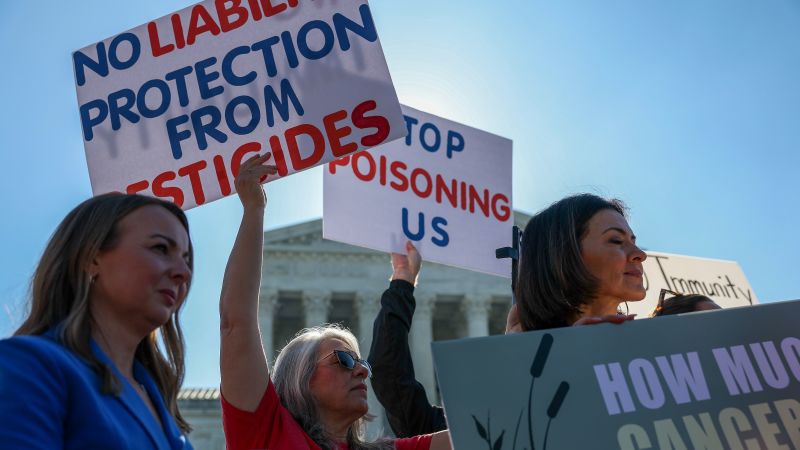
Hundreds of protesters convened in front of the court ahead of the arguments, where speakers rallied attendees to push for more pesticide protections.
DeWayne “Lee” Johnson, a San Francisco school groundskeeper, was just 42 when he was diagnosed in 2014 with terminal non-Hodgkins lymphoma. For years, he had sprayed the herbicide Roundup around the grounds he maintained, once becoming drenched in liquid after a sprayer he used broke. After that, he began seeing rashes and lesions all over his body.
In 2018, Johnson won a landmark $289 million settlement from Monsanto, the maker of Roundup, which was found liable for his diagnosis.
The man who helped him win was RFK Jr., then an environmental lawyer in California.
Through subsequent court appeals, Johnson’s settlement was reduced to $20.4 million. But it marked the first decision in one of many liability cases that have been mounted against Monsanto, now owned by Bayer.
Although the company has since committed to pay out billions of dollars over claims that it is liable for health harms — including a proposed $7.25 billion settlement in February — Bayer has maintained that Roundup is safe and that its alleged links to cancer are unproved. The company has pointed to the Environmental Protection Agency’s review of the product and its label, which makes no mention of cancer.
The case before the Supreme Court will determine whether Americans can bring further cases against Bayer. The plaintiffs are led by a Missouri man who argues he got cancer after regularly using the product.
In a brief filed with the court, US Solicitor General D. John Sauer wrote that the “EPA has repeatedly determined that glyphosate is not likely to be carcinogenic in humans, and the agency has repeatedly approved RoundUp labels that did not contain cancer warnings.”
In court on Monday, the justices appeared divided over how to resolve the case, with difficult questions posed to both sides. At the heart of legal arguments is not the issue of whether glyphosate causes cancer, but rather whether a 1972 federal law supersedes the ability of individual states to set their own product labeling.
Bayer has argued that law is intended to bar individual states from imposing their own labeling requirements, thus creating a patchwork of different rules – a point Justice Brett Kavanaugh, a member of the court’s conservative wing, zeroed in on in the final minutes of the argument.
But Chief Justice John Roberts, a conservative, questioned what role states might have as the EPA delves into the process of reviewing new information.
“If it turns out that they were right,” Roberts posed, “it might have been good if they had an opportunity to do something to call this danger to the attention of the people while the federal government was going through its process.”
Following the arguments, a spokesperson for Bayer said that a ruling in Monsanto’s favor would “provide essential regulatory clarity for companies.”

Kennedy, now secretary of the Department of Health and Human Services, landed the role in part with promises to ban glyphosate and rein in pesticide use.
But the Trump administration has since ordered more domestic production of the chemical, backed away from suggestions it may be harmful, and thrown its support behind Bayer by arguing that it is up to the EPA, not the courts, to decide the safety and risks of agricultural chemicals.
The positions on glyphosate have sparked tension between traditional conservatives and the MAHA voters who argue they provided pivotal votes to secure Trump’s 2024 win.
Views on pesticides have also forged unusual — if tenuous — political alliances.
Speakers at the rally on Monday included Republican Rep. Thomas Massie and Democratic Sen. Cory Booker, MAHA supporters, and environmentalists.
Dennis Kucinich, a former Democratic congressman, told the crowd that the case will determine “whether or not states have a fundamental right to be able to stand up for the health and safety of their people and give people access to due process at a state level.”
“If the Supreme Court rules the other way, they will have taken down a cornerstone of our country,” he added.
Ahead of the rally, Sarah Starman, a third-generation farmer and campaigner with ecological group Friends of the Earth, noted the paradox of the moment.
“The Trump administration has gutted protections for health and for the environment,” she said. “But at the same time, the public momentum against pesticides and behind cleaning up toxic chemicals in our environment and behind healthy food and farming is so strong.”
MAHA, midterms and miscalculations
The Oval Office meeting with MAHA moms was facilitated by Erika Kirk and MAHA allies in the administration who see the importance of keeping the movement’s support heading into the midterm election, according to people familiar with the logistics.
“Mothers do not want their kids poisoned by pesticides that cannot wash off produce and they cannot get away from, and they’re breathing it in, in the air. That is what matters to moms,” Clark, the podcast influencer, told CNN. “And nobody votes, and nobody rallies, and nobody shows up to the polls, or doesn’t show up to the polls if they’re mad, like a mother. This is the No. 1 group that you do not want to piss off and that you do not want to lose on your side.”
Some advocates warn that is already happening. Besides Trump’s order to produce more of the chemical, a government report last August on chronic disease in America backed away from earlier Kennedy rhetoric about the alleged harms of pesticides. Congress is also wrestling over a proposed law that would effectively shield pesticide manufacturers from further liability, regardless of the Supreme Court’s decision.

Throughout the debate, some farming organizations have warned that any action restricting pesticide use could destabilize the American food supply by leaving crops vulnerable to weeds and vermin.
During a marathon of budget hearings this month in which several lawmakers grilled him on his earlier promises about regulating the chemical, Kennedy sought to defend both the president’s action and his own beliefs.
“I was very clear with the president about my own displeasure with the executive order,” regarding ramping up glyphosate production, he said on Tuesday. “The president felt it was necessary for national security reasons,” he added.
Asked directly whether the chemical causes cancer, he replied: “Yes.”
Besides the fight before the Supreme Court, the EPA is due to release a court-ordered review of glyphosate’s safety in October — weeks ahead of the midterm elections. A provision in the House version of farming legislation would push that deadline to 2031.
For MAHA activists, it is another in a series of battles they say will energize their voting base come November.
“Glyphosate is going to be a midterm issue because the Trump administration made it an issue,” said Vani Hari, a food and wellness influencer known for her “Food Babe” blog.
“This is what we’re marching towards, this is what we’re thinking about. We got to make some meaningful change.”
This story has been updated with additional details.