




SCOTT DETROW, HOST:
In Colombia, the saga of the so-called cocaine hippos rolls on. For years, descendants of a drug lord’s private zoo have been proliferating and roaming the wild. And now there is a new debate over whether they should be culled and – or somehow saved by an Indian billionaire. Manuel Rueda reports.
(SOUNDBITE OF HIPPOS GRUNTING)
MANUEL RUEDA, BYLINE: Here in Doradal, a small town in the center of Colombia, the grunt of hippos has become part of the soundscape.
(SOUNDBITE OF HIPPOS GRUNTING)
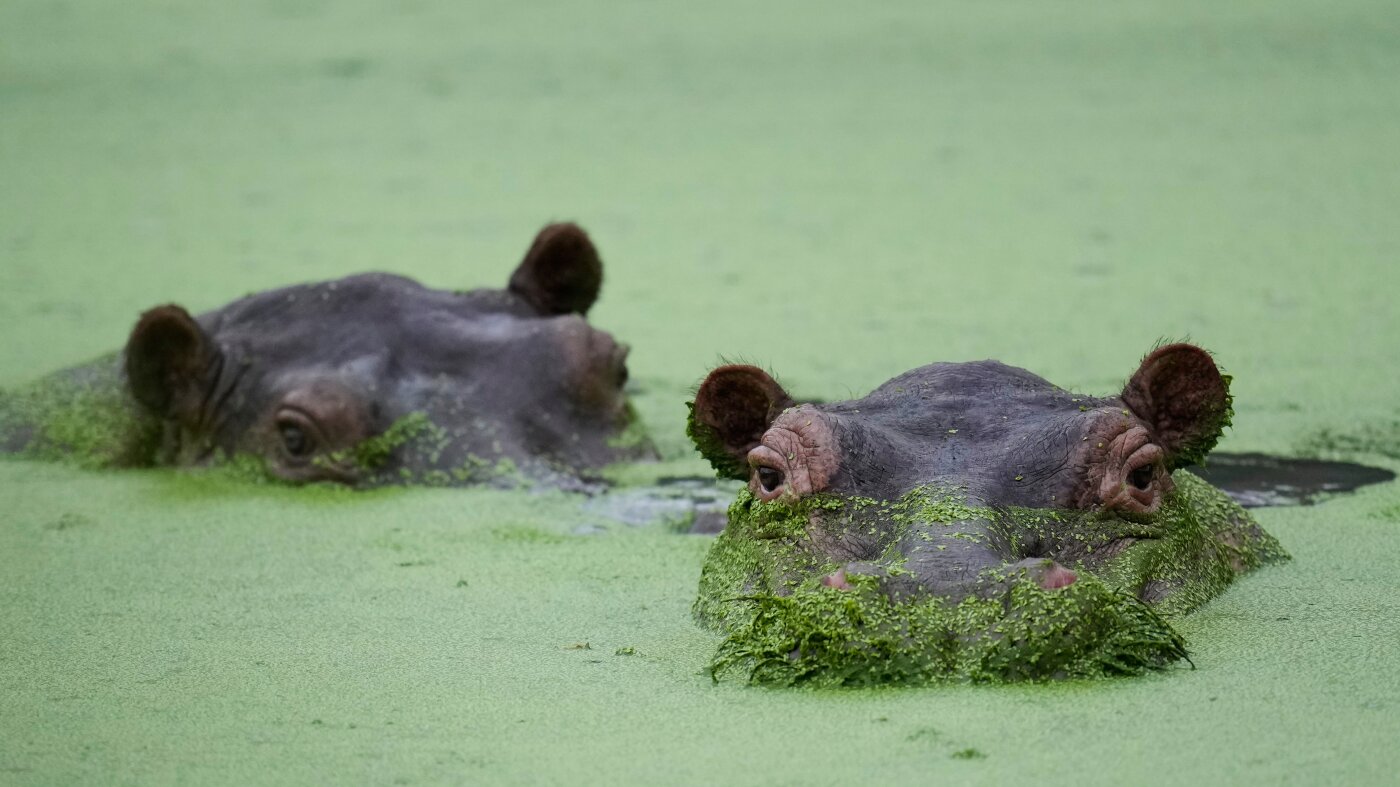
RUEDA: Every afternoon, locals and tourists hang out at a lake on the edge of the town. They chat and drink beers as they watch the giant beasts floating in the lake.
LINA MORALES: (Speaking Spanish).
RUEDA: “This is one of the main attractions in town,” says Lina Morales, a local hotel worker.
(SOUNDBITE OF HIPPO GRUNTING)
RUEDA: The hippos are the descendants of four animals brought illegally to Colombia in the 1980s by Pablo Escobar. The notorious drug lord owned a private zoo on a ranch near Doradal, where he also had elephants, giraffes and zebras. But no one captured the hippos after the Colombian government seized Escobar’s properties, and because of the lack of natural predators, their population exploded.
(SOUNDBITE OF HIPPO GRUNTING)
RUEDA: Scientists estimate there are now 200 hippos roaming freely around Doradal, a town that’s surrounded by lush forests and big rivers. And some say the time has come to cull them. Biologist Nataly Castelblanco says the hippos deposit large amounts of waste in lakes and riverbeds, and this can lead to drastic changes in the chemical composition of the water.
NATALY CASTELBLANCO: Including changes in the pH and also less oxygen. So then all the plants that needs oxygens in the water are going to be collapsed because of this.
RUEDA: With fewer underwater plants, the local food chain suffers.
CASTELBLANCO: The hippos have transversal impact on the ecosystem.
RUEDA: In mid-April, Colombia’s government announced a plan to control the country’s hippo population, including culling up to 80 animals this year.
(SOUNDBITE OF ENGINE RUNNING)
RUEDA: But many in Doradal are against those plans. Here, the hippos have become a tourist attraction with statues of the animals displayed throughout the town.
TANIA GALINDO: (Speaking Spanish).
RUEDA: “They’re part of our community now,” says business owner Tania Galindo. “There’s no other place outside of Africa with wild hippos.” Some locals in Doradal now take visitors on hippo safaris. Others sell key rings, T-shirts and other souvenirs featuring the semi-aquatic mammals.
GALINDO: (Speaking Spanish).
RUEDA: “Their population should be controlled,” Galindo says. “But in a peaceful manner that respects their life and the appreciation we have for them.” Colombia initially tried to curb the hippo population through sterilization, first with surgeries, then contraceptive injections. But biologist Nataly Castelblanco says the procedures are costly and risky, making large-scale sterilization difficult. She says culling is the most effective solution.
CASTELBLANCO: We do it with lionfish. You see the cases of the camels in Australia.
RUEDA: But now, Colombia’s hippos may have been thrown a lifeline. Indian billionaire Anant Ambani has offered to relocate 80 hippos to his wildlife reserve in Gujarat state.
SERGIO ESTRADA: It would be a major undertaking, for sure.
RUEDA: Sergio Estrada is a biology professor at Bogota’s Rosario University. He’s skeptical of the billionaire’s proposal.
ESTRADA: Depending when they – where they lure them and catch them, they would have to drive them in huge trucks and lorries to the Rio Negro airport near Medellin, and that is about 150 kilometers. So that in itself is no easy task.
RUEDA: Then the hippos would have to be put on planes to India on a long flight that requires a stopover.
ESTRADA: And so imagine, what would you need to do to keep these animals safe and relaxed during this trip?
RUEDA: There are also questions about how these wild animals would fare in Ambani’s reserve, which is tiny compared to the area these hippos now live in.
ESTRADA: I don’t see these animals living and roam freely in this location in India.
RUEDA: Colombia’s environment ministry says that if drastic measures are not taken to control the hippos, their population could double over the next five years.
(SOUNDBITE OF HIPPOS GRUNTING)
RUEDA: That might lure more hippo lovers to Doradal. But it also leaves Colombian officials with difficult choices about how to manage a growing and unpredictable population.
(SOUNDBITE OF HIPPOS GRUNTING)
RUEDA: For NPR News, I’m Manuel Rueda in Doradal, Colombia.
Copyright © 2026 NPR. All rights reserved. Visit our website terms of use and permissions pages at www.npr.org for further information.
Accuracy and availability of NPR transcripts may vary. Transcript text may be revised to correct errors or match updates to audio. Audio on npr.org may be edited after its original broadcast or publication. The authoritative record of NPR’s programming is the audio record.