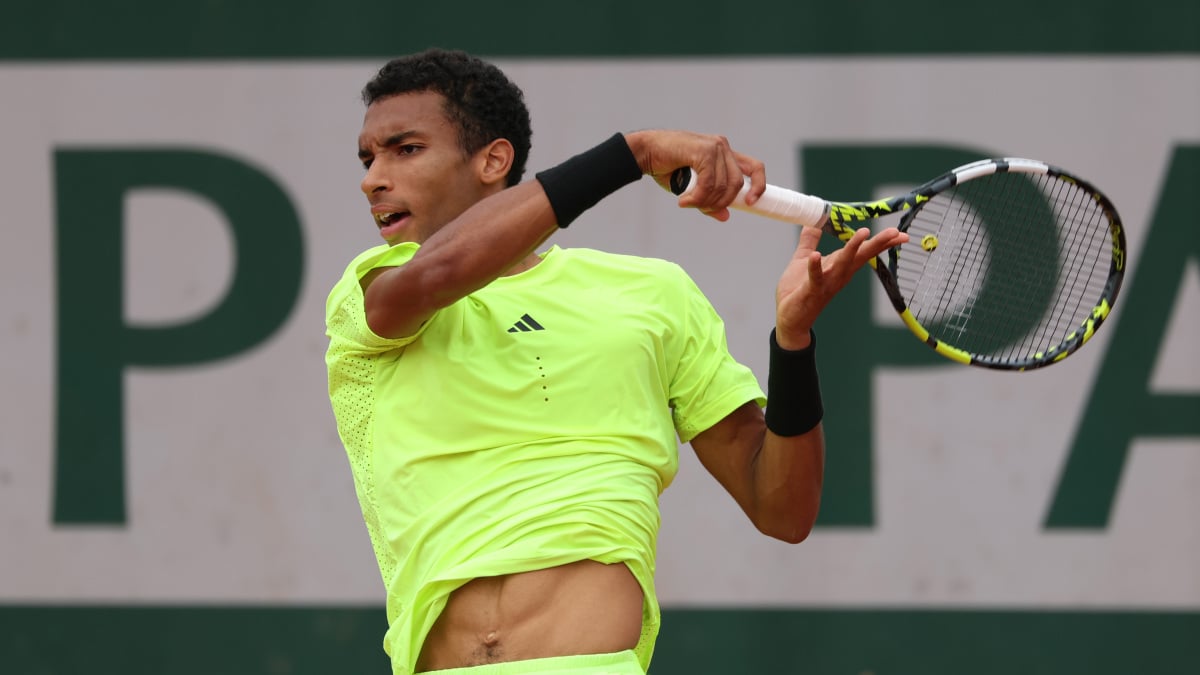




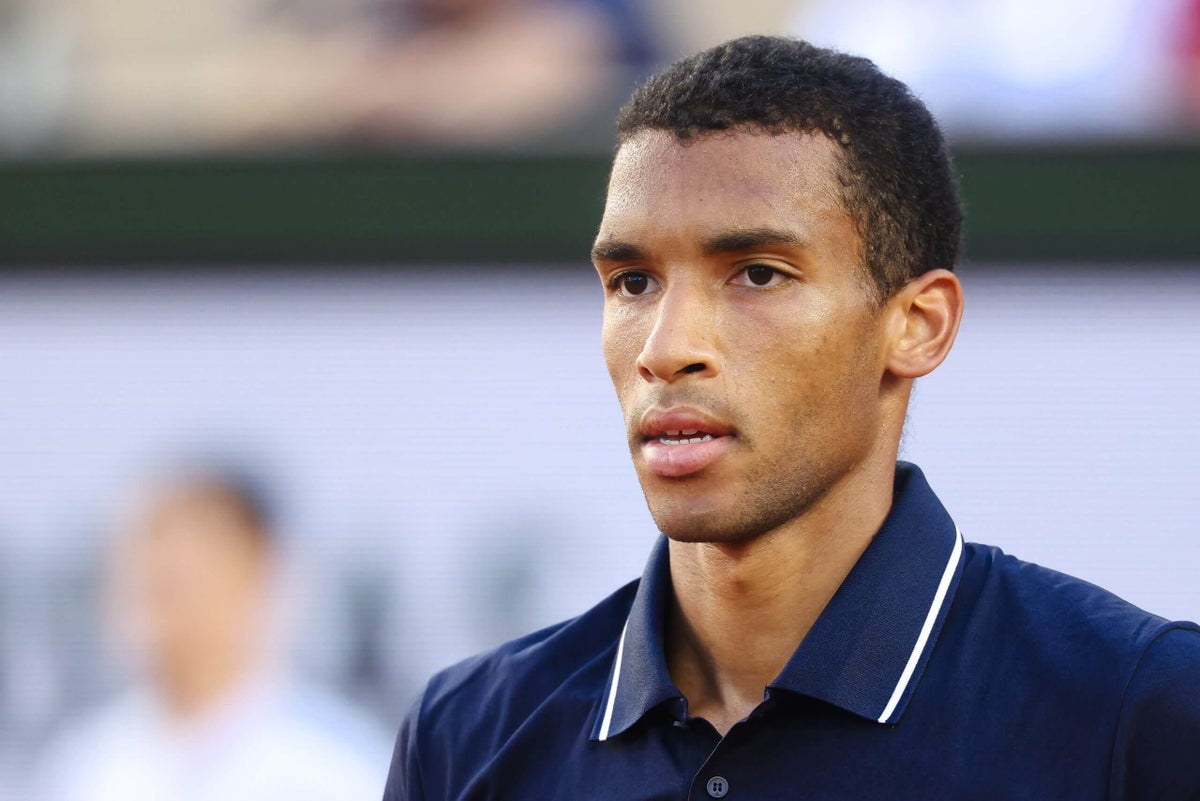
PARIS — At 25, Félix Auger-Aliassime is still on his way up. Just a couple years shy of the typical late-20s athletic peak for men, the Canadian is far from old.
He’s not young anymore though, especially in tennis terms. He’s played through his teenage years, as a possible next big thing. He’s gotten within shouting distance of the top of the tennis mountain, tumbled back down, and then climbed back up, all the way to a top-four seeding at this year’s French Open and a place in the world’s top five.
His first match, Tuesday evening against Daniel Altmaier of Germany, was a five-set saga. Auger-Aliassime clinched it in a match-deciding tiebreak, winning 4-6, 6-4, 4-6, 6-1, 7-6(7) after four hours, 16 minutes that captured the essence of a player desperate to become a mainstay at the top of the sport. Auger-Aliassime came back from a set down twice, and from down a break of serve final set. His mind had every opportunity to wander toward calling it a night and looking toward the grass, a surface far more hospitable to his power game.
Instead, he hung tough.
“I think it’s the first time that I’ve asked myself what player do I feel like?” Auger-Aliassime said of his career-high No. 5 world ranking in a news conference before the tournament.
“I am who I am. I believe I am a good tennis player. Obviously Carlos is not here, so that’s why I’m fourth seed and not fifth. I’m currently fifth in the world, and I’ve worked for my spot there.”
It’s a nice neighborhood. Three of the four people ahead of him are all-time greats: Carlos Alcaraz, Jannik Sinner and Novak Djokovic. The fourth, Alexander Zverev, is arguably the best active men’s player to have never won a Grand Slam, a three-time major finalist. It’s a pretty lofty spot.
Plenty of highly touted players have held it the past couple years before stalling there. Some of them have been to world No. 4, depending on their health or how much Djokovic was playing between Grand Slams.
Taylor Fritz. Jack Draper. Andrey Rublev. Lorenzo Musetti. Holger Rune. Ben Shelton. All of them are top players. All of them have run up against a seemingly impenetrable ceiling, tied to the top three’s domination of the Grand Slams and Zverev’s consistency in getting to their final stages.
Auger-Aliassime, who spent 2023 and 2024 managing a knee injury while Alcaraz, and then Sinner, staged a takeover, is far from giving up.
“He never lost the belief,” said Federic Fontag, the veteran coach who started working with Auger-Aliassime in 2017 and took on a full-time role in 2020.
Auger-Aliassime staged his first rise by playing the version of the sport he thought he needed to topple the likes of Roger Federer, Rafael Nadal and Djokovic. Since his first descent, he has learned that getting to the top in Sinner and Alcaraz’s version of tennis needs something different.
For Auger-Aliassime, it was yet another big ask in a lifetime full of them.
“I was kind of, you know, put with high expectations from 14, 15-years old,” Auger-Aliassime said during a recent interview.
Seven years ago, when Auger-Aliassime played a 20-year-old Stefanos Tsitsipas in the quarterfinals of Queen’s, the prestigious warm-up tournament for Wimbledon, former world No. 4 Greg Rusedski predicted that Auger-Aliassime and Tsitsipas would meet in 15 Grand Slam finals during their careers.
That prophesy has not aged so well.
Still, Auger-Aliassime is blessed with the physical gifts to excel at nearly any sport. His coaches say he has long approached tennis with a level of seriousness and discipline far beyond his years. He has long had one of the biggest serves in the game, and when he gets the chance to hit it, a huge forehand to follow it up.
He will need that and more to remain in his lofty position through the end of the season. The gulf between Carlos Alcaraz at No. 2 and Zverev at No. 3 is more than 6,000 rankings points. That’s three Grand Slam titles and change.
On Monday, Shelton moved 20 points ahead of Auger-Aliassime, to bump him to No. 6. Just 730 points separate Auger-Aliassime and Alexander Bublik at No. 10. With the draw at Roland Garros becoming more open by the day, there is likely to be a good bit of shuffling when the red clay settles on Court Philippe-Chatrier in 10 days’ time.
Fontag said the biggest threat to a player like Auger-Aliassime does not come from their peers. It’s all the quality lower down the ladder.
“If you are between 5 and 10 percent under your level one day, you can lose to the No. 60 or 70,” Fontag said
Auger-Aliassime hasn’t been in that zip code since 2019, but in early 2024 he was closer to world No. 60 than he was to world No. 5. He was getting dangerously close to entering that awkward existence of a player who is more famous and far better remunerated that his ranking suggests he should be.
Carlos Alcaraz dismissed Félix Auger-Aliassime 6-2, 6-4 at last year’s ATP Tour Finals. (Clive Brunskill / Getty Images)
A Canadian with French and Togolese heritage, Auger-Aliassime is the rare player with natural appeal on three continents. He has long had lucrative sponsorship deals with Adidas and Babolat, which are endemic to tennis. He recently renewed both. But Auger-Aliassime also has sizable deals with major companies whose products are only tangentially related to sports, including Rodgers Communications, the Canadian telecom corporation, and BNP Paribas, the multinational financial institution.
Those are far harder to get. Auger-Aliassime began working with the sport’s representation behemoth, IMG, ahead of the 2025 season. In March he became an ambassador for Polestar, the Swedish electronic automobile manufacturer.
Auger-Aliassime said he has “learned to be able to separate things where, ‘OK, the tennis I need to take care of, and then the deals and the attention and all the pressure that comes from the business side of things.”
The Polestar deal followed three hard years of figuring out how to manage a ligament tear in his left knee that had him hobbling around the court in 2023. He’d finished 2022 by qualifying for the ATP Tour Finals, the season-ending tournament for the top eight players of the season. By March of 2024, he’d tumbled to No. 36.
Auger-Aliassime never had surgery, but did receive stem cell injections to promote healing as he mostly played through pain for two seasons. At one point, with the improvement slower than everyone wanted it to be, Fontag offered to step back, or even leave.
“You need the relationship to be based on the truth and the reality and the needs,” he said. He wanted Auger-Aliassime to not blame everything on the injury. “We have goals. If there is no result where is it coming from? If I can’t bring it, we are bringing in expertise outside of mine.”
Auger-Aliassime’s game, which he has built around that big serve and forehand, thrives indoors. That has forced him to play a lot in tournaments and at times of the year when other top players take breaks, because those events give him his best chance to win.
That became especially complicated during the past three seasons, as Auger-Aliassime faced a trifecta of obstacles. He had to simultaneously manage his injury, the challenge of climbing back up the ladder while playing the top players far earlier in tournaments than he had gotten used to, and altering his game to fit the changing demands that Alcaraz and Sinner have put on the chasing pack.
He can remember being taught the fundamentals of building a point and waiting for opportunities, the way Federer, Nadal, Djokovic and Andy Murray all did in their prime.
“Amazing strengths, but they would kind of know when to use them,” Auger-Aliassime said.
“Roger would use a slice to mix things up as well, on grass, especially.
“All of this is used now, but it’s such a higher speed and such a higher level of efficiency. And the defense also has become not just defense. You’ll play Carlos and Jannik and you’re coming to the net and if you don’t approach really well, they might hit a passing shot that you don’t really have a play on.
”The speed is so much faster. You need to be so much more precise with that speed to put the opponent in a difficult position.”
As his knee improved, his serve and his overall explosiveness got back to where it had been and even a few clicks better, but the progress was gradual.
A telling Auger-Aliassime statistic is his tiebreak record, where serving well at a crucial moment becomes a difference-maker. He plays a lot of them, because his serve is hard to handle and his return game, especially on his backhand side, can be vulnerable.
In 2022, he went 60-27 and was 32-23 in tiebreaks. During the two injury-plagued seasons that followed he went, 52-44 and was 24-26 in tiebreaks. Last year he was 50-23 and 32-14 in tiebreaks. Tweaking that serve, trying to make it more accurate without losing velocity as he did when he was injured, has helped him gain confidence and, he thinks, instils more uncertainty in his opponents.
“It makes guys feel like if you play Félix it’s going to be a tough day because the best thing you’re going to do is beat me in tiebreaks,” he said. “If I play like that against a majority of players and I get broken against only a few of the best players in the world, I become very dangerous and consistent.”
Through last season, Auger-Aliassime gradually climbed the ladder. Then, at the U.S. Open, the draw delivered a matchup against Zverev, the No. 3 seed, in the third round. Auger-Aliassime was the world No. 27.
“It’s a key match because you win that big match and then you beat the third seed and all of a sudden, I’m in a position where I can win the fourth round, I can win the quarterfinals,” he said. “These are matches that are tough, but that are attainable.”
Auger-Aliassime was finally playing the way he wanted to play, using his strengths and being solid on the backhand side, but also waiting for the right opportunity, being disciplined, but also aggressive.
He beat Zverev in four sets, turning the match in a second set tiebreak. Then he beat Andrey Rublev in straight sets and Alex de Minaur in four, winning two of them in tiebreaks. He made Jannik Sinner work in the semis, winning the second set before losing the next two.
Then the fall indoor swing arrived with Auger-Aliassime in top form, serving in a windless environment and pounding balls through fast courts. He won the European Open in Brussels, lost the Paris Masters final to Sinner, and made the semifinals at the ATP Tour Finals to finish the year as the world No. 5.
Now comes the next climb up the mountain, starting with a second-round duel against Román Andrés Burruchaga, an Argentine who loves clay-court tennis and made the U.S. Men’s Clay Court Championships finals in Houston this spring. After a stodgy run of early-round exits, which followed a title at the Montepellier Open and a final at the Rotterdam Open, Auger-Aliassime is looking forward.
“I’m happy with how things have evolved,” Auger-Aliassime said. “Sometimes I wish it was a bit quicker, that I was getting the results that I wanted, but I know it’s going to come if I keep doing good work.”
Source link
See more: https://theglobaltrack.com/
https://corinthiames.com.br/