

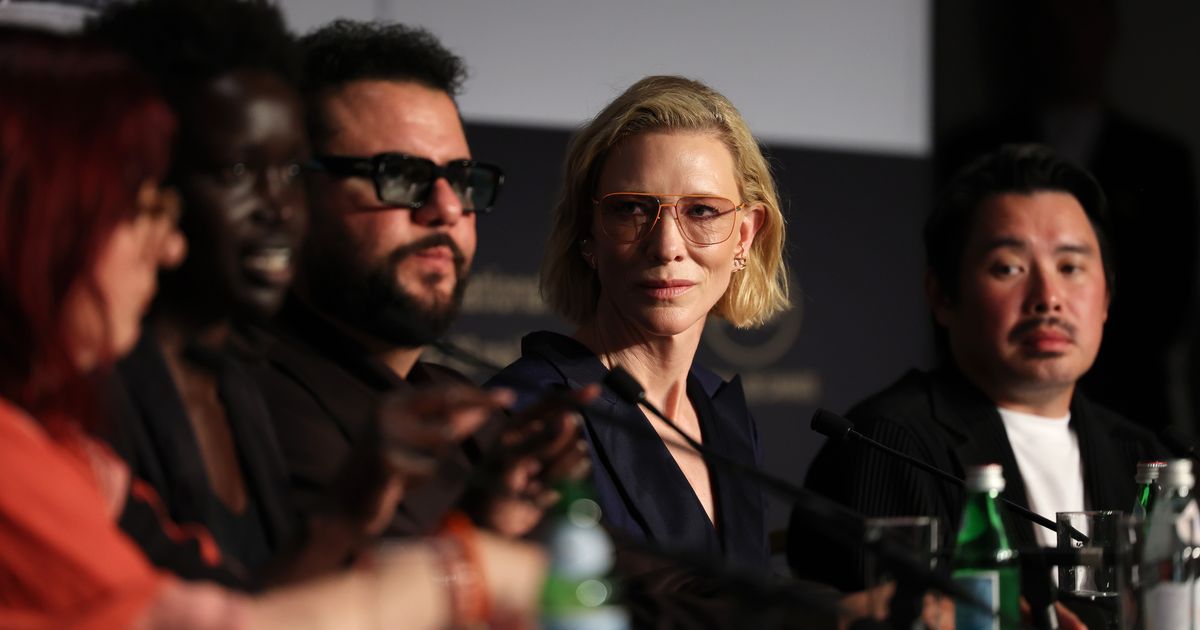
The actress co-founded the Displacement Film Fund, the initiative behind Mo Amer’s and Bao Nguyen’s next films.
Photo: Hoda Davaine/Getty Images
When I try to enter a room at the top of the Palais to interview Cate Blanchett, a Cannes Film Festival employee stops me. I explain that I’m here for an interview, and she looks at me with a distinctly French mix of pity and disdain that I have come to know quite intimately. “It is not possible,” she says, shaking her head. “It’s with Cate Blanchett,” I say. She immediately lets me through.
If merely speaking Blanchett’s name aloud carries enough weight to alter the inexorably random but iron-clad rules of Cannes, imagine how much weight it carries if you’re a filmmaker. That’s part of the idea behind the Displacement Film Fund, which Blanchett co-founded alongside the International Film Festival Rotterdam to champion and fund the work of displaced filmmakers or “filmmakers with a proven track record in creating authentic storytelling about the experiences of displaced people.” This week, Blanchett unveiled the year’s grant recipients: Mohammed “Mo” Amer, Annemarie Jacir, Akuol de Mabior, Bao Nguyen, and Rithy Panh.
A day after her delightful chat at the festival, where she talked about everything from Carol to Tár to a long fable about assholes that was once told to her by Guillermo del Toro, I sat down with Blanchett — clad entirely in off-white, including a pair of platform loafers — to talk about the fund as well as follow up on some of the above. We were accompanied by Vietnamese American filmmaker Nguyen, whose film How to Ride a Bike follows a Vietnamese dad who never learned to ride a bike but, after a failed attempt to teach his son to do so, begins learning in secret, and Amer, the Palestinian American comedian, writer, and director behind Mo on Netflix, whose new project Return to Sender follows a Palestinian stand-up and refugee who experiences progressively senseless immigration restrictions while on a global tour.
I love those shoes.
Cate Blanchett: Oh, thank you. I’m impressed that they’re still relatively white. It’s a real achievement. I think they’re Sanderson. Very comfortable. I had heels on before and I got out of them. I was like, I can’t do it anymore.
What conversations were you having that led to you starting this fund?
C.B.: Well, a group of us were at the Global Refugee Forum: Ke Huy Quan, Echo Quan, Ayman Tamer, Koji Yanai, and Isaac Kwaku Fokuo. Each table was asked to make a pledge. Koji had just produced Wim Wenders’s Perfect Days, and there was an Afghan former refugee who’s an educator and activist who was telling us about her stories, and it was incredible. I said, “Why don’t these stories make it more into the mainstream? More documentary, more features?” So we thought, Why don’t we make our pledge to the room? We will find a way, as our table, to champion and fund and highlight the work of displaced filmmakers. Because in displacement, you don’t stop being a filmmaker.
That was the genesis of the idea, and we set about getting support. I’m old friends with Clare Stewart, who runs Rotterdam, so I spoke to them and it was very much in line with their mission. It just seemed there was a synergy between all of these big public organizations but also private individuals, corporate partners, and filmmakers. We thought, We’ll treat it more like a small version of the MacArthur Genius Grants. It’s not thrown open for wide submissions. We really wanted to make sure we were supporting midstream experienced filmmakers, presumably who wanted to get their stories into the main frame, and not to ghettoize them. And the guys at Film Forum have kindly offered to host the first cohort and have a qualifying round and a week of screenings in New York sometime in the fall.
Why these filmmakers, and how did you let them know they were selected?
C.B.: We had a two-stage process. There’s a nominations committee and a selection committee. This year we had Agnieszka Holland, Barbara Broccoli, Ke Huy Quan, and Jonas Rasmussen, who made Flee. We had a long list and then it rapidly became a much shorter list, and we prayed that the five selected filmmakers were available.
Mohammed Amer: I said “no.” I was like, “Just stop calling.”
C.B.: Lots of fruit baskets.
M.A.: No, I got the call and clearly I’m a big fan of Cate’s work. It became an easy “yes” to cram it into my life. It’s one of the most important things I’ll do this year. You’re leaving behind a body of work that hopefully inspires others that are trying to break through as well. To be part of this collective is an absolute privilege. When she called, I was like, “I’m in.”
Bao Nguyen: We have a mutual friend, Ke Huy Quan, who’s an amazing friend and artist and comes from a Vietnamese refugee experience. I’ve always been trying to find a project to work on with him, but he’s the busiest guy in showbiz after winning an Oscar for Everything Everywhere All at Once. We’ve been yearning to tell this story of the Vietnamese American experience in a more nuanced way, not just as, like, boat people or through the lens purely of the war. When he told me he was talking to Cate about this initiative, I had all these stories floating around in my brain and this year they asked me if I was available. I planned the schedule of the film: Finish shooting by August, give the footage to my editor, get married, and they can come back with a rough cut while I’m gone.
M.A.: He’ll use the funds for his honeymoon.
B.N.: I promised my fiancé I wouldn’t be working … But it’s sadly rare to get the opportunities to tell these deeply personal stories with a lot of agency and little restraint, to have the financing and support of an artist I admire so much like Cate. I’m always trying to negotiate that too — trying to have impact and what that means. Maybe I’ll move my wedding if I need to.
C.B.: Just change the pitch to a wedding film.
Cate, yesterday at your talk you spoke about a tool you’ve co-founded that helps artists consent, or not, to usage of their work for AI. I’m curious what your own personal level of consent for AI is.
C.B.: Yes, RSL Media. Look, I’m not AI-phobic. I have respect for it as a tool, but it needs to be treated with caution. Now we’re at a point where the use of AI — and you guys might be interested in using it in your filmmaking — that there’s an inevitability. But the issue that isn’t resolved, apart from guardrails, is the issue of consent and transparency. RSL Media provides a machine-readable way to activate and express consent. “I’m about to take your image, are you okay with that?” I’m okay with saying, “Yes, you can have it, but you need to speak to this rep or this lawyer, and we can negotiate it.” I’m okay with an exchange. But stealing isn’t negotiation.
You also said something that made me laugh about how you still have moments where you wake up at 3 a.m. and stare at your wardrobe and think about killing yourself rather than going to work. When was the last time you felt that way, and how do you get yourself out of it?
C.B.: [Long pause.] Xanax. Gummies. I usually poke my husband awake the night before and go, “What’s my process?!” He says, “You’ll be fine.”
M.A.: Did somebody say gummies?
C.B.: Look, the world is an anxiety-making place at the moment. There’s a lot of people waking up at 3 a.m. But when you have an idea about something, and a whole lot of other people adhere to that idea, it’s really enlivening. I was with someone the other day who said, “We can’t just have hope. We have to have hope with its sleeves rolled up.” So it’s like you’re looking at the wardrobe, and you’re thinking, It’s gonna be now, but you have to have hope. Not in a Pollyanna-ish way. There’s much to do. Get on and do it. The act of doing, collectively, you gain strength. The next night you sleep a little better.
It was nice to hear that even you still feel like you have no idea what you’re doing.
C.B.: Oh God, yeah. I’m breathing into a paper bag.
M.A.: I say this all the time but making season two of Mo, I feel like I died and was reborn several times. It’s part of making great art — it’s part of living — juggling all of these things.
C.B.: It’s when the stakes are high, the anxiety is high. We all want to work with high stakes, because then you’re risking something. If you’re not risking anything, everything tastes like rehydrated potatoes.
I loved your story yesterday about the asshole …
C.B.: I was clearly on mushrooms. I do draw strength from the other people that I work with because I thrive on different points of view. I’m not conflict-averse. Someone asked me a minute ago, “What happens if your partners have different opinions?” And I’m like, “That’s great! Let’s talk about it.”
How involved are you personally in these films?
M.A.: She’s writing the whole thing. She doesn’t know it yet.
C.B.: Part of the caveat was that there had to be a role for an aging white actress [laughs] in your displacement narrative. No, we’ve talked a lot about creative freedom. They all come with their producing partners and we’re here to help when they need.
B.N.: It’s so rare to be given that freedom. I enjoy the challenge of that agency and having that prompt — “You’re from a displaced community. That’s it. You don’t have to emphasize it as a theme.” Given that sort of canvas, what do I think is a story that hasn’t been told before?
Another topic in the air right now is the strange lack of Hollywood and studio films at Cannes this year. What do you make of that?
C.B.: Having been inside the festival — I presided over the jury — and having been here with films many times, you get a sense that themes emerge. But not consciously. They see thousands of films, and they know it’s a very exposing platform. They want the films to be able to thrive here, and they want them to be able to speak to one another. Every iteration has its own character. I don’t think it’s by design. It’s just shaken out that way. There’s a lot of Japanese and Spanish films this year. I saw James Gray’s film the other night — I’ve only had a chance to see that and Hirokazu Kore-eda’s films — and I thought Paper Tiger was beautiful. America should be proud.
B.N.: Cinema is still breathing and alive when you come to a place like this. When people ask me about the industry, I’m like, “Come to Cannes, watch a movie! Clap for six minutes!” That’s all the energy I need to fuel me for the end of the year.
Thierry Frémaux said Hollywood had been “quiet.” Does it feel that way to you? Fewer roles or good scripts?
C.B.: It feels people are risk-averse. But there’s a lot of filming in the U.K. and Central Europe. I think some people are nervous to activate production in certain parts of America because there’s a federal war on some of the states that are not adhering to the administration. But there are also a lot of films happening at certain lower-budget points. We’re a very resilient, inventive industry. I think a lot of these complicated conversations, like around AI and displacement, happen in our industry first. It’s just that we thrash it out in public and people think, Oh, you’ve got a lot of problems there! And of course we do. The creative life is full of problems.
You have two highly anticipated projects, at least. The Brady Corbet film and the Martha Stewart biopic. Have you spoken to Martha yet?
C.B.: No! We haven’t met yet. But I’m a drooling fan. I find her life and her impact and her outlook absolutely compelling. We’ve got a great script and we’re working with that now. But it’s early stages.
And The Brutalist was made for 9 million bucks. Brady Corbet is very adamant on making films where he won’t give up any control. The bigger the budget you have, the more caveats and unhelpful voices it comes with.
M.A.: Sure. My series sometimes felt that way. There were a lot of pressures, and you’re working with different partners, A24 or Netflix. And those are just normal parts of that collaboration. Everyone has an opinion and thoughts. This is what makes this so unique — that I could do something completely unhinged. Do whatever I want and really put it out there and hopefully it makes an impact. And when you’re dealing with this kind of budget, you have to get inventive and call in favors. I remember I was having a discussion with a director once about money and what I wanted to make, and he goes, “You know, we love this thing so much, they’d know we do it for free. So maybe sometimes they take advantage of that.” It’s true. Telling stories is in my bones. It’s not about the money. It’s making something special, that then in turn makes you popular and then in turn gives you fame and money.
C.B.: So you can buy a pair of glasses like the ones you’re wearing now.
M.A.: [Laughs.] Yes, of course. I want to look good.
What’s something people would be surprised to learn about Cate?
M.A.: How witty she is. Over texts and stuff, she’s hilarious. I didn’t expect it. When you get the call, [affects a British accent] “Cate would like your number.”
C.B.: Why were they speaking in that voice?
M.A.: When I read your texts, that’s how I read them.
Source link
More: https://theglobaltrack.com/
https://corinthiames.com.br/