



Oil prices fall to two-week lows
Oil prices hit two-week lows on Monday on optimism that the US and Iran were moving closer towards a peace deal even though they remained at odds over key issues, including blockades on the strait of Hormuz that continue to restrict oil supply from the Middle East.
Brent crude futures fell $4.71, or 4.55%, to $98.83 a barrel by 2234 GMT, while US West Texas Intermediate was at $92.03 a barrel, down $4.57, or 4.73%.
Both contracts touched their lowest points since 7 May earlier in the session, Reuters is reporting.
Key events
Continuing with financial news, the US dollar slipped at the start of Asian trading on Monday as hopes of a deal reopening the Hormuz strait pushed oil prices below $100 a barrel, even as the Trump administration played down the chances of reaching an agreement with Iran soon.
Against the yen, the US dollar was down 0.2% at 158.87 yen, while the euro rose 0.3% to $1.1642 and the British pound gained 0.4% to $1.3485.
Many global markets are closed for holidays on Monday, thinning liquidity across the region.
Reuters also reports that the Australian dollar advanced 0.4% to $0.7160, while New Zealand’s added 0.5% to $0.5877.
Oil markets tumbled, meanwhile, with Brent crude prices falling 5.1% to $98.29 a barrel and US West Texas Intermediate down 5% at $91.76 a barrel.
Traders expressed cautious scepticism over whether a peace deal would stick.
“Markets have become conditioned to be incredibly patient on a tangible breakthrough, but the base case of a deal remains firm, with the weekend news providing further conviction, even if the timing remains unclear,” said Chris Weston, head of research at Pepperstone Group Ltd in Melbourne.
In line with with predictions, Japan’s Nikkei share index has jumped amid hopes for a deal to end the Iran war and reopen the strait of Hormuz.
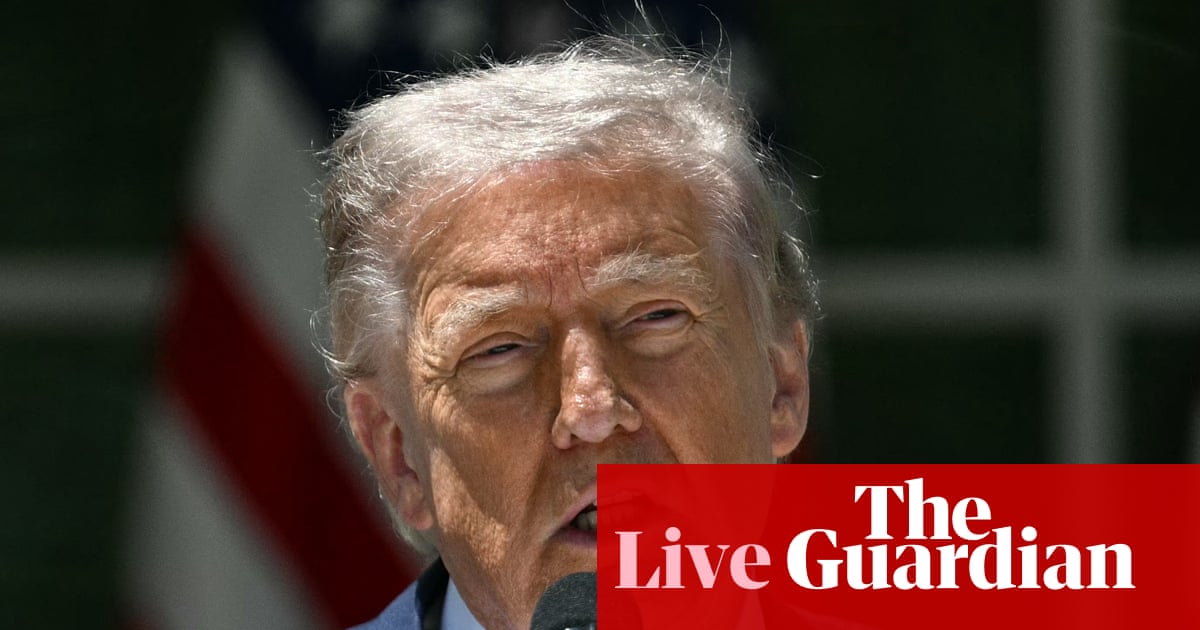
It rose more than 3%, although Donald Trump has told his negotiators “not to rush into a deal” with Tehran.
Around 0145 GMT the Nikkei 225 was reportedly up 3.2%.
Iran supreme leader holed up in undisclosed location – report
US intelligence shows that Iran’s supreme leader is effectively holed up in an undisclosed location with little access to the outside world and is reached only by a labyrinth of couriers, CBS News is reporting, citing US officials.
The Iranian officials authorised to work with the Trump administration have been having a difficult time communicating inside of their own government system – and it’s a central reason why the details of a potential deal with Iran and past agreements have been slow to emerge, the report says.
When the US sends proposed details, the difficulty in reaching supreme leader Ayatollah Mojtaba Khamenei means there can be a long delay before the US receives a response, CBS quotes two of the officials with knowledge of the matter as saying.
A White House spokesperson declined to comment on intelligence on Khamenei’s whereabouts or Iranian communication methods, the report says.
It quotes a senior Trump administration official as saying on Sunday that Khamenei had “agreed to the contours of the current draft agreement”.
Khamenei – who was injured in the US-Israeli strikes that began the war in late February – “is taking extreme measures to avoid the strikes similar to the ones that killed his father”, former supreme leader Ayatollah Ali Khamenei, the report says.
Mojtaba Khamenei has not been officially seen or heard in public since before the war started, it says.
In case you missed this earlier, Donald Trump has had to defend himself against criticism from fellow Republicans over the potential Iran deal after news of it dismayed party hawks.
As they called it a disaster and questioned why the US president launched the conflict in the first place, Trump claimed on social media that his nuclear deal with Tehran would be “the exact opposite” of the one agreed by Barack Obama, which Trump pulled out of in 2018.
The 2015 deal limited Iran’s nuclear enrichment in return for sanctions relief.
Trump announced on Saturday US time that a peace deal with Iran was “largely negotiated” and that the “final aspects and details” of a memorandum of understanding were still being discussed and “will be announced shortly”, with the strait of Hormuz reopening as part of the deal.
But as Patrick Wintour reports, Trump said the following day that he was not rushing into a deal, and that “both sides must take their time to get it right … There can be no mistakes!”
The president also insisted “the US blockade of Iran’s ports will remain in full force and effect until an agreement is reached, certified, and signed”.
“Nobody has seen” the deal “or knows what it is”, the US president later added. “It isn’t even fully negotiated yet. So don’t listen to the losers, who are critical about something they know nothing about.”
Facing the mounting criticism from inside his own party, Trump insisted: “I don’t make bad deals!”
Australian members of a flotilla that tried to deliver aid to Gaza have been welcomed home in emotional airport scenes after being freed from detention in Israel.
Eleven Australians were among 400 people detained by Israel last week in international waters west of Cyprus.
The broader group of flotilla participants allege they suffered abuse at the hands of Israeli forces, such as broken limbs, sexual assaults, tasers to the face and being injected with unknown substances.
Seven of the Australian contingent arrived in Sydney on Monday morning, while the rest were due to arrive in Melbourne and Brisbane, reports Australian Associated Press.
Walking out into a Sydney airport hall, the flotilla participants returned triumphant with fists and peace signs held high.
A large contingent of supporters – including family, friends and federal senators – greeted them on arrival with rapturous applause and chants of “free, free Palestine”.
The Israeli ambassador to Australia, Hillel Newman, has claimed the detained flotilla members were handled with “great sensitivity”. He rejected claims of violence and sexual abuse.
As well as oil prices falling, US stock futures rose on Monday at the prospect of a deal to end the Iran war, although uncertainty over when the strait of Hormuz would open kept enthusiasm in check.
Nasdaq futures were 0.89% higher and S+P futures were up 0.6%.
Nick Twidale, the chief market analyst at ATFX Global, expected the market to embrace more risk on Monday but not to surge higher until there was confirmation the Hormuz strait would reopen.
He said:
We will need to see an agreement out in place in the coming sessions as we know there are still some major sticking points.”
Reuters also reports that Japan’s Nikkei was poised for a strong start to Monday’s session. The most important issues for financial markets are when the Hormuz strait would reopen, Commonwealth Bank of Australia strategists said in a note.
Oil prices fall to two-week lows
Oil prices hit two-week lows on Monday on optimism that the US and Iran were moving closer towards a peace deal even though they remained at odds over key issues, including blockades on the strait of Hormuz that continue to restrict oil supply from the Middle East.
Brent crude futures fell $4.71, or 4.55%, to $98.83 a barrel by 2234 GMT, while US West Texas Intermediate was at $92.03 a barrel, down $4.57, or 4.73%.
Both contracts touched their lowest points since 7 May earlier in the session, Reuters is reporting.
Iran has indicated its reported understanding with the US to halt the regional war would include Lebanon, but Israeli prime minister Benjamin Netanyahu said on Sunday that Donald Trump had reaffirmed his support for Israel’s right “to defend itself against threats on all fronts, including in Lebanon”.
Israel’s military chief, Lieut Gen Eyal Zamir, said that “we continue to strike Hezbollah across all dimensions … the security of civilians and the safety of our forces remain paramount”, a statement cited by AFP said.
The nominal ceasefire between Israel and Lebanon – brokered by the US – was recently extended by 45 days.
Israeli strikes pounded south and east Lebanon on Sunday despite a ceasefire as Hezbollah’s chief expressed hope for an agreement between Iran and the US to end the Middle East war that includes Lebanon.
Lebanon’s health ministry said two people including a paramedic from the Hezbollah-affiliated Islamic Health Committee were killed on Sunday in Israeli raids.
The ministry raised the overall toll in the war since 2 March to 3,123 killed, AFP is reporting.
A day earlier 11 people including six women and a child were killed in a single strike in the south’s Sir al-Gharbiyeh, the ministry said on Sunday, decrying a “massacre”.
Israel’s military has continued to hit what it says are Hezbollah targets in Lebanon despite a nominal ceasefire since 17 April.
The Iran-backed Hezbollah, meanwhile, claimed more than 20 attacks on Israeli troops in southern Lebanon on Sunday.
As reported earlier, Hezbollah chief Naim Qassem said he hoped the agreement between Iran and the US would be finalised and “accordingly that we too will be among those included in this agreement” on a full cessation of hostilities.
US-Iran deal: Still waiting on details, US accused of dragging its feet
As we move into Monday morning in Tehran, the world is still awaiting further details about the evolving US-Iran deal. But the longer we wait, the more likely it seems there are still differences between the two countries.
Here’s what we know so far:
-
The US and Iran deal is not expected to be finalized today, according to multiple sources, with more still needing to be ironed out. US secretary of state Marco Rubio told the New York Times an agreement with Iran had garnered regional support but a nuclear deal couldn’t be achieved “in 72 hours on the back of a napkin”. His comments came after Donald Trump told his negotiators “not to rush into a deal” with Iran to end the three-month war.
-
Trump confirmed on Sunday that talks are still ongoing. “It isn’t even fully negotiated yet. So don’t listen to the losers, who are critical about something they know nothing about,” he posted on Truth Social. “Unlike those before me who should have solved this problem many years ago, I don’t make bad deals!”
-
Similarly, Trump spoke on the phone with various Arab and Muslim leaders on Saturday. During the call, he encouraged the leaders to sign on to the Abraham Accords, according to Axios, and establish diplomatic relations with Israel. The Arab and Muslim leaders were surprised by the US president’s request and stayed silent on the call, prompting Trump to jokingly ask if the leaders were still there. Currently, Saudi Arabia, Pakistan and Qatar do not have diplomatic relations with Israel.
-
Reports suggest that Israel is pressuring the US government to take some hardline stances while it continues to negotiate with Iran. Drop Site News reported that a senior Iranian official said Israel is attempting to undermine parts of the deal. “We hope that the US administration will make its decision independently of external influence and in favor of the broader collective interests of all parties involved,” the official reportedly said.
-
Despite posturing by the US over the weekend, Iran’s Tasnim News Agency said the US government is not budging on some clauses of the agreement, including with the issue of releasing frozen Iranian assets. An Al Jazeera English reporter said today the ceasefire in Lebanon has also become a sticking point, with Israel pushing the US to include language in the deal that would allow for further Israeli military operations in Lebanon.
-
Rubio scolded a BBC reporter during an event in India this Sunday. The reporter asked Rubio about a deadly strike on a school in Iran that killed 120 schoolgirls on the first day of the war on Iran, pressing the secretary of state whether it was “reckless”.
The liberation of frozen assets belonging to Iran have become an important part of the US-Iran negotiations, with Iran pushing for an unfreezing of assets worldwide.
But why are countries around the world temporarily holding onto Iran’s assets?
Since 1979, sanctions on Iran have crippled its economy. Throughout the years, the justification for US-imposed sanctions has shifted. At first, the US sanctioned Iran due to the 1979 hostage crisis. But in recent years following, sanctions have been amplified over the country’s nuclear program.
The sanctions placed on Iran have prevented the country from accessing its assets, like money from oil sales, frozen by various countries.
Multiple different countries are holding Iran’s frozen assets, including Japan, Iraq, China, India and the US. Experts estimate the frozen Iranian assets are worth around $100bn.
When the US-Israel war on Iran began, Iran pushed for assets to be released before any negotiations could begin.
Now, the unfreezing of those assets seem to be key parts of the negotiations between the US and Iran. Various reports claim that the unfreezing of assets has become a sticking point in the negotiations.
Source link
More: https://theglobaltrack.com/
https://corinthiames.com.br/