



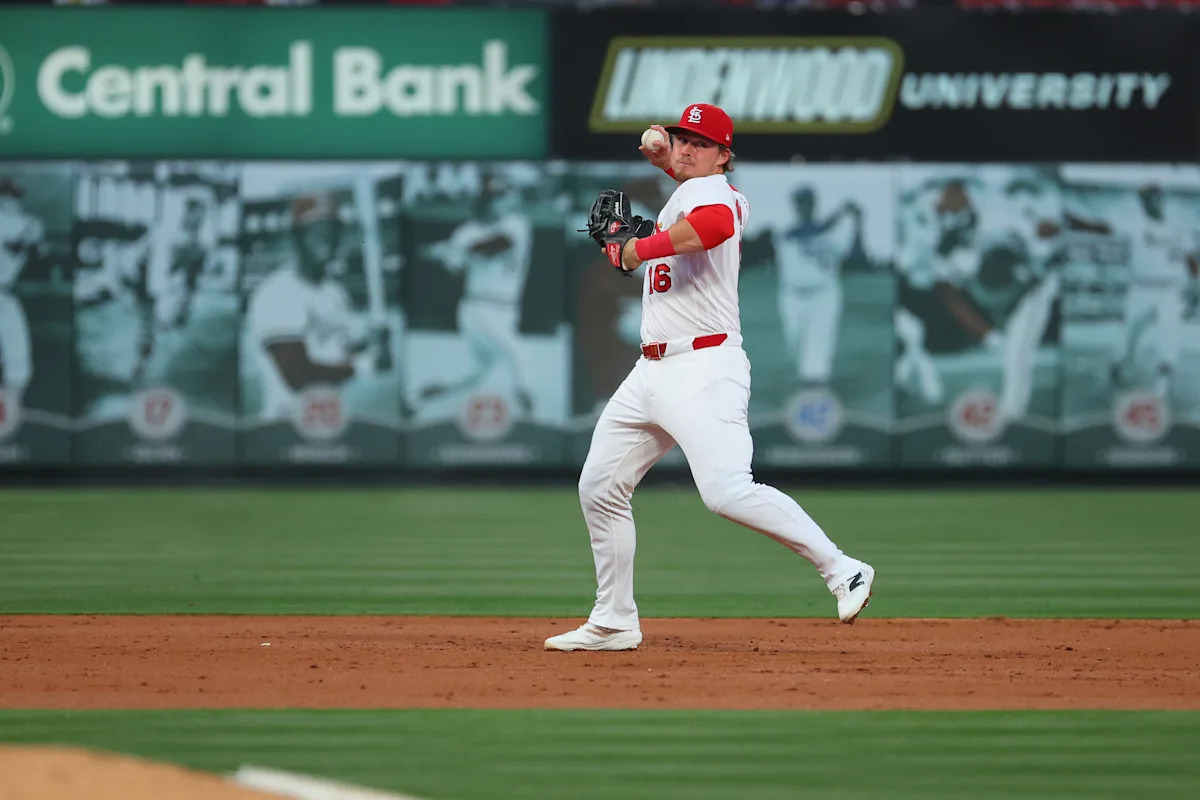
In the comments, when discussing Jordan Walker, Memphis Myke wondered if it mattered that Jordan Walker had minimal protection in the lineup, since he’s followed by Nolan Gorman. Who hasn’t really hit at all this year. Gorman does have a surprisingly high number of RBIs though considering his poor hitting thus far. He has 18 RBIs in 29 games. And not that he’d play in 162 games, but that’s 100 RBIs over a full season.
Breaking news: RBIs don’t tell you how good a hitter is. Also Gorman driving in runs has not a lot to do with protection as it pertains to Jordan Walker. Pitchers don’t see Gorman on deck and see the RBIs and think “well now I have to pitch to Jordan Walker.” They see the .214 average, the .357 slugging, and the 79 wRC+. You’d rather face him than Jordan Walker.
Advertisement
I instinctively said that protection is a myth. I read an article years ago on this very site that looked at the performance of the #2 hitters in front of Albert Pujols, and they didn’t really play much differently in that spot than in other parts of the lineup. I could not find that article. I did find an article by Tom Tango, however, talking about protection.
And his conclusions were indeed that pitchers pitched a little differently to hitters if there was a strong hitter behind them versus not. If you have a weak hitter behind you, they will probably pitch around you. Both BB% and K% increase with a weak hitter. Interestingly though, if you actually make contact with the ball, there’s no difference. What he terms a protected hitter is not seeing better pitches to hit. Pitchers still don’t want to give a good hitter a pitch to hit, and it doesn’t matter how good the hitter is behind him.
The entire point of protecting a batter is to improve his offensive output (wOBA) by forcing the opposing pitcher to pitch to him. And indeed, we saw above that opposing pitchers pitch to protected hitters, something that is evidenced by the fewer walks. However, when the ball is put into play, we see no significant difference between how the two sets of hitters perform. The unprotected hitters have a wOBA of .395 (counting only balls that are hit), compared with .391 for protected hitters. The difference of .004 is not statistically significant.
…..
However, what we hoped to find was that, when pitchers pitch around the corners, batters tend to make worse contact (if they make contact at all). And we don’t see this. Instead, we again find that, if walks are ignored, the two types of hitters perform equivalently in wOBA. (The slight increase in strikeouts is compensated by a slight increase in the fraction of balls hit well when contact is made.) In short, we simply cannot find any evidence to suggest that the pitcher’s approach has any significant impact on the batter’s stats, aside from the obvious changes in walks and strikeouts.
So a couple of interesting takeaways here. The good news is that it doesn’t seem like the hitter behind him matters at all when it comes to contact quality. His batted ball data should not be affected. His overall performance should be the same. But it could also explain the strikeouts and the higher walk rate this season. Again though, pitchers saw what Jordan Walker was doing, and then adjusted the way they pitched to him. This had nothing to do with a weaker hitter behind him. If prime Albert Pujols was behind him, they’d try their best to avoid Walker hitting the ball.
Nolan Gorman’s defense
In an interesting twist, the early returns on Nolan Gorman’s defense are very, very good. Unsustainably good certainly. But if he’s good on defense at 3B, then he’ll have an MLB job for quite a while, even if it doesn’t end up being on the Cards. A defense-first 3B who once jacked 27 homers? Yeah that guy would get lots of chances. Of course, we don’t know if he’s actually a good defender. Way too small of a sample size.
Advertisement
But, just to illustrate the importance of him being a good defender, I wanted to present what a +5 defender at 3B looks like with different offensive outcomes. Last year for example, it could have been the yips, but he was -6 OAA in 410 innings. The offensive bar is quite high if your defense is that bad. It would take a lot of faith in Nolan Gorman the hitter that I just don’t think people have.
But maybe he can reach a much lower bar and maybe if he does reach that, he still has a frustrating way to be an average overall player. Hey these are the kinds of things that we need to find out. Prior to last season, he had a combined 126 innings at 3B in the majors. Then, like I said, I think something mental was going on, because he kept throwing it wildly off, and that’s not been an issue this season. He has pretty much passed the eye test, and certainly it’s obvious how much better he is than last year. It’s not like we’re seeing the same thing and getting wildly different results.
So I will present a few different outcomes just to illustrate the importance of him actually being good on defense. I’ll show you Gorman as 85 wRC+ hitter, which would be a career low, as a 95 wRC+ hitter, a 105 wRC+ hitter, and just for fun a 120 wRC+ hitter. And we’ll see how each of those hitting lines work with a -5 defender at 3B, a neutral defender at 3B, and a +5 defender at 3B. We’ll start with more or less worst case scenario:
85 wRC+, -5 defender = 0.5 WAR (per 600 PAs)
Advertisement
95 wRC+, -5 defender = 1.2 WAR
105 wRC+, -5 defender = 2 WAR
120 wRC+, -5 defender = 3 WAR
Not ideal, although I will point out he doesn’t need to be an especially good hitter to still be average here. My faith in Nolan Gorman the batter is not very high, but a 105 wRC+ isn’t crazy to imagine for me. He’s done it twice in his career. That said, not a super appealing profile here. Gorman won’t get 600 PAs if he’s a 105 wRC+ hitter and a bad defender, so he wouldn’t reach 2 WAR. Let’s take the conservative approach, probably what we’re “supposed” to do in this situation, assume an average defender:
Advertisement
85 wRC+, 0 defender = 1 WAR
95 wRC+, 0 defender = 1.8 WAR
105 wRC+, 0 defender = 2.5 WAR
120 wRC+, 0 defender = 3.6 WAR
Again, remember where Gorman was at last year. I would have for sure taken it if you could guarantee me Gorman was an average defensive 3B. With this version, predictably, his offense dictates how good he is. Below average hitter, he’s more of a bench player. Average or better and he’s a starting caliber player.
85 wRC+, +5 defender = 1.6 WAR
95 wRC+, +5 defender = 2.3 WAR
105 wRC+, +5 defender = 3 WAR
120 wRC+, +5 defender = 4.1 WAR
And the best case scenario is he’s a genuinely good defender, because even the career low wRC+ is a solid sub, if not necessarily someone you want as your starter. If he gets close to average offensively, he is solidly in above average player territory. And if we combine that with good hitting, then he’s either a great trade candidate or someone you hold onto.
Advertisement
My approach to Gorman turned into “trade him even if he breaks out” because I didn’t trust him to maintain his production. If he’s a good defender, this does change somewhat. He goes from fool’s gold to a high floor guy who might hit 40 homers one year. If I have to bank on him being a good hitter, I’m not a fan. If being a good hitter is just a bonus, then I can roll with that. Doesn’t even matter if it’s unlikely he becomes a good hitter.