




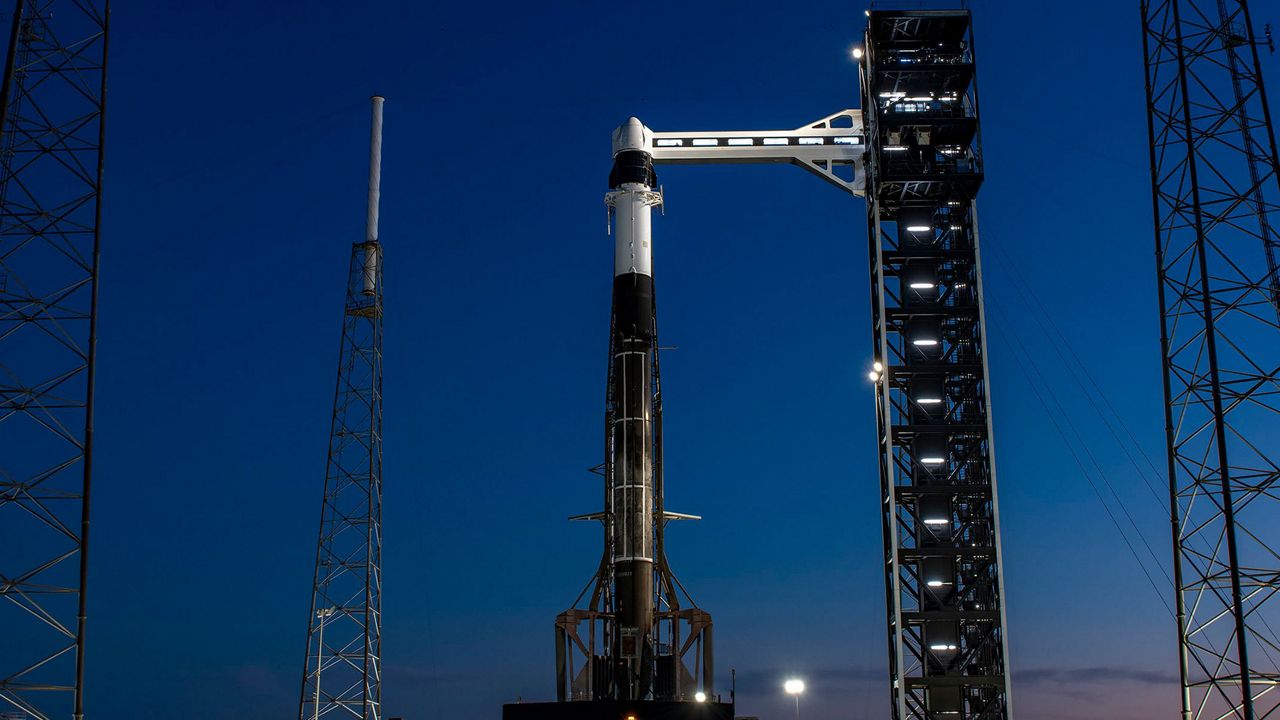
CAPE CANAVERAL SPACE FORCE STATION — It was not a surprise that poor weather forced SpaceX to scrub its launch of a NASA resupply mission to the International Space Station on Tuesday.
What You Need To Know
- The CRS-34 mission will send about 6,500 pounds of cargo and experiments
- Some of the experiments include medical and how planets are formed
SpaceX still plans to send up its Falcon 9 rocket with the CRS-34 (commercial resupply services) mission from the Cape Canaveral Space Force Station’s Space Launch Complex 40, stated the company.
But it will not be Tuesday night, where there was going to be an instantaneous launch at 7:16 p.m. ET.
“Teams stood down from Tuesday’s launch opportunity due to forecasted inclement weather around Space Launch Complex 40 at Cape Canaveral Space Force Station in Florida,” stated Jimi Russell, a NASA public affairs officer, in an email to the press.
For the Tuesday night launch attempt, the 45th Weather Squadron gave a 35% chance of good liftoff conditions. The main concerns against the launch were the cumulus cloud, anvil cloud and surface electric fields rules.
The next attempt will be Wednesday at 6:50 p.m. ET.
The squadron is giving a better forecast prediction for Wednesday, with a 60% chance for go.
There are concerns about Wednesday’s launch: the cumulus cloud, anvil cloud, and flight-through-precipitation rules.
Going up
This will be the sixth mission for B1096, the name of this Falcon 9’s first-stage booster.
After the stage separation, the first-stage booster will land on Landing Zone 40, very close to the launch pad. So, do not be surprised if you hear a sonic boom.
The Dragon spacecraft is expected to autonomously dock with the space station’s Harmony module at around 7:35 a.m. ET, Thursday, Russell confirmed.
About the mission
The Dragon will be carrying about 6,500 pounds (2,948 kilograms) of cargo to the International Space Station, confirmed NASA.
The U.S. space agency shared some of the experiments and technology that are part of the cargo.
In addition to cargo for the crew aboard the space station, Dragon will deliver several new experiments, including a project to determine how well Earth-based simulators mimic microgravity conditions, a bone scaffold made from wood that could produce new treatments for fragile bone conditions like osteoporosis, and equipment to evaluate how red blood cells and the spleen change in space to protect future astronauts. The Dragon spacecraft also will carry a new instrument to study charged particles around the Earth that can impact power grids and satellites, an investigation that could provide a fundamental understanding of how planets form, and an instrument designed to take highly accurate measurements of sunlight reflected by Earth and the Moon.
The Dragon will be at the International Space Station until mid-June, when it will undock and return to Earth with cargo and research.