



When theoretical physicist David Gross was 13, he received a copy of a popular science book, “The Evolution of Physics” (Cambridge University Press, 1938), signed by Albert Einstein. The book, co-authored by Einstein himself, started Gross on a journey into the hearts of atoms, where he eventually helped answer a question that had bedeviled particle physicists for years: whether the constituent parts of protons and neutrons, called quarks, could be broken apart.
The resulting principle of asymptotic freedom, which he developed in concert with Frank Wilczek and H. David Politzer, revealed that the forces between quarks waned as they got close to each other and strengthened as they moved apart. Asymptotic freedom became part of a larger model called quantum chromodynamics and paved the way to unifying the strong, weak and electromagnetic forces, which completed the Standard Model of particle physics. The trio earned the Nobel prize in physics for their work in 2004.
For the past few decades, Gross has shifted from studying the parts of an atom to developing string theories that could unify the fourth force — gravity — with the other three. Formerly the director of the Kavli Institute for Theoretical Physics at the University of California, Santa Barbara, Gross recently won the $3 million Special Breakthrough Prize in Fundamental Physics, in honor of a lifetime of physics achievement.
Live Science spoke with Gross about his life and work, what lies at the heart of an atom, why uniting the four fundamental forces is so challenging, and why he thinks the major barrier to a theory of quantum gravity isn’t science but humanity’s time left on Earth.
Tia Ghose: Tell me how you first got interested in physics.
David Gross: I was always good at and enjoyed doing math puzzles. At my bar mitzvah, I got a present from a friend of the family who happened to be the brother of Leopold Infeld, who collaborated with Einstein on a popular science book. It’s called “The Evolution of Physics.”
I really got entranced by that book. At that time, I realized that mathematical puzzles were much more interesting when you applied mathematics to the real world, and I kind of decided to become a theoretical physicist. Once you decide you want to do theoretical physics, the path is straight; it’s not particularly crooked: You have to learn mathematics; you have to learn physics; you have a long way to go till you get to the frontiers of knowledge. And so it was an early and wise decision.
TG: Do you feel like you got to the frontiers of knowledge?
DG: Oh yeah — even beyond!
TG: In 2004, you won the Nobel prize in physics for developing the theory of asymptotic freedom. Can you tell me about that?
DG: When I started graduate school … theorists really had no clues, no deep understanding of what was going on inside the nucleus.
Shortly after I got out of graduate school, I went off to a postdoctoral fellowship, from Berkeley to Harvard, and there were some wonderful experiments going on. [In these experiments, the goal] was to shoot electrons, which we understand very well, onto protons at very high energies, and look at the various scatterings of these electrons … to essentially have a microscope that looked inside the proton.
These experiments were very surprising, and they seemed to indicate that the proton was made out of some point-like particles, [with] no structure. That had at least been observed at short distances and over short times, and that was pretty mysterious.
I’d been working on this and making predictions of what might happen if you made various outrageous assumptions. And it looked like these particles were consistent with being what are called quarks, which were hypothesized earlier as mathematical objects to explain the patterns of the particles that were being produced.
But this experiment revealed that they were real and somehow moving freely — which made no sense at all, because then they would easily be knocked out of the proton if you hit it hard enough. Nobody had ever seen the quark.
And so I got obsessed with that, which led to the discovery of asymptotic freedom and then quantum chromodynamics. Asymptotic freedom is this property that the force between the quarks gets weaker when they get closer together, which is counterintuitive and unlike any other theory that we knew.
The force gets weaker when they get closer, the force gets stronger when they get farther apart, and maybe strong enough so that you can never pull them apart, which seems to be the case.
So that was the watershed moment for the theory of the strong nuclear force. In the same years — in the early ’70s — the theory of the weak nuclear force was also being constructed, again, in a different setup, but the same kind of generalization of electrodynamics. And by the middle/end of the ’70s, we completed what we call the Standard Model, the standard theory of particle physics: what makes up matter, what are the forces that act between them.
TG: At that point, it seems like we united three of the forces, but there’s this outlier, gravity, right? So from there you move on?
DG: I couldn’t move on immediately. Once we had a theory in which you could calculate nuclear phenomena … one could calculate, make predictions and test the theory.
Quantum chromodynamics is a very deep and long and complicated and beautiful story that goes on today in full force. At short distances, when the quarks are close, it’s easy because the [strong] force gets weaker and weaker, so you can calculate easily — and people now have extended those calculations over 50 years to incredible accuracy.
But what I was most interested in was trying to understand, is it really true that quarks are completely confined, and how does that work? And how do you control the theory when the forces become strong? That’s much harder.
Many questions are open. But I got tired of it because it was hard, and I couldn’t really solve it.
And besides that, as you say, there were indications within the standard theory that, if you pushed it to the extreme — to very high energies and very short distances — it failed because gravity came in. So that was a sign that we should try to unify all the forces with gravity.
And that led to string theory, which I’ve been mostly working on ever since.
TG: Can you explain a little bit about string theory and what you’re working on?
DG: Questions that we ask [in string theory] are even more ambitious than unifying all the forces. Gravity is, according to Einstein, in our understanding, the dynamics of space-time, right?
Now we’re beginning to understand that we’re going to have to, once again, like many times in the history of physics, modify, improve our understanding of space-time.
What is space-time made of, and how does it behave at short distances? How did the universe evolve?
We don’t understand much of that. But we especially don’t understand the beginning, and that’s where all of our ideas break down — even, so far, attempts to use string theory — but string theory still offers the best hope of trying to address the question of how the universe began.
TG: So one of the roadblocks is that you have all these [unified] theories, but then to test them, you need experiments, and the energy regimes where you could test them are extreme?
DG: It’s very hard to directly test them. So, in the 19th century, chemists and physicists hypothesized the existence of atoms.
But nobody had ever seen an atom or had any direct way of probing what an atom is made out of, or even if there are atoms and so on. So it was a similar situation.
And then breakthroughs or the real advances in understanding that the atomic structure of ordinary matter and of the atom happened in the 20th century — they weren’t anticipated, and many people regarded atoms as, “OK, some kind of mathematical gimmick to construct theories’ but they weren’t really real.”
That happens over and over again [in science], and of course, the great thing is that experiments can settle the issue. That happened with atoms, with Brownian motion [the random motion of particles, which was elucidated by Einstein] and Rutherford [whose gold foil experiments showed atoms were mostly empty space with densely-packed nuclei]. And then quantum mechanics was developed, and now we understand ordinary material completely.
In this case [testing string theories], it gets harder and harder the farther away you get from the human scale. I mean, the scale we’re looking at is so teeny. It’s about as teeny as you can get.
TG: And this is the Planck scale [1.6X10⁻³⁵ meters, where quantum effects are thought to dominate gravity]?
DG: Yes, the Planck scale is the scale where gravity becomes a very strong force, where the structure of space itself becomes so complicated that it’s probably not a good idea to even think about space.
TG: To use the word “space” doesn’t even make sense maybe at that scale.
DG: Space is … a picture of the world that we develop as infants in order to get the toy or the food. It’s how we explain how the world works.
But it might not be the right explanation; it might be a coarse-grained or a kind of approximate notion. And in fact, that’s where we’re being led, but we’re just beginning to understand what that could possibly mean and develop the tools to deal with it.
TG: Do you feel that in 50 years, we’ll be closer to having some kind of unified theory that incorporates all the forces?
DG: Currently, I spend part of my time trying to tell people … that the chances of you living 50 [more] years are very small.
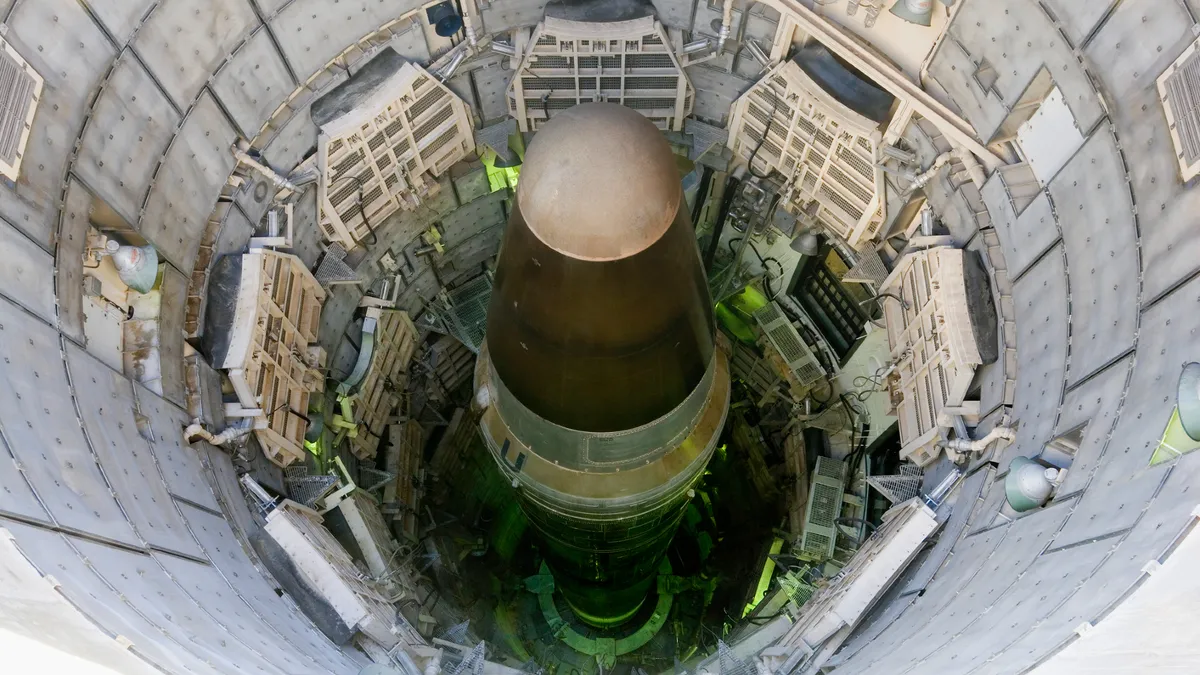
Due to the danger of nuclear war, you have about 35 years.
TG: Why do you think that we’ll blow ourselves up, essentially, within 35 years, give or take?
DG: So it’s a crude estimate. Even after the Cold War ended, [when] we had strategic arms control treaties, all of which have disappeared, there were estimates there was a 1% chance of nuclear war [every year]. Things have gotten so much worse in the last 30 years, as you can see every time you read the newspaper.
I feel it’s not a rigorous estimate, that the chances are more likely 2%. So that’s a 1-in-50 chance every year. The expected lifetime, in the case of 2% [per year], is about 35 years. [The expected lifetime is the average time it would take to have had a nuclear war by then. It is calculated using similar equations as those used to determine the “half-life” of a radioactive material.]
TG: So what do you suggest as remedies to lower that risk?
DG: We had something called the Nobel Laureate Assembly for reducing the risk of nuclear war in Chicago last year.
There are steps, which are easy to take — for nations, I mean. For example, talk to each other.
In the last 10 years, there are no treaties anymore. We’re entering an incredible arms race. We have three super nuclear powers.
People are talking about using nuclear weapons; there’s a major war going on in the middle of Europe; we’re bombing Iran; India and Pakistan almost went to war.
OK, so that’s increased the chance [of nuclear war]. I would really like to have a solid estimate — it might be more, and I think I’m being conservative — but a 2% estimate [of nuclear war] in today’s crazy world.
TG: Do you think we’ll ever get to a place where we get rid of nuclear weapons?
DG: We’re not recommending that. That’s idealistic, but yes, I hope so. Because if you don’t, there’s always some risk an AI 100 years from now [could launch nuclear weapons], but chances of [humanity] living, with this estimate, 100 years, is very small, and living 200 years is infinitesimal.
So [the answer to] Fermi’s question of “Where are the civilizations, all the intelligent organisms around the galaxy, and why don’t they talk to us?” is that they’ve killed themselves.
You asked me to think about the future, and I am obsessed the last few years, thinking about that — not the future of ideas and understanding nature, but of the survival of humanity.
TG: I think in some ways, during the Cold War, it was easier for people to conceptualize because we had one major enemy. Now there’s chaotic interactions between countries.
DG: There are now nine nuclear powers. Even three is infinitely more complicated than two. The agreements, the norms between countries, are all falling apart. Weapons are getting crazier. Automation, and perhaps even AI, will be in control of those instruments pretty soon.
TG: That scares me too — that a lot of weapons are using AI systems to make decisions on some level.
DG: It’s going to be very hard to resist making AI make decisions because it acts so fast. If you have 20 minutes to decide whether to send a few hundred nuclear armed missiles to both China and Russia for “our dear president,” the military might feel that it’s wiser to make AI make that decision. But if you play with AI, you know that it sometimes hallucinates.
TG: The problem feels too big for ordinary people to do anything about, which is the same thing with climate change, right?
DG: People have done something about climate. So that’s something scientists began to warn people about 40 years ago. And they convinced people that’s a real danger.
It’s a much harder argument to make than about nuclear weapons.
We made them; we can stop them.
Editor’s note: This interview has been edited and condensed for clarity.
How much do you know about Albert Einstein and his theories? Test your knowledge with our Einstein quiz!