



[ad_1]
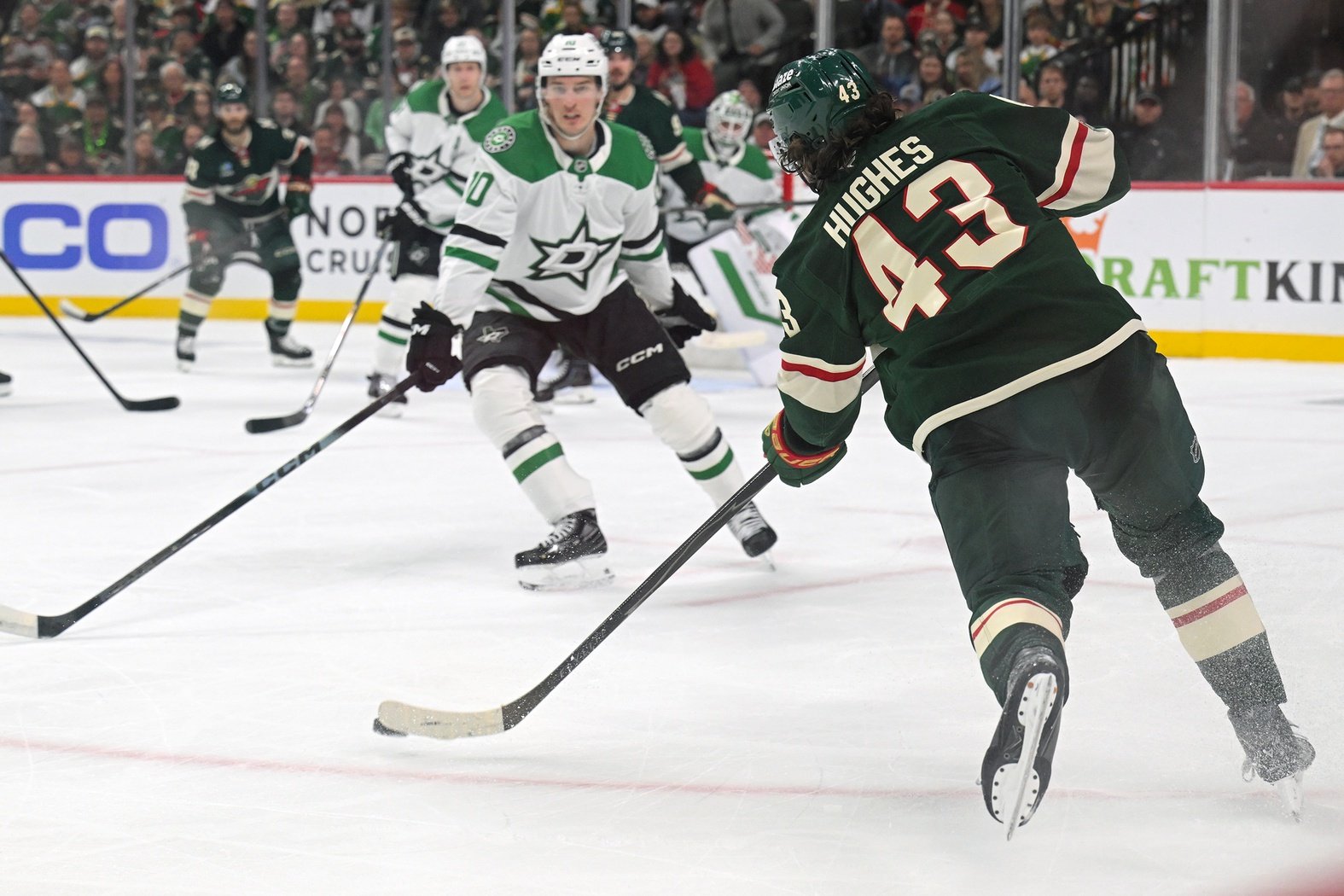
Entering the postseason, the Minnesota Wild’s hopes for success more or less boiled down to: They have Quinn Hughes this time. It was a great reason for hope.
Wild fans watched the superstar defenseman elevate their favorite team for 48 games this season, supercharging the power play and picking up the pace at 5-on-5. After years of losing to superstar defensemen like Alex Pietrangelo (2025, 2021), Miro Heiskanen (2023), and Hughes (2020), Minnesota finally had a difference-making blueliner of their own.
Hughes has four points through four games. However, with the Wild tied 2-2 in their series with the Dallas Stars, fans are looking for a bit more from their world-class defenseman. Hughes has been a main culprit in the team’s power-play woes, and at 5-on-5, Brock Faber‘s terrific play is outshining him.
There’s no denying that Hughes hasn’t looked quite so dynamic through the first four games, whether because of his pre-series illness, an undisclosed injury, or a mere slump. Still, even a less-than-100% Hughes is finding a way to make a positive difference against the Stars.
The power play woes are overshadowing how brilliant Hughes has been at 5-on-5. With Hughes on the ice, Minnesota has out-scored Dallas 6-0 at 5-on-5 and controlled 55.5% of the scoring chances, per Evolving-Hockey. Only Kirill Kaprizov (66.0%) and Joel Eriksson Ek (57.3%) have been able to dominate more with both teams at 5-on-5.
That’s a massive advantage for the Wild, considering that Hughes leads the NHL in postseason ice time, accounting for 45.3% of their 5-on-5 minutes. Hughes has continued to push the pace at 5-on-5, making smart decisions and crisp passes.
In Game 1 alone, Hughes went 11-for-11 on stretch passes. He’s also doing it with just three giveaways on the series, which is mind-boggling considering how often he has the puck.
His sheer amount of ice time means that Dallas can’t hide anyone from Hughes. There’s no line-matching with someone who plays half the game, which means Hughes is helping to put a lid on Dallas’ superstars.
For example, Heiskanen. He has four points in four games, so no one can say Heiskanen is struggling this series. But he’d likely be doing much more damage if he didn’t have to spend 42 of his 76 5-on-5 minutes going head-to-head with Hughes.
It goes beyond Hughes’ 2-0 edge in goals over his Stars counterpart. Per Natural Stat Trick, Hughes has a 36-22 edge on shots while facing off against Heiskanen, a 21-20 edge in scoring chances, and a 10-10 draw in High Danger Chances. What happens when Heiskanen gets time away from Hughes?
Well, the Wild are very, very lucky to have Jesper Wallstedt in net for those minutes. Dallas out-shoots Minnesota by a margin of 20-to-10 and controls scoring chances 16-to-6. Still, goals are the most important stat, and the Wild are 3-0 in that time. However, that looks to be all Wallstedt.
That also holds true for Mikko Rantanen, arguably the Stars’ best forward. Rantanen has five points, but all of them are on the power play. Rantanen and Wyatt Johnston have faced Hughes for 33 minutes at 5-on-5, and the Wild have buried the star duo during that time. Hughes has out-scored Rantanen/Johnston 3-0 while almost doubling them up in terms of scoring chances (19-to-9 for Rantanen, 19-to-11 for Johnston).
Some of that has to be attributed to Faber’s monster series, of course. Still, the attention Hughes demands creates room for his partner to operate. The way Hughes can break out of his zone so effortlessly enables Faber to go on the attack in a way he couldn’t do last postseason with Jonas Brodin as his partner.
Hughes still creates a ripple effect down the lineup, where everyone is in the role they would be on a theoretical Stanley Cup-winning team. Faber gets to shine as Robin to Hughes’ Batman. Brodin and Spurgeon get fewer, but important shutdown minutes. John Hynes can be selective with Jake Middleton and Zach Bogosian‘s minutes, rather than overexposing them to Dallas’ All-Star-caliber players.
And this is with a version of Hughes who’s only starting to look at his best. Game 4 saw him beginning to return to his peak levels of ankle-breaking space creation, and that’s a good sign for the rest of the series.
Two things can be true at once. We can and should expect to see another level from Hughes than we have seen in the first four games. Even so, it’s hard to imagine Minnesota being in a tied series after four games without Hughes. He didn’t get a point on Marcus Foligno‘s game-tying goal in Game 4, but his fingerprints were all over it. Hughes was a major catalyst for the Wild winning Game 1 as easily as they did.
The Wild still have hope in this series, and a lot of it is for the same reason we all thought going in: They have Hughes this time. If he can find that extra bit of dynamism he showed in the regular season and snap out of his power play funk, Hughes is more than capable of lifting Minnesota to an upset over Dallas.
Think you could write a story like this? Hockey Wilderness wants you to develop your voice, find an audience, and we’ll pay you to do it. Just fill out this form.
[ad_2]
Source link