


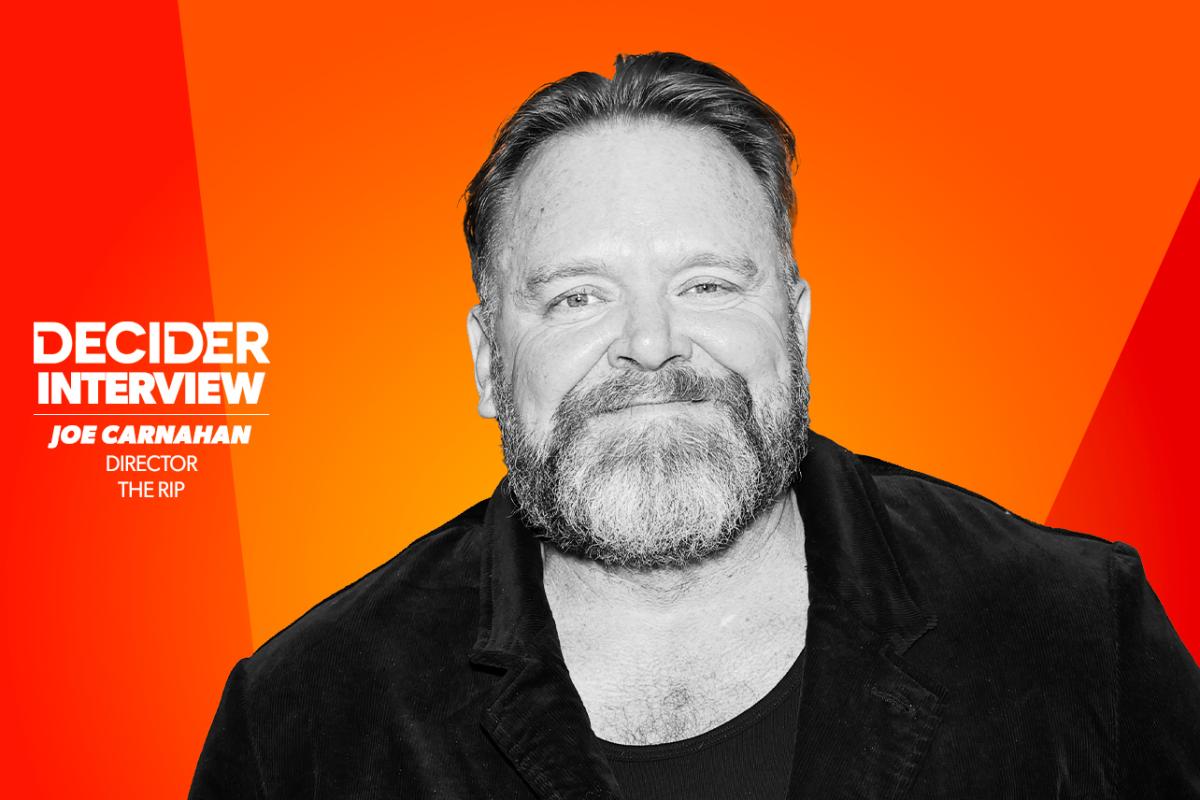
The new Matt Damon and Ben Affleck movie, The Rip—which began streaming on Netflix today—offers a sympathetic portrayal of overworked, underpaid police officers. Writer/director Joe Carnahan knows that might ruffle some feathers.
“I voted Democrat most of my life,” Carnahan told Decider in a recent Zoom interview. “Maybe the most illiberal thing about me is how pro-cop I am.”
Carnahan has been writing and directing cop movies since 2002’s Narc, starring Ray Liotta. It’s not all he does—he’s also known for the Liam Neeson survivalist thriller The Grey and the sci-fi time-loop movie Boss Level—but it’s a genre that Carnahan has revisited time and time again (including once before with star Ben Affleck, in 2006’s Smokin’ Aces). In The Rip—produced by Damon and Affleck via their Artist’s Equity production company—the Boston-based besties star as seasoned Miami cops who seize, or “rip,” a large stash of cartel cash in a suburban neighborhood home. They know they don’t have much time before somebody shows up to get the money, but protocol requires them to count it on site. Will one or both of them give into the the temptation to skim a little from the top?
In his script—which was by inspired a real-life Miami cop friend of the director’s, who came across $24 million in a real-life rip—Carnahan takes care to provide his audience with reasons to sympathize with these cops, even the potentially dirty ones. Damon, who stars as Lieutenant Dane Dumars, is forced to ask his team to work after hours for no overtime pay. Early on in the movie, Dane confesses to his No. 2, Sergeant JD Byrne (Affleck), that he “hates being a cop.” He lost his son to cancer, and can barely afford a living on his salary, let alone the medical debt he’s in. That last detail came straight from Casiano’s life, who lost his 11-year-old son Jake to cancer in 2021.
“These guys worry about paying bills,” Carnahan said. “When Chris went on that rip, his son had been diagnosed, and his chemotherapy was like $1 million a month. He didn’t have insurance. That money is life changing.”
Decider spoke to Carnahan about his friend Chris Casiano, and why he’s still firmly pro-cop—and, by extension, pro-cop movie—despite the increased public outcry in the face of police violence in the last decade.

DECIDER: I read that the idea for the movie came from a friend of yours, a real Miami cop, Chris Casiano. Tell me about the real life rip—what year was that, and what that really happened?
JOE CARNAHAN: I want to say like, 2014, 2015. I’ve known Chris about ten years, and it happened just before he and I met. It was one of the stories he told me early on that stuck with me. I could see the cinematic possibilities in that.
I based Matt Damon’s character loosely on Chris, and what he went through. He lost his son, unfortunately, very tragically, to to cancer at 11. [The movie] was me trying to conceive something that would help my friend deal with grief—the crushing, agonizing, sadness that that would bring. It’s a parent’s worst nightmare. Nobody wants to outlive their child. I can’t think of a worse fate. [This was] a clumsy way of of trying to give him something. Through art, we could build a memorial, a monument, to Jake and his time here—his short, 11-year life.
Once I got that in my head, and then I took it as a great responsibility to be able to honor that, and at the same time do something that had a traditional aspect of it—something relatable, something that I had a fairly good grasp on, which was this genre and types of stories. The interpersonal is absolutely the engine on this movie more than anything else.
In the actual rip that happened, with Chris, was there any corruption, dirty cops, or confrontation over the money?
No, there wasn’t that. But all that stuff about counting [the money] on the seizure, on scene, is all true. You’re required to count it twice, actually, by hand. The real rip—Sasha’s character [Desi, played by Sasha Calle], in real life, that was an older man. At some point they sat this guy down to start counting. [Laughs.] They had to get the guy that owned the place also counting! If you’re off by a dollar, Internal Affairs gets involved. This is a very real thing.
A lot of those facts I kept intact because I thought, “You can’t beat the real thing.” The responsibility was to take the elements of it that I thought were cinematic and parse through it. In real life, it took 42 hours to count that money. We couldn’t make a 42-hour movie. Certain things were expedited, certain things were snipped, and and so on.

Tell me about taking the script to Matt Damon and Ben Affleck, as producers and also as stars. What were those early conversations like?
Dani Bernfeld, who was with Artist’s Equity and is a producer on this film, she knew about the script. She hounded me about it. We’re friends, and we’ve been friends for a while. She said, “Listen, just give it to me. Give me 48 hours.” The internal move for her was, “I’m going to try to go get Matt and Ben.”
I was more like, “Oh, that’d be great to make it with you guys.” The dream scenario was to get both of them, but I didn’t go in there thinking [we would]. But within 24 hours, I had Matt on the phone. We’d all known each other for many years, Matt and Ben, and I. I worked with Ben [on the 2006 film Smokin’ Aces]. I almost worked with Matt. There’s a familiarity and a commonality with the three of us.
Matt responded, then Ben. They said, “Who are you thinking, for cast?” I’m like, “Pauly Shore and Liza Minnelli. What do you mean? It’s you guys!” This almost never happens, where the stars align, there’s this great shift, and everything is just crystal clear. Their question was “Who do you want us to play? Which one?” I told them and they’re like, “OK, great.” Everything just slotted in, and off we went. It was amazing. It almost never happens like that in movies. This script didn’t exist two years ago!
That first scene that Matt and Ben have in the bathroom together is one of my favorites of the film. I think that’s the most times I’ve heard the word “f–k” in one scene. Can you tell me about writing and shooting that scene?
[Laughs.] If you watch my movies, you’ll hear it all the time! That’s a staple of my films, the F-word. In that moment you mentioned, Ben actually [has talked] about—he breaks. You can hear his voice crack. It’s such a touching [moment]. When you when you get your hooks into people like that—you’ve got these two super talented guys who happen to be lifelong friends. That’s something you can’t fake. You can’t fake that connective tissue. I dined out on it, and really used it to my advantage. There’s not a scene [where they] go at one another that’s not just absolutely riveting. That has a lot to do with how much they love one another and that decades-long friendship.

Can you walk me through writing and filming some of those big action sequences, from the gunfights to the car chases? What were some of the challenges of those sequences and how did you address them?
I had Scott Rogers, who was the second unit director, who is just an extremely talented guy. He and I spent a lot of time talking. We spent a lot of time talking with Juanmi [Azpiroz], his DP. I’m a big believer in this idea that you can feel these [action sequences] in your chest. Those gunfights have to rattle you. You have to feel the percussive nature of that. We did this technique where we put it on a what’s called a Libra head which is maybe the most expensive stabilized head you can use. Of course, what do we do? We flip the switches off the destabilize them. We call it the “seizure wheels,” where we do this thing to give it that movement.
There’s not a ton of [action], but when it happens, it’s meaningful. I love velocity, and impact, and the sense that these characters are in peril. They’re not bulletproof. They can be hurt. They can be shot, they can be wounded. Bullets have consequences. I never showed the outside, who was shooting at them. They remain mysterious. They make their escape. The subjective nature of staying with our guys, staying with our guys, staying with our guys, is always interesting to me. As it’s happening to them, it’s happening to the audience.
I couldn’t help thinking these action scenes would have looked cool on the big screen. How do you feel about the movie coming out on Netflix rather than being released in theaters?
A good movie is a good movie is a good movie. I know people who go like, “Well, I don’t want people watching on their phones. ” But it doesn’t matter if it moves them. This is the means with which we consume these things.
I’m a huge proponent of the theater-going experience. No one will ever replace the communal sense of sharing something with a group of strangers in a dark room. It’s its own thing. It has a singularity to it. I’m not worried about theaters going anywhere.
I’m going tonight to see it on the big screen. It’s a blast to watch on the big screen. But it’s also equally powerful… and by the way, people have sophisticated home viewing systems. They have great speakers. They have great televisions. Almost everybody I know has some version of a home theater. The culture is adapting to Netflix, and Netflix is adapting to the culture. This is the way it goes. I’m very happy it’s coming out on Netflix.

A recurring motif in the is the the officers not getting paid overtime, or being disrespected, or feeling worn down. Matt Damon says he hates being a cop. What message or theme are you conveying with that aspect of the movie?
We forget that the police are civil servants. It’s a thankless job. I voted Democrat most of my life. I feel like I’m a centrist in a place with no center. Maybe the most illiberal thing about me is how pro-police, how pro-cop I am. From personal experience, I’ve had the great fortune of knowing a lot of extraordinary men and women that were in law enforcement. Just exemplary human beings.
One of my favorite scenes in that film is Catalina [Sandino Moreno, who plays Detective Lolo Salazar] and Teyana [Taylor, who plays Detective Numa Baptiste]. Catalina is saying, “Just this little bit of money would make my life so much easier to live.” That’s a reality. Once you’re also grounding it in those stakes—in this very blue-collar atmosphere—it makes those characterizations that much more profound. There’s a relatability there. We’re all in it right now. It just seems like it’s a bunch of us, and billionaires.
There’s no center. There’s no healthy moderation. I don’t like that. These guys worry about paying bills. When Chris went on that rip, his son had been diagnosed, and his chemotherapy was like $1 million a month. He didn’t have insurance. That money is life changing. Really, the money, at the end of the day, is the villain in the movie. It has bad guys, but the villain—the big boss, final boss, bad guy—is the money.
[Spoiler warning: Skip this next question if you haven’t yet watched the film.]
At one point, I thought they were going to steal the money, and I wouldn’t have been mad it if they did. Was the movie always going to end the way it did?
I wanted there to be the sense that you didn’t know. I love the fact that you said, “It wouldn’t have bothered me if they had.” Some part of [you feels] that they deserve that. It’s all that temptation. It’s all that desire. But as Chris would say—you pick up $5, you pick up $5 million. It doesn’t matter. It’s like that great line from The Insider, “They can paint everything with that brush.” Now you’re a dirty cop, and you’ve got to decide what that means to you. I love that morality. The struggle with that is fascinating to me.

I do think this is a tough moment for American audiences to feel sympathy for armed officers in the country. What you might you say to viewers who are skeptical of the movie for not addressing criticisms that people have of police violence?
I don’t want to conflate ICE—the monstrosity and the grotesque nature of what they are— because they’re not cops. Those are outlaws that have been empowered by what I consider a corrupt regime. That is an amoral body. I don’t want there to be that association at all. I think, by and large, cops are good, well-meaning. Like anything, there’s bad apples everywhere. But again, I’m talking about my own experience. I’ve known incredibly noble, incredibly decent, incredibly honorable cops. Men and women of all ages. I found them to be unshakable and have a great sense of the ethical. I didn’t want to drag them through the mud. I wanted to use people’s perceptions, as you mentioned about armed officers, what they’re doing. The mistake is, don’t associate these issues with ICE, or what’s happening with that, which is just outlaw, criminal, disgusting behavior.
I know this is a genre that you’ve worked in a lot. Has the shifting public attitude towards police, and these killings, changed how you think about the cop film genre?
Because I have such an abiding respect for law enforcement—with exceptions, notable exceptions when when cops do not honor the obligations of their duty. But, no. There’s always this moral gray area that they occupy. They are the thin blue line that separates us from anarchy. Nobody wants them until you need them, and then they’re the most important people in the world. I think that dichotomy is very interesting. It’s like, “Get these cops out of here!” But then suddenly, somebody’s breaking into your home, “Call 911.” You want them to come riding in to save the day. Most of them do, and do successfully, and do so for not a great wage, and risk their life. They have families. They have kids. I had several cops in the film. All of them outstanding. All of them well-regarded. All of them stand-out Miami cops. I just thought the world of them. These are just regular people trying to make a difference.
This interview has been edited and condensed for length and clarity.