


This is Executive Dysfunction, a newsletter that highlights one under-the-radar story about how Trump is changing the law—or how the law is pushing back—and keeps you posted on the latest from Slate’s Jurisprudence team. Click here to receive it in your inbox each week.
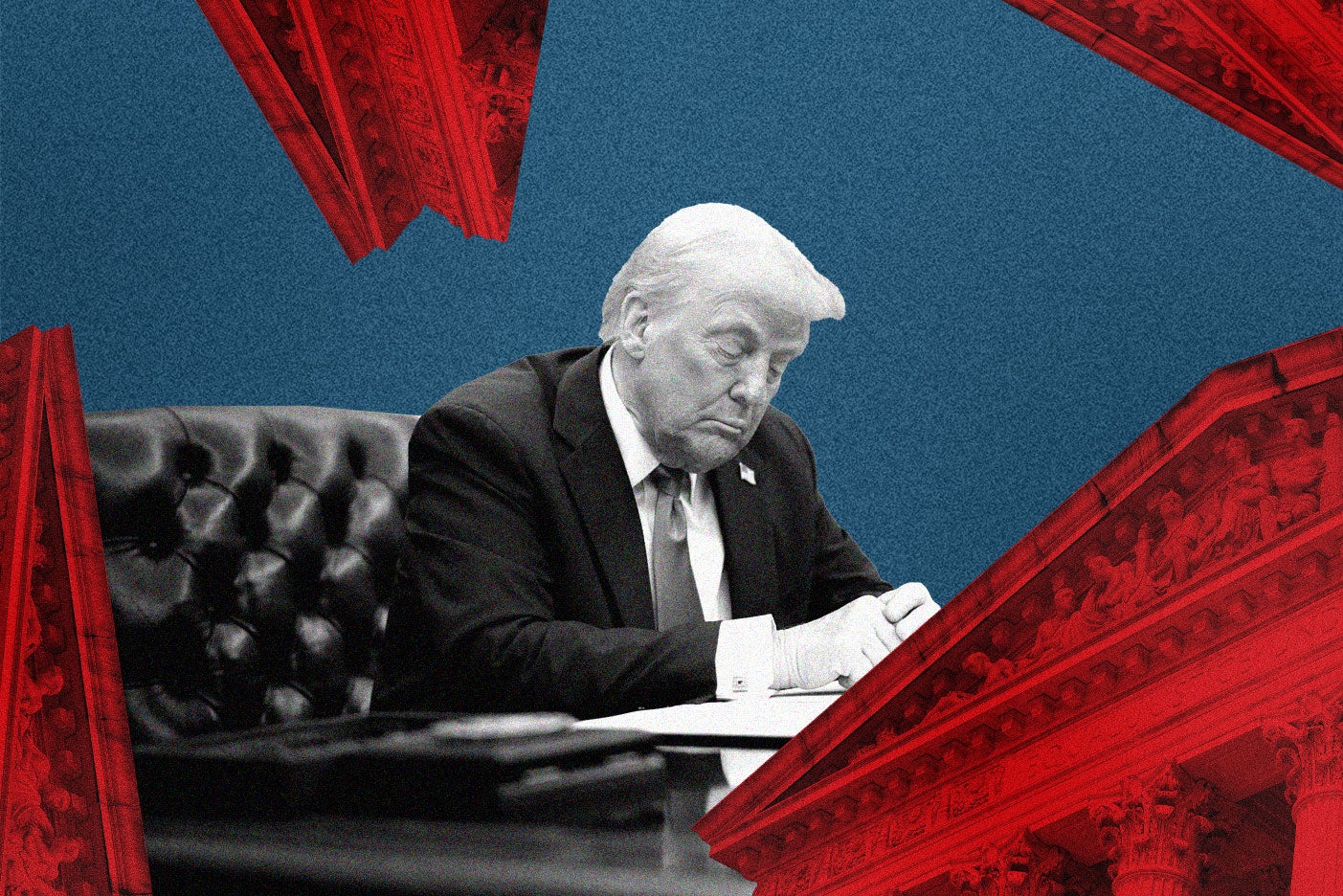
President Donald Trump has been taking what feels like an Oprah Winfrey–style approach with his pardon power: All you Jan. 6 rioters, you get a pardon! And all you folks who helped subvert the 2020 election for me, you get a pardon! And what the hell, that crypto billionaire charged with a felony, you also get a pardon! All in all, Trump has issued about 1,600 pardons since the start of his second term. Last week, the Wall Street Journal reported that Trump has even told his staff he will issue preemptive pardons for them in 2028 before he’s slated to exit the White House.
No former U.S. president has exercised his pardon power quite like Trump has. In fact, he’s even outdone his full first-term numbers, when Trump issued fewer than 250 pardons and commutations. The Wall Street Journal estimated that to date Trump has issued six times that number over the first 15 months of his second term. And he apparently has no intention of slowing down, with administration officials telling WSJ the president has repeatedly “raised the specter of pardons with White House aides and other administration officials, particularly when staff have suggested they could face prosecution or congressional investigations over decisions.” It’s become a running joke within the White House, as Trump has promised he will pardon anyone who came within 200 feet of the Oval Office.
Trump is wielding the pardon power with full impunity, aided by Supreme Court rulings that have affirmed the presidential pardon authority as “unlimited,” and left little to no room for congressional oversight. The only exceptions are in cases of impeachment and for state criminal offenses. This has essentially inspired Trump to wield pardons as a tool of political influence, as he pardons people facing serious federal criminal charges and who may have otherwise faced prison time. Now, these folks have a new lease on life, all thanks to the president, who expects unflinching loyalty in return.
To understand what risks Trump’s mass pardons create and what Congress can do to slow, if not outright stop, Trump, I spoke with Frank Bowman. He’s a law professor at the University of Missouri, a former federal prosecutor, and a pardon expert. He’s the author of a forthcoming book Pardons: Discretionary Clemency and the Rule of Law in Britain and America 1066–2026, all about the history of U.S. presidential pardons and the power they hold.
Here’s our conversation, edited and condensed for clarity.
Shirin Ali: What’s been your impression of Trump’s approach to the presidential pardon?
Frank Bowman: One has to see Trump’s use of the pardon power in the context of his
general attempt to undermine the rule of law and establish a sort of autocratic form of presidential governance. His uses of pardon power fit in with, for example, his progressive destruction of the Department of Justice as a meaningful law enforcement agency, and his transformation of it into an agency whose dual purposes are essentially to protect his friends or people who share his business interests, and to punish his enemies. We’ve seen that in a whole variety of contexts, essentially as Trump disabled large swaths of the DOJ’s enforcement capacity, particularly in the areas of white collar crime and political corruption, to the benefit of people who are political adherents of Mr. Trump, or are, in the case of cryptocurrency offenders, people who are actually in the same business as the Trump family. Or in the case of finance, people who are directly contributing to the Trump family wealth.
You have one side of Trump’s second-term behavior, where he’s essentially hamstrung the Department of Justice at the front end of the criminal prosecution and investigation process, and then the pardon power, as he’s used it so far, is twinned with that. Trump has used the pardon power to excuse people who perhaps have already been prosecuted, or are in the course of being prosecuted for offenses. These are people that, again, are his political supporters, who share his economic interests, or for some reason, catch his attention.
You have to see Trump’s misuses of the pardon power in context of this overall transformation of the federal criminal justice process into essentially a personalized area of presidential control. The other instances of this, of course, began on his first day in office, when he issued pardons to all the Jan. 6 rioters and insurrectionists. Some months later, he preemptively pardoned 77 people who haven’t yet been charged, but certainly could be, for their roles in the effort to overturn the results of the 2020 election. These are people who were in some cases literally his co-conspirators in former special counsel Jack Smith’s election interference criminal case.
It’s in this vein that you have to see his most recent comments in the White House that he’s going to pardon everybody within 200 feet of the Oval Office. In other words, what he’s saying is, If you folks commit crimes on my behalf, don’t worry about any criminal consequences. I’ll simply pardon you all at the end. He’s creating a whole permission structure for illegality, as long as it’s illegality that helps him and of which he approves.
Trump has suggested to his staff that if they carry out his orders, even if unlawful, he will pardon them. This sounds like a blatant manipulation tactic—what do you make of it?
All of that is made possible by the Supreme Court. If one looks back on fairly recent American history, Richard Nixon dangled pardons in front of the various Watergate conspirators, directly and indirectly. It was obviously considered both wrong in the general sense and criminally prosecutable. That practice by Nixon of dangling pardons was in fact one of the grounds on which the House Judiciary Committee voted to impeach him. The fact that at that time everyone conceived of this kind of behavior as fairly overt obstruction of justice and possibly criminally prosecutable for the president himself is surely at least one of the reasons why Gerald Ford felt it appropriate to issue Nixon a pardon after he left office. He widely understood that he was potentially liable for a whole array of conduct that was both impeachable and prosecutable. At that point, to stop the mouths of potential witnesses, Nixon offering pardons was a criminal offense of obstruction of justice.
However, what happened a couple of years ago is that the United States Supreme Court in Trump v. United States extended completely unprecedented immunity from criminal prosecution to the president and made that immunity absolute. What it characterizes, again, completely without precedent, as core powers of the presidency among which it lists pardons. Essentially, as of 2024 the Supreme Court has said any use by the president of the pardon power, even overtly corrupt and indeed criminal uses of the pardon power, cannot result in criminal liability to him.
Trump also knows, or thinks he knows, based on the failures of two impeachments to result in his conviction in the Senate, that he is essentially immune for an impeachment even for overtly criminal conduct. He knows that he can do something that Richard Nixon could not. When Nixon dangled these pardons back in the 1970s, he did so in extreme secrecy, knowing that if it ever came out it would certainly be impeachable, and it might very well be a criminal offense. There was considerable deterrence against this kind of behavior, but Trump is in a different world, one where the Supreme Court has given him permission to commit crimes if they involve pardons and his own political party has essentially given him permission to commit impeachable offenses because they won’t vote to convict him. He is at liberty to throw around promises of pardons for any kind of prospective criminal behavior by his aides and associates in the knowledge that nothing’s going to happen to him.
Despite the Supreme Court’s sweeping presidential immunity decision, can Congress do anything about how Trump’s using his pardon power?
Well, understand that regardless of the sad political reality, which is to say, the congressional Republican Party is so enthralled by Trump that it will not vote to impeach, even if he overtly commits crimes. I mean, that’s a sad political reality, but it doesn’t change the constitutional law of impeachment. Is it an abuse of the pardon power to pardon the past conduct of your criminal co-conspirators or to promise pardons for the commission of future crimes? Is that impeachable? Of course it is.
That being so, Congress certainly has the power to investigate, if that’s what the president’s doing. Congress today, if it wanted to, could investigate the uses and promises to use the pardon power of the president. Now they won’t do it of course, because both chambers of Congress are controlled by Republicans. However, Democrats, if they gain a majority in either or both houses, I think it’s incumbent on them to investigate this pretty unapologetically. They should investigate these potential criminal misuses of pardon power as part of their oversight authority and through their power to inquire into impeachable conduct.
Former President Joe Biden issued a slew of pardons on his way out of the White House, including for his son, other family members, and even members of the House committee that investigated the Jan. 6 attack on the Capitol. Did he essentially open the door for Trump to abuse the presidential pardon power?
I understood Biden’s impetus to issue preemptive pardons for members of his family and for a number of other people, like the Jan. 6 committee, Dr. Anthony Fauci, and Gen. Mark Milley. Trump and his surrogates were openly promising efforts to bring criminal charges against members of the Biden administration and others for things which were plainly not criminal, just simple retribution for political opposition. One understood Biden’s disposition to try to protect his own family and other folks who were simply doing what public servants should do, and while you had active promises from the incoming presidential administration of Mr. Trump that they were going to misuse the criminal justice system, I think it was a bad idea.
For one, I think it indicated a really insufficient amount of confidence in the criminal justice system to screen out totally baseless prosecutions, recognizing that even getting investigated, even if you’ve done nothing wrong, is a tremendously burdensome process in terms of reputation, time, and money. It’s a form of harassment, even if it’s ultimately not successful in securing the prosecution and I understand that. I also understand Biden’s impetus to try to spare people even that degree of embarrassment, expansive inconvenience, and so forth. But I thought at the time, and I think at least so far events have proven me correct, that efforts to try to charge people with noncrimes are very unlikely to succeed. We see this in the James Comey and Letitia James cases, where the justice system just spit out retaliatory, baseless prosecutions against Trump’s enemies. Grand juries and judges are simply throwing them out and I suspected that this would be the case. I think Biden should have had more faith in the system’s ability to deal with this kind of stuff.
My second reason for not approving of these preemptive pardons is precisely that they create at least an excuse for Trump to do worse. They create a precedent, where Trump being Trump, he would not need, but he would absolutely use, along with his supporters to justify his own use of preemptive pardons to protect people around him who really had committed crimes. I was concerned that Biden was creating a precedent that would be abused and I think in that respect, I was correct. I think Biden made a grievous error in issuing preemptive pardons—understandable, but a mistake.
Presidential pardons don’t apply to state crimes, so is one avenue out of Trump’s abuse of power to rely on states to pursue justice against the people he has already pardoned and those he may in the future?
You’re certainly right that the presidential pardon power does not extend to state criminal offenses. Trump purported to pardon Tina Peters, a county clerk in Colorado who tried to
mess with the state’s accounting system. Colorado courts recently just waived that away, correctly saying, “Sorry, you can’t do that.” And it’s as plain as anything in the law that Trump can’t do that. So yes, it is possible for states to bring state criminal actions against people who have received federal pardons. The tricky bit there, however, is the collection of evidence. If you take a look at the events in Minneapolis, you have ICE agents who shot and killed people, conduct which might well be a crime under state law, and which Minnesota authorities are investigating. However, a lot of the evidence of those offenses is in the hands of federal authorities who are refusing to turn it over. At least so long as Trump remains in office, there are going to be difficulties in collecting evidence, and even after he leaves office, there certainly would be concerns that relevant evidence of certain kinds of crimes would be lost or even consciously destroyed.
That concern becomes exacerbated by a recent opinion by the Justice Department proclaiming the Presidential Records Act, which requires that presidential records be retained and remain the property of the United States—those need not be turned over by the president when he leaves office. If you’re a state and you want to prosecute a federal official for some things that they’ve done that amounts to a state crime, but Trump has pardoned them, they’re going to be evidentiary obstacles.
Another obstacle is that many of the kinds of crimes that you might want to prosecute somebody for and committed by a federal official during the Trump administration may not be state crimes.
They don’t perfectly match; there just may not be a state statutory authority to reach some of the constant behavior that Trump is going to pardon people for. For example, the extrajudicial killings that happened on the high seas. Trump and his appointees are frankly committing murder on the high seas, violating the laws of war and U.S. military code. There’s very little argument that they’re actually committing crimes out there. But, they’re committed on the high seas, so to the extent there’s jurisdiction at all, this falls under the authority of federal district court or federal military tribunals. States have no jurisdiction there.
Contemplating committing a crime and hoping that I’d get pardoned for it, I’d be wanting to look over my shoulder and see if there’s state jurisdiction that will extend beyond the current president’s term. It’s by no means sufficient to really fill the gap, but states could jump in here.
We hope you learned a thing or two from this edition of Executive Dysfunction, and if you enjoyed reading it, please consider supporting our legal journalism by becoming a Slate Plus member!
Elsewhere in Jurisprudence
-
In this week’s Amicus, Dahlia Lithwick sits down with Rep. Jamie Raskin of Maryland’s 8th Congressional District. They discuss how Congress could tap into a lesser-talked-about section of the 25th Amendment to try to remove Donald Trump over his recent threats to end an entire civilization. Instead of going through the typical impeachment process, which requires both houses of Congress and a two-thirds majority, the vice president and a majority of the president’s Cabinet “can determine that the president is unable to successfully discharge the duties of office and then transfer the powers of the president to the vice president,” Raskin explains. Congress also has a role in creating a body that can stand in for the Cabinet in backing a vice president who invokes the 25th Amendment.
-
In the Amicus bonus episode, Dahlia and Mark Joseph Stern ponder Justice Sonia Sotomayor’s surprisingly direct comments about her fellow Justice Brett Kavanaugh. Referencing his infamous opinion that allowed the federal government to detain immigrants based in part on their “apparent ethnicity,” leading immigration detentions to be dubbed “Kavanaugh stops,” Sotomayor said the opinion came “from a man whose parents were professionals. And probably doesn’t really know any person who works by the hour.” The comments were surprising largely because Sotomayor has historically gone out of her way to praise her colleagues, but now the public is witnessing a breaking point where the Supreme Court’s interpersonal deliberations are spilling out for all to see.
-
A new lawsuit is testing the Trump administration’s brute force immigration strategy by suing federal officers under state law for violating a Maine man’s constitutional rights. As Mark explains, Immigration and Customs Enforcement agents don’t technically have absolute immunity from legal liability, but they do enjoy broad protections from prosecution thanks to federal law. The Supreme Court has issued conflicting decisions over if and how federal agents can be sued under certain federal laws, but just a few years ago a lower court judge—appointed by Trump—declared states can allow plaintiffs to sue federal officials if they allege federal constitutional violations. If the courts allow this lawsuit to proceed, “They will finally compel immigration agents to operate within the Constitution—or face consequences for defying it,” Mark writes.
-
Friend of Slate Steve Kennedy, organizing and network director at the People’s Parity Project, explains how the Trump administration quietly proposed a new rule under the National Defense Authorization Act that declares all men between 18 and 26 would automatically be registered for the draft. The change demands the Supreme Court’s intervention, Kennedy argues, because it raises a simple question that has been neglected for far too long: Is the draft itself constitutional?
Thank you for reading Executive Dysfunction! We’re thrilled to be in your feeds and will be back with more dysfunction analysis next week.
Source link
See more https://theglobaltrack.com/