


His lawyers wrote that Ataie’s experience is part of a broader “illegal crackdown” on speech at the school.
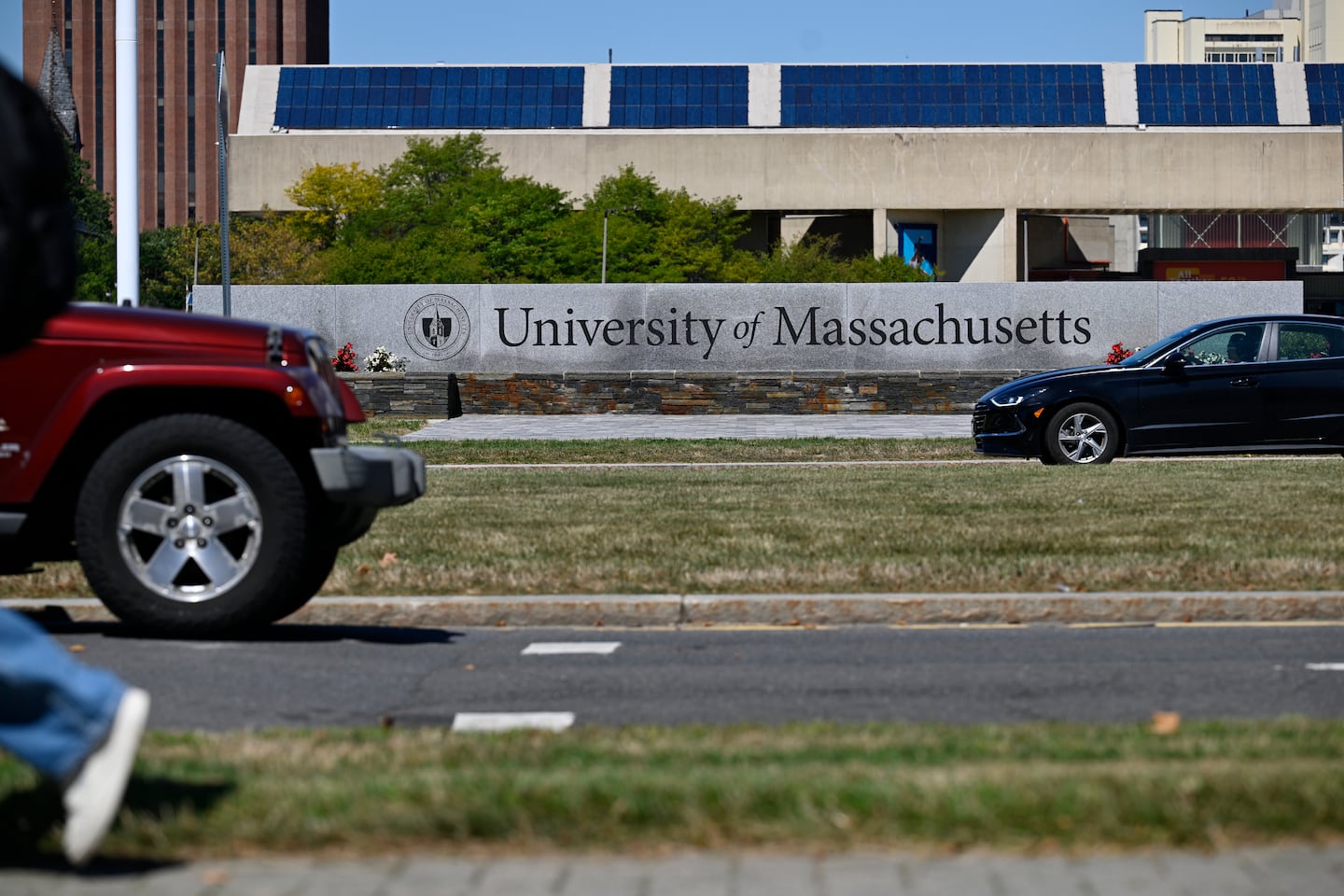
UMass spokesperson Emily Gest wrote in a statement that faculty hiring at the university is “grounded in academic excellence” and that “diverse perspectives are welcomed and debated” there.
In court filings, the university criticized Ataie for his “heavy reliance on speculation, conjecture, and fundamentally inaccurate information.” His “free speech retaliation claims have so little basis,” UMass attorneys wrote, “as to be reckless.”
The case, filed April 7 in Hampshire Superior Court, puts the state flagship university in the midst of the growing national controversy over rights to free speech and the protection of Jewish students on college campuses. And it is not the first time the issues have surfaced.
UMass students’ widespread protests against the war in Gaza ended with the arrest of 130 people in 2024 and later prompted the Trump administration to include UMass in a list of 60 schools it accused of allowing antisemitism to thrive on campus. Months later, a pro-Palestinian protest organizer sued the school for mandating his yearlong suspension and impinging on his protected speech. (He won a court injunction in February.)
In Ataie’s case, he attests that he was wrongly denied the professorship in the history of the modern Middle East, even as dozens of students and professors supported his appointment last year. Administrators recently hired a candidate for the open tenure-track professorship, despite Ataie’s plea to halt the search as he filed suit. He now claims to face “serious economic losses” and “emotional pain and suffering,” according to court documents.
Attorneys for Ataie did not respond to requests for comment.
The UMass lawsuit underscores the thorniness in the debate around academic freedom on college campuses. Similar free-speech incidents around pro-Palestinian advocacy have emerged nationwide — at Emerson College and University of California Berkeley, for example — as faculty face calls to curtail their political views in the classroom. And schools well beyond that are squabbling over professors’ rights to put up Pride flags and to teach “contested” subjects about race and gender.
Ataie’s case may be an extreme example of the controversy around Middle East studies in particular, which is being scaled back at more universities, though notably not at UMass. Harvard, for instance, in December forced out the director of its Center for Health and Human Rights, where programming often touches on Middle East conflicts.
During the original UMass faculty search that ended in spring 2025, Ataie’s academic expertise on the Iranian Revolution and modern Middle East politics, including the long-running conflict between Israel and Palestinians, was a point in his favor, according to his complaint. He was ultimately ranked second among three finalists; the first candidate declined the job offer.
But Ataie never received a formal offer, he said, as fear of federal scrutiny took hold. UMass received the letter alleging discrimination from the Department of Education in March 2025. In the following months, the Trump administration elevated public criticism of controversial fields and revoked research funding for some universities, including $8 million for ongoing UMass projects.
UMass subsequently instituted cost-cutting measures and scaled back hiring on several open roles, including the tenure-track professorship in Ataie’s department. In court, UMass said “an unprecedented financial crisis” warranted those moves.
In May 2025, a Jewish student in Ataie’s History of Israel-Palestine class filed a complaint against him, claiming that he taught a “one-sided” syllabus and created a “hostile environment” for her, Ataie’s lawsuit says. Attorneys for Ataie said in court filings the allegations of antisemitism were ”based largely on the course’s exposing her to pro-Palestinian content” and impacted his candidacy for the promotion.
Ataie alleges that UMass administrators investigating the complaint asked him about his religious beliefs, place of birth, and opinions on Israel, as well as proof he assigned Israeli readings in class. (The lawsuit says he did.)
Ataie claims, too, that administrators told him that a student “complaint of this nature would not have required investigation in the past, but with external pressure from the federal government the University was required to show it was active against antisemitism.”

In court documents, UMass administrators said the decision not to hire Ataie was in no way connected to the antisemitism complaint, which was later dismissed with no findings of misconduct.
Faculty and administrators involved in the search did not consider Ataie’s political beliefs, UMass said in its filings.
Ataie is a member of the UMass chapter of Faculty & Staff for Justice in Palestine. In 2024, he helped students organize events, including teach-ins on Middle Eastern topics, and served as part of a faculty support group for students arrested while protesting against the war in Gaza.
Even so, in the Israel/Palestine course, Ataie says he was “scrupulous in ensuring that his classroom provides a place of civility and mutual respect.” At least one history professor corroborated in a court filing that Ataie’s class offered appropriate balance.
Regardless, by August 2025, a history department administrator reduced Ataie’s teaching load from six classes to one and dropped the Israel/Palestine course altogether, the lawsuit alleges.
Later, the first professorship search Ataie participated in was considered “failed,” and a new search was mandated for the same job. Ataie alleges that this was “different than the norm” in other academic departments, which either canceled the roles or returned to the existing search process.
Instead, “the Provost forced History to ignore the search that had produced three finalists, all pre-approved for hire, and to start the process over with an entirely new search,” the lawsuit reads.
A UMass dean said in court documents that Ataie’s canceled classes were “under-enrolled” and the promotion he was up for was deemed “not critical” when the university stopped hiring for multiple pending positions across campus.
In fall 2025, Ataie applied for the professorship again when a second candidate search began, but his lawsuit said administrators did not seriously consider him. Administrators did not offer Ataie a Zoom interview, saying later in court documents that his application was “thin” and that his record of publication was “significantly substandard” compared with other applicants.
But Ataie alleges that the job requirements were improperly rewritten to exclude him with new preferences “against candidates who had a Middle East Studies focus” and for those from “well-established graduate programs.” (Ataie obtained two master’s degrees, in Iran and Lebanon, before getting his PhD in history at UMass.)

Another candidate accepted the professorship in early April — an appointment Ataie is asking the court to intervene in as he seeks a jury trial.
Allowing Ataie to “suspend and disrupt the University’s hiring cycle for years while this litigation proceeds to conclusion would have disastrous consequences,” UMass wrote in court filings.
The next hearing is scheduled for Wednesday.
Correction: A previous version of this story incorrectly described details in a UMass affidavit. This article was also updated to reflect the title of the job Ataie was seeking.
Diti Kohli can be reached at diti.kohli@globe.com. Follow her @ditikohli_.