


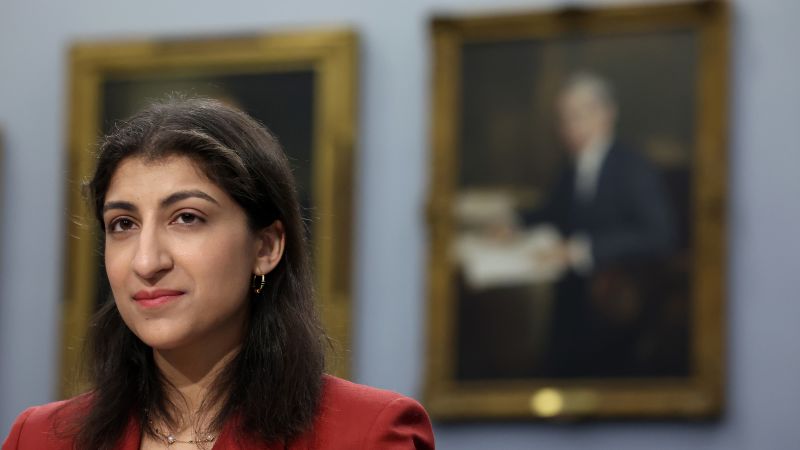
Elizabeth Warren, Steve Bannon, Pete Buttigieg and — at least as of a few years ago — JD Vance have agreed on this: A short, ultra-private antitrust lawyer plotting a war on tech companies and monopolies from her new office at Columbia Law School understands what Americans are demanding out of their government.
When then-President Joe Biden named her chair of the Federal Trade Commission, Lina Khan was too much for many leading Democrats. Senate Democratic Leader Chuck Schumer declined meetings when she was chair, people familiar with the matter tell CNN. Former Vice President Kamala Harris, once she took over as the 2024 nominee, conspicuously didn’t speak about Khan and avoided appearances with her on the campaign trail.
Now, Khan is getting constant calls from Democrats, many of them thinking about presidential runs, who are sounding out problems or workshopping potential solutions. Schumer headlined a press conference in Washington to introduce a bill that would break up meat processing companies, inspired by Khan’s methods and with her input, but which a Schumer aide noted also drew on years of his own consumer advocacy.
Khan, 37, hasn’t changed so much as the world around her has. Many Americans are furious about rising costs, affordability, technological changes and soaring profits for the rich. And President Donald Trump has used federal power in ways that were once considered off-limits in both parties.
If Trump could extract a “golden share” for the government from US Steel, Khan argues, if he could demand proposed mergers and prosecutions, and if he could invoke the Alien Enemies Act of 1798 as legal justification for deportations, just think what a prepared, populist progressive could do.
“Sometimes there can be a political perception that the Democrats are the nerdier ones who just haven’t been able to figure out how to talk to regular people,” Khan told CNN in an interview at Columbia. “The way that this administration came in — with not just having a very clear agenda, but mapping that agenda onto very specific legal authorities that they were ready to hit the ground running with immediately — just showed a level of mastery over governing authorities and levers that I think, frankly, our side has a lot of catching up to do.”
What Khan has in mind for the next Democrat in the White House isn’t a 1,000-page blueprint like the Heritage Foundation’s Project 2025. It’s more of an overall strategy rooted in her specialty: excavating long-forgotten laws already on the books, then finding ways to apply them to 21st century companies that Khan argues are as much as monopolies like Standard Oil ever were.
As Biden’s transportation secretary, Buttigieg found common ground with Khan flexing authorities against airlines to get refunds and pushing back on late flights.
“Democrats’ vision should not be about picking up the shards of what this administration destroyed and try to tape them back together,” he told CNN. “We should be unsentimental about the things that don’t work and bold in fashioning a new and better way of governing.”
New Jersey Sen. Cory Booker, another potential 2028 contender, also praises her ideas and invokes President Franklin D. Roosevelt.
“We need to get back to the time of FDR, when everybody from farmers to factory workers knew the Democratic Party was fighting for them, that Republicans were the elite party and we were the party of working Americans,” he said.
In other words: Whomever emerges as the party’s nominee two years from now could be running on Khan’s track, with her influence, indirectly or via a top role she’d have in a future potential administration.
Which is why Warren said part of her time these days is spent giving Khan’s number to the many prospective candidates who come asking.
“If you’re a leader who wants to deliver on affordability, it’s a smart move to call Lina Khan,” Warren said.
“The array of people that reach out, in terms of not just people who code as progressives,” Khan said, “is encouraging.”
Vermont Sen. Bernie Sanders had already called Khan the best FTC chair in modern history when, backstage at a rally in Queens a week before last year’s New York City mayoral election, he kept asking her for ideas about what Zohran Mamdani should do in City Hall.
The morning after he won, Mamdani named Khan a transition co-chair, but that title sounds more honorary than the direct role she had infusing the administration with her sensibility, setting up groups of lawyers to pore through the city charter and agency codes, helping pick staff and joining nightly calls of top advisers.
If they can make her aggressive progressivism work in the financial capital of the world, Khan and Mamdani believe, they’ll be able to make it work anywhere: in cities across the country, but also among those Democratic presidential contenders she’s still trying to convince.
“She is not satisfied with an answer that says, ‘We have not done this before’ or ‘This is not how we do things,’” Mamdani told CNN.
His first encounter with Khan, Mamdani recalled, was at an event in the Bronx organized by Rep. Alexandria Ocasio-Cortez that he attended as a new assemblyman. Khan talked about price gouging, he remembers, and what laws she was activating in ways to fight the companies involved.
“In a moment where it feels like so much of this work is abstract, that we struggle to translate it to the needs and interests of working-class Americans, here is an example of how we can do exactly that – and we can do so by listening to those very people about the ways in which they’re being priced out of their day-to-day lives,” Mamdani said.
Khan officially wrapped up her role at Mamdani’s 100-day mark but remains involved as an adviser. One of her biggest staff picks was recruiting Sam Levine, the new city consumer and worker protection commissioner, who remembers showing Khan where to get coffee at the FTC when she first arrived as a summer fellow. Levine was the director of the FTC’s Bureau of Consumer Protection while she was chair.
Now, his creaky office in a nondescript building close to the New York Stock Exchange is the nerve center of making already nervous national companies see an unpleasant future. Mamdani and Levine are going after hidden hotel fees, landing settlements with fast food chains for violating workers’ scheduling rights, and targeting food delivery apps by securing a settlement to give $5 million to delivery workers.
“People should want to go into government to solve problems. And you should go into the government, I think, with a conviction that you are going to find a way to solve them,” Levine told CNN. “And you’re either going to find a tool you have, or you’re going to find way to get that tool.”
Affordability and ‘accountability’

Just 32 years old when she was confirmed as the youngest FTC chair ever – going from the intern desk she used as a summer fellow in law school to the leadership suite in under five years – Khan quickly became known for sending skeptical and sometimes reluctant agency lawyers diving into the archives.
In 2023, the FTC challenged patents it said were improperly listed, pushing drug manufacturers to allow generic, cheaper versions of some asthma inhalers. And Khan dusted off a 1973 rule originally inspired by book-of-the-month club enforcement and tried to use it to require sellers to make it easier for people to click to cancel online subscriptions.
She went after Amazon for fees charged to businesses selling on the platform. She also moved to stop a $24.6 billion acquisition of the Albertsons grocery chain by Kroger on the grounds that it would raise costs and reduce consumer choice. The acquisition was eventually abandoned after a federal judge blocked the deal.
Today, Khan says the “affordability part of the conversation” inside the Democratic Party must be “paired with accountability.”
“Where delivering affordability is going to require conflict with, or taking on, entrenched powerful interests: Who’s willing to do that?” Khan said. “And I think that’s going to be part of both the kind of credibility question, but also: Can you be effective when it is some of the same actors who are hiking up prices?”

These days, Khan has become so popular in a certain hyper-aware corridor of the left that she sometimes gets emails asking for signed photos to be given as wedding presents. Mark Cuban, the billionaire former “Shark Tank” investor working on lowering prescription drug prices, said in an email that he felt Khan should have been more aggressive against insurance companies but credited her for going “after scammers who targeted vulnerable people” using images of celebrities.
“That was a big deal that she didn’t get credit for,” he said in an email.
New Jersey Rep. Josh Gottheimer, the vice-chair of the bipartisan Problem Solvers Caucus who works with many business-minded moderates, told CNN that he worries about both the policy and political impact of moving more in Khan’s direction. He’s among the Democratic leaders worried about how many tech leaders turned hard against Democrats in 2024 because of what they felt was too much regulation.
“You may fire up some portion of the base, but you’re also going to alienate a lot of people who, while they want competition and success for everybody, they also believe that you can start a business and be successful in America,” Gottheimer said.
Not every potential 2028 contender is jumping on board with Khan. During Harris’ presidential campaign, Maryland Gov. Wes Moore appeared for an interview with CNBC’s Andrew Ross Sorkin, who noted there had been “a lot of calls from the donor class” to move away from Khan. Sorkin then asked Moore if “we are going to hear about a shift in terms of (Harris’) regulatory views.”
“I think we will,” Moore replied. “I think we have to.”
Asked recently for Moore’s views about Khan, a spokesman for the governor replied: “He doesn’t have thoughts about her one way or the other.”
Rahm Emanuel, the former Chicago mayor and chief of staff to former President Barack Obama, said that while he agrees with many of the problems Khan is pointing to, he is less convinced by her proposed solutions.
“In every period of time in history when we’ve had a concentration of wealth and an economic structure that is only accentuating that, the government has been a countervailing force,” Emanuel told CNN, citing consolidation in health insurance companies and retail especially.
“Rather than say ‘Lina Khan,’ which has its own explosion, the guiding light should be where Teddy Roosevelt was more about regulation and Woodrow Wilson was more about breaking out: that spirit is important, and that mindset,” he added.
Jim Kessler, the executive vice president of the centrist Democratic think tank Third Way, told CNN that Khan is “very smart, and she’s very creative, and Democrats with national ambitions should be talking to her and taking her viewpoint into account,” but warned against voters seeing that as going after things they like, such as fast Amazon deliveries.
“It is critical that future national Democrats talk about issues that voters care about, not what intellectual elite progressives care about,” Kessler said.

Democrats aren’t the only ones with Khan on their minds.
Last April, Steve Bannon, the outside Trump strategist, called Khan one of the more important political figures in the country and said Democrats might have won in 2024 if they’d listened to her more. There’s even a photo of them standing next to each other, smiling after a tech competition event in Washington.
Also on a list of onetime Khan fans: Vance, whom she got to know when he was an Ohio senator.
“At that time, he was very focused on issues of corporate power in the technology sector and he was very substantive,” Khan said.
She said she couldn’t remember exactly the last time they spoke, but she does remember how Vance came publicly to her defense not long after being put on the ticket in 2024, in those days when Democratic opponents saw a window to come after her and he was eager for the opportunity to turn the screws of populism against Harris.
“I don’t agree with Lina Khan on every issue, to be clear, but I think that she’s been very smart about trying to go after some of these big tech companies that monopolize what we’re allowed to say in our own country,” Vance told CBS in August 2024.
It’s unclear where Vance, the likely front-runner for the 2028 Republican nomination, stands these days. Asked whether the vice president stands by that quote or his work with Khan when he was in the Senate, spokesman Buckley Carlson declined comment.
For her part, Khan said of the current administration that “the campaign platitudes they had about wanting to fight for the working class or gestures to populism, I think, have just been revealed as totally hollow.”
Khan doesn’t plan to endorse a candidate in the upcoming Democratic primary and deflects when asked if she would serve again in an administration, arguing that her focus remains building up a new center at Columbia Law aimed at training a new generation of antitrust lawyers.
“It does seem like a lot of people are now talking about affordability and the cost-of-living crisis, which is important in terms of being focused on, ‘How do we make sure government is materially making life better for people in ways that is visible?’” Khan said. “That can help restore trust in what government can do and the purpose government serves.”