



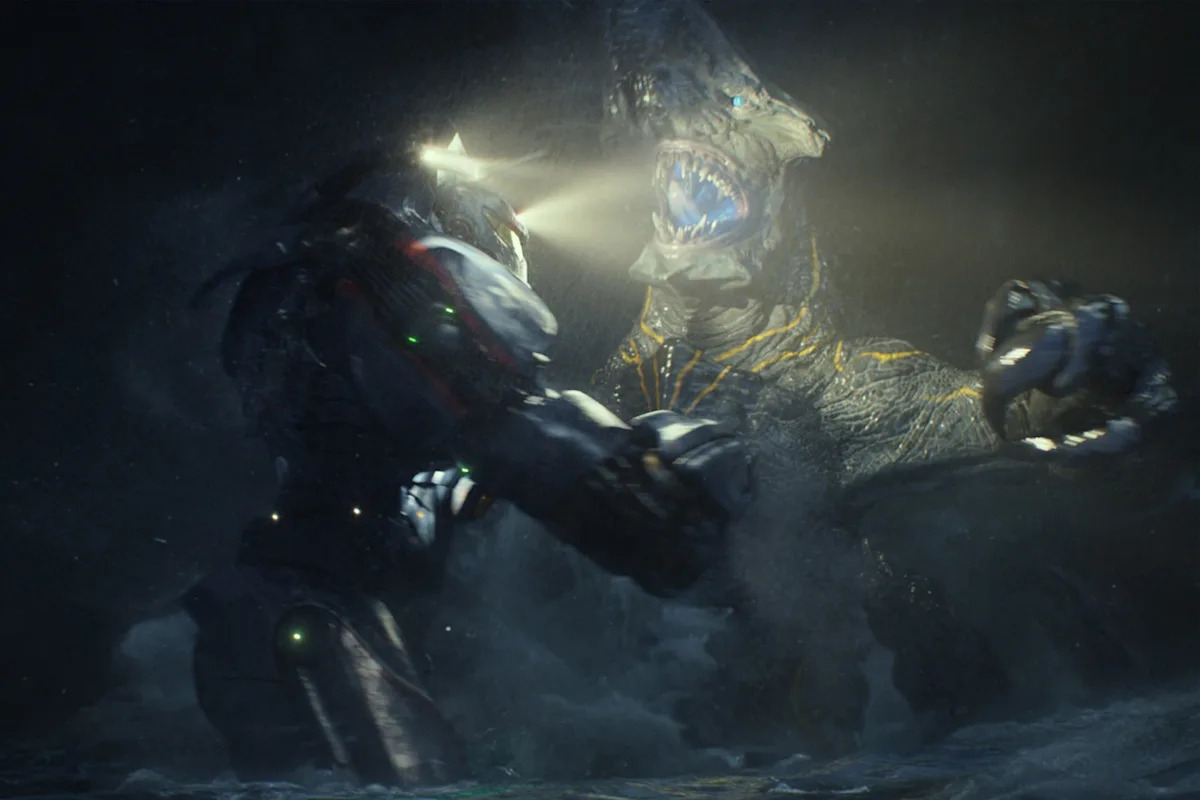
Guillermo del Toro never takes the path of least resistance.
When he signed on to direct and co-write Pacific Rim—inspired by Japan’s giant monster and mecha traditions—he could have easily instructed his concept artists to draw as much as they could from Godzilla and Gundam.
Instead, he did the opposite, striving for an end product that was familiar, yet radically fresh at the same time.
Why Pacific Rim designers were forbidden to watch giant monster movies
“What I didn’t want to do,” del Toro explained in David S. Cohen’s Pacific Rim Man Machines & Monsters, “was make a movie about the genre.”
To that end, he expressly forbade the designers to watch giant monster movies during pre-production. “We know them and we love them,” the director added, “but we didn’t want to make it specifically about one single strand of that.”
Rather, he pointed his team to reference points such as National Geographic, Goya’s 19th century painting The Colossus and “the sketches of naturalists from the 16th century, when they would draw a whale and it would be a monster,” del Toro said. “When they would draw the rhinoceros and it would like a creature of fantasy.”
Another pitfall he hoped to avoid while crafting the various Kaiju seen throughout the film was a desire to make them look cool.
That may sound counterproductive for a summer blockbuster full of awe-inspiring imagery, but del Toro’s mandate really meant the skyscraper-sized creatures needed to be more than just eye candy. Despite their immense stature, they needed to feel real and alive, channeling both the beauty and horror of the natural world.
“If you see a lion in repose, the lion looks majestic, noble, beautiful,” he said. “But if that lion is on top of you and about to bite you, he looks [ferocious]. Not pleasant at all. And yet, it is the same animal.”
And like many organisms that roam the Earth today, the Kaiju are paragons of evolutionary excellence, a “Darwinian army,” as described by co-screenwriter Travis Beacham. “They’re grown in some alternate universe and pitted against one another, and [only] the strongest mutations survive.”
As a result, every single part of their anatomy serves some kind of destructive purpose, bringing to mind the Greek myth of the Hydra. Just because you cut off one part of the body, doesn’t mean you’re necessarily in the clear.
“If we create a Kaiju with three or four tails, I want to see it use them,” del Toro concluded. “If the Kaiju has a mouth on the end of the tail, then I’m going to use it to fight the robot with both ends.”