


Fortune favors the bold.
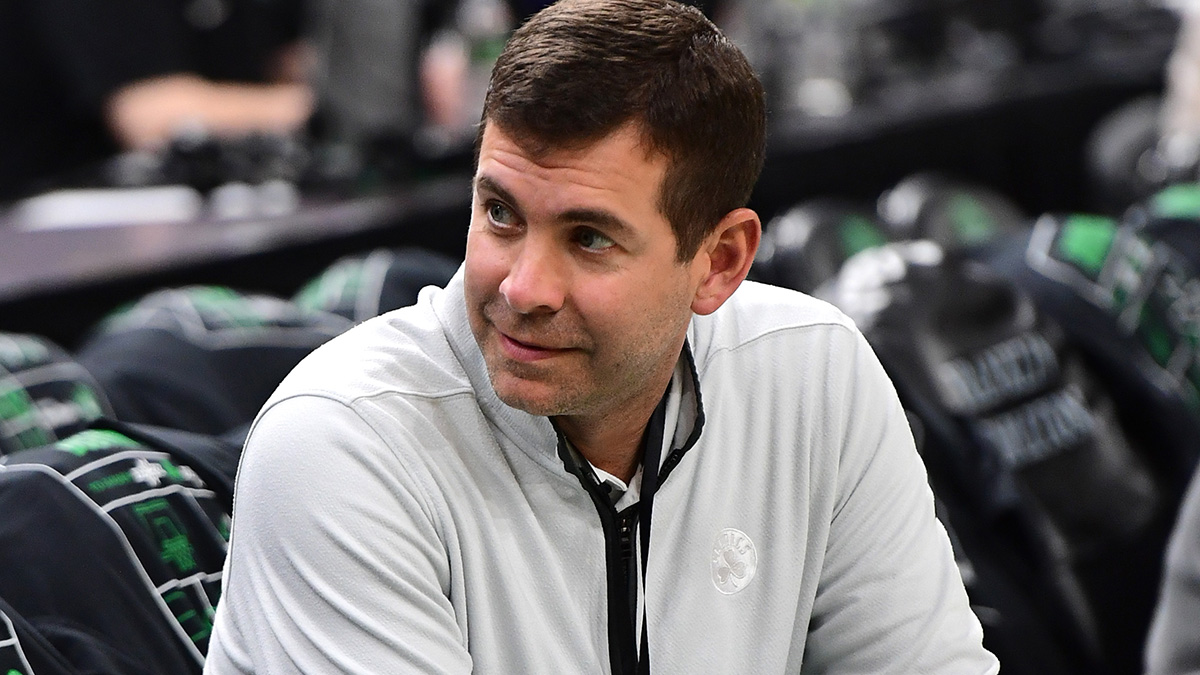
That philosophy has basically been the guiding light for every person who has served as general manager of the Boston Celtics. From Red Auerbach to Danny Ainge to Brad Stevens, there is no reward without risk.
This past summer, Stevens made the swallow-hard decision to trade off beloved pieces from Boston’s most recent title team with a need to balance Boston’s books. Pundits predicted a gap year as the Celtics bid farewell to Al Horford, Kristaps Porzingis, Jrue Holiday and Luke Kornet.
The remaining core refused to comply.
Even after shaving more than $350 million off Boston’s books, Stevens delivered an energy-filled, new-look squad that posted the second-best record in the Eastern Conference. Boston now stands as the favorite to emerge from the East as it begins a playoff trek where a trip back to the title stage feels perfectly reasonable.
The NBA will announce the peer-voted winner of Executive of the Year on Tuesday afternoon. Stevens, who already landed the honor for Boston’s 2024 title season, ought to collect a second trophy for his salary cap masterclass. Much like he did two years ago, he’ll basically ignore the honor and try to keep the focus on his coaches and players.
But the efforts of Stevens and his front office staff deserve a spotlight. The Celtics entered the summer with a projected tax bill that would push the team’s total spend to $540 million for the 2025-26 season. Stevens slashed that number down to $187.8 million, not only getting the Celtics off the restrictive second apron, but clearing them out of the luxury tax entirely while walking a financial tight rope to the finish line of the season.
The Celtics now have a pathway to resetting repeater penalties that would allow the team to spend big again in future seasons, all while showing no drop off in competitiveness in the short term.
Pundits who thought Boston would tumble into a lottery year greatly underestimated the talent remaining despite the roster changes. Jaylen Brown elevated to an MVP level, Payton Pritchard showed he could be an impactful starter (even if he continues to produce his best basketball in the Sixth Man role), and Derrick White impacted the game in a million different ways, even as his shot defied him for much of the season.
Getting Jayson Tatum back from an Achilles injury after just 10 months on the sideline certainly pushed Boston’s ceiling higher as well.
But it was Stevens’ work on the fringes of the roster that really allowed Boston to truly sustain. From the moment the team acquired White at the 2022 trade deadline, Stevens and his staff have worked tirelessly to find low-cost players with high upside to supplement a costly core.
Neemias Queta, waived by the Sacramento Kings before Boston’s 2024 title season, leapfrogged from fourth on the big-man depth chart to the starting role and put up some of the best advanced numbers in the entire league.
The Celtics watched the wing buffet of Baylor Scheierman, Jordan Walsh, Hugo Gonzalez, and Ron Harper Jr. all impact winning when given their opportunities this season. Three of those four wings were recent Stevens draft picks and all were selected late first round or beyond (Gonzalez at 28; Scheierman at 30; Walsh at 37).
By investing in those younger players, even when they barely saw floor for more talented teams, Stevens and Boston’s coaching staff put the Celtics in position to seamlessly navigate a roster turnover.
“When we knew the costs were going to be high and we knew that there would be some tweaks to the CBA, we knew that it was going to be even more important to be able to either hit on later picks, and/or sign minimum contracts and/or two-ways, that we could make part of our next iteration of the Celtics,” Stevens told NBC Sports Boston.
“So, we had those more experienced teams that were, on paper, better, [but] that has been a huge focus of the last three years. Just making sure that, just because Jordan Walsh isn’t playing, he needs to be really invested in every day. Baylor Scheierman’s not playing last year, he needs to be really invested in.
“Neemi and the staff have done a great job of that all the way through the whole organization, but specifically the coaching staff and [player enhancement] staff.”
Maybe the most endearing quality of this team is how everyone has embraced their opportunities. Head coach Joe Mazzulla routinely changed how he utilized his bench pieces and it kept everyone on their toes. The Celtics were rewarded with a pass-the-baton type production where there was virtually no letdown regardless of who Mazzulla inserted.
Scheierman became an indispensable part of the rotation. Walsh weathered some lulls in playing time and has reemerged as an energy defender in the postseason. Gonzalez has all the potential to be a key piece of the Celtics’ future.
Stevens admits that a willingness to put in the work is a huge part of what drew him to those wings on draft night.
“The players have to be freakin’ workers. That’s basically the only thing I care about beyond just the minimum level of talent, since I was at Butler,” said Stevens. “It’s a great separator — is a guy going to compete, and are they team guys?”
Stevens also did well with his minimum-salary signings this offseason. Luka Garza has been a bundle of positive energy whenever he hits the floor and played more minutes this season (1,118) than he had in four previous seasons with Detroit and Minnesota (973 total). Josh Minott turned in some solid early season play before being a victim of Boston’s cap shuffling at the trade deadline.
In a league where so much of roster building is typically done via trades, the Celtics can take pride in a mostly homegrown roster. Tatum, Brown, and Pritchard were all Ainge picks. The Celtics traded for White but nurtured his development after his arrival.
Queta had less than 150 minutes of NBA experience when he came to Boston and played nearly 2,000 minutes this season. The Celtics swooped in to land Hauser on a two-way after he went undrafted in 2021.
Nikola Vucevic, acquired at the trade deadline for center depth, is one of the few rotational presences who wasn’t nurtured in Boston.
No Boston GM has won Executive of the Year twice since the award began with the 1972-73 season. Only 12 general managers have won multiple times. Red Auerbach won the award in 1980, while Danny Ainge earned his lone honor in 2008.
Just like his predecessors, Stevens wasn’t afraid to make bold choices. He’s been richly rewarded every time he’s embraced that risk.