



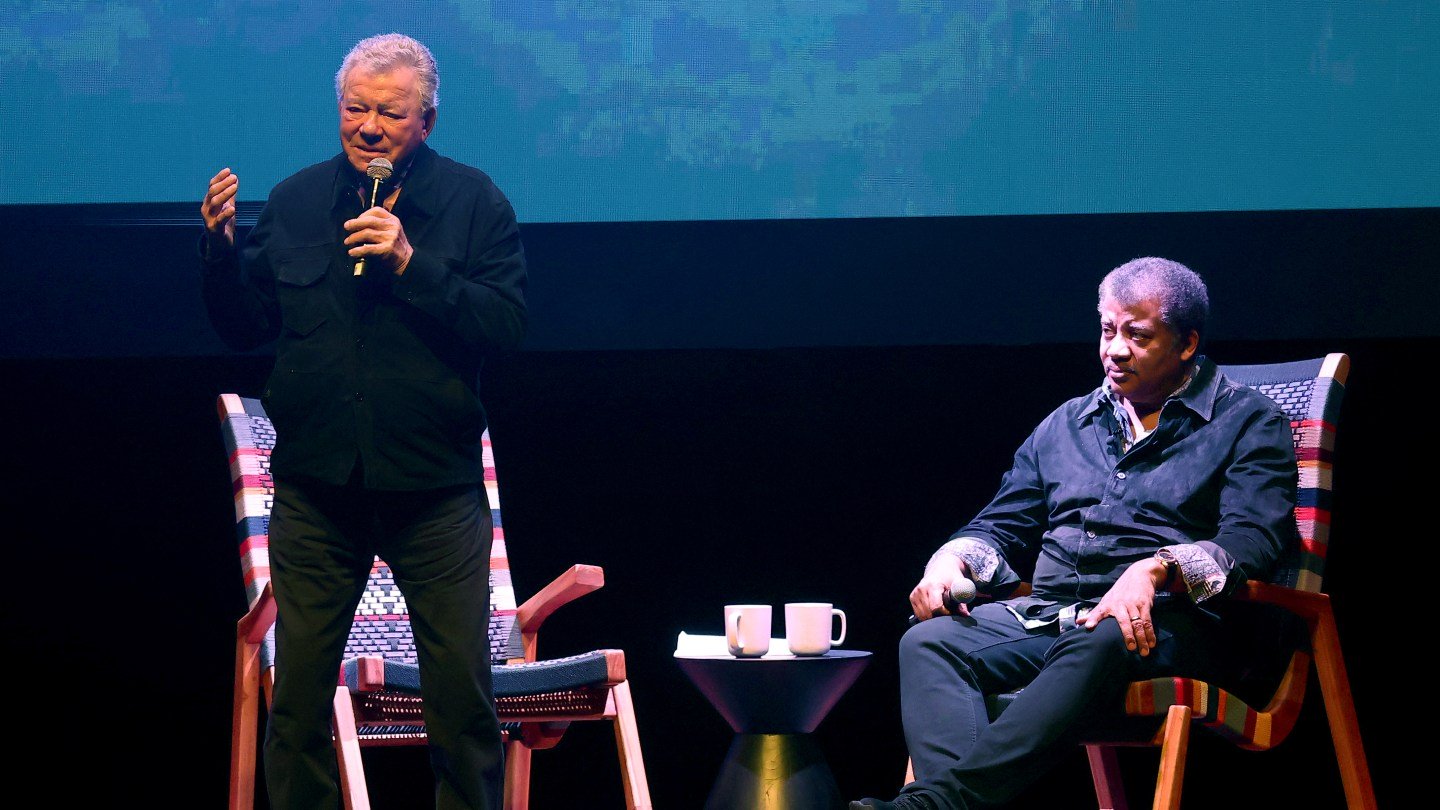
William Shatner and Neil deGrasse Tyson regaled an enthusiastic crowd with stories of everything from our understanding quantum physics to Shatner‘s space flight to the meaning of the universe on Wednesday night during a conversation dubbed “The Universe Is Absurd!” at the Saban Theatre in Beverly Hills.
The event was actually the second of a two-night event wherein the close friends ribbed each other and shared personal anecdotes of their adventures together, including their 2024 trip to Antarctica, where they first met. The audience may have even learned a few things about astrophysics along the way. (“The electron is so small, we do not know how small it is,” Tyson shared. “Every measurement of the electron is smaller than our attempts to measure it. As far as we’re concerned, it’s infinitesimally small.”)
The topic of Shatner’s age (95 years) came up quite often. At one point, he mentioned his forthcoming heavy metal album (yes, you read that right), out in October. (“Why does everyone approach me with a smile when they hear ‘heavy metal album’?” Shatner deadpanned.)
Later, Tyson turned the talk to back to quantum physics, noting that Shatner was born in 1931, which earned him some applause, at which the actor bristled, quipping: “I don’t like being applauded for my age. Applaud me for my heavy metal album.” Tyson went on to note that the neutron was discovered by James Chadwick the year after Shatner was born. The astrophysicist then went on to explain quantum physics to the crowd, some of whom were familiar with the topic (THR sat next to a woman who works as an engineer at Blue Origin) and others who were not. In the 1920s, “we learned that the universe is not continually divisible. You reach a point, you have a certain amount of energy, then you have less energy and less and less and less. There’s a point where there’s a unit of energy and you cannot have less than that. That is a quantum of energy.”
Shatner argued that scientists previously said that same thing about the atom, for example, and they were wrong. “They said it about every new discovery of the entrails of a molecule, of an atom,” Shatner said. When Tyson questioned his use of the word “entrails,” the Star Trek icon said: “I’m trying to use the language that I understand. It’s not your language because you are a Ph.D.” Quipped Tyson: “Yeah, that word [entrails] didn’t appear in my thesis at all.”
Shatner also discussed his trip to space in a Blue Origin rocket in 2021. He noted that he had to climb 11 stories in the gantry to get up to the opening of the ship. At one point, he noticed some gas coming off one of the vents and inquired as to what it was. When he was told that it was hydrogen, he instantly thought of the Hindenburg disaster. “So now, with trepidation, I enter the ship and I’m in the chair, a five-point buckle, and the countdown begins,” he said, during which someone in ground control noted that there was an “anomaly.” “What the fuck is an anomaly?” he recalled thinking. The countdown continued, and he heard: “All right, everybody, we’re removing the gantry. Anybody who wants to get off, get off now. And I go, OK. And I think, ‘I can’t, I’m Captain Kirk. I can’t.’” He describe the g-force as an “elephant sitting on your chest … and then suddenly it’s off and suddenly you’re floating.”
William Shatner performed “Rage,” from his new heavy metal album.
Tommaso BoddiFUTURE of SPACE
Shatner said once he unbuckled, he headed straight to the window. He had seen videos of Blue Origin founder Jeff Bezos floating through the cabin while getting Skittles “thrown at his asshole” by a teenager passenger on a previous space flight. “I thought, ‘That’s not gonna be me,’” he joked.
When Shatner landed, he was overcome with emotion. “Jeff Bezos was there with a microphone and international cameras, and I’m weeping,” he said. “I’m crying uncontrollably, and I don’t know why.” After some reflection, he realized “that I’m in grief.” He reflected on visiting far-flung locales “that are in trouble” for a show called Voice of the Planet. For example, he went to the Himalayas and was aghast at the amount of garbage left behind by hikers and climbers. “Shit is all over the place in this pristine mountains and it echoes the shit that we’ve left all over the planet with,” he said. “Now we’ve learned that microplastics are floating in our blood. As I speak to you, I could drop dead from microplastics. It’s a tragic thing that we’re doing to our planet, and I was in grief for the Earth and the beauty that we see all around us.”
Tyson then broke down the feeling of weightlessness, after Shatner said the English language doesn’t have an appropriate word for it, given how few people have experienced that sensation. He likened it to cutting the cables in an elevator, saying that a person inside it would be falling at the same rate as the elevator, so if they were standing on a scale, the scale would read zero pounds. Likewise, if someone is just above the Kármán line, which is recognized as the official boundary of space, they are simply falling toward Earth at the same rate that Earth is curving away from them. “So anybody in orbit is weightless because they are continually free-falling toward Earth,” he said. “Not because they’re in space.”
Shatner said that more recently, he’s been thinking about why it’s so important to send humans, and not robots, into space. He previously appeared on The Late Show With Stephen Colbert, where he asked why “vulnerable” humans are being sent out to explore, but he’s changed his mind. “The voyage of exploration, which going to Mars will be … needs to be experienced by a human being,” he said. “It takes the human being’s experience, it takes the soul, the brain, the conscious and the unconscious being that we are to experience this magical thing called exploration,” he said. “A cold robot can send back the facts probably better … [but] only a human being can experience that. It’s not the same experience to send mechanical entities. … What a marvelous thing for a human being to discover whatever there is to discover on Mars as opposed to a cold robot running along there and running out of power.”
Responded Tyson: “Let’s summarize what you just said. No one has ever given a ticker-tape parade for a robot. No one has ever named a middle school after a robot.”
Toward the end, Shatner spoke at great length about how he’s starting to realize his place in the universe. “I know I feel an affinity toward this mysterious thing we call the universe and I’m beginning to understand my place in the great unknown,” he said.
Replied Tyson: “Do you know what your place in this great unknown is? You lip-kissed a Black woman on television for the first time.” Tyson, of course, was referring to the legendary TV moment when Captain Kirk (Shatner) kissed Lt. Nyota Uhura (Nichelle Nichols) in an episode of Star Trek that aired in 1968.
At the end of the event, Tyson read three meaningful quotes along with the last few paragraphs of his 2007 book, Death by Black Hole: And Other Cosmic Quandaries, accompanied by a pianist. Shatner, meanwhile, performed a song called “Rage” from his forthcoming album, backed by a trumpeter. “So I was asked to do a heavy metal album,” he shared. “That’s generally greeted by some laughter; I’m not sure it’s derisive or not.”
Afterward, the pair took part in a meet and greet for VIP ticket holders, with Tyson staying behind for quite some time to chat with fans about everything from aliens to AI. The event was organized by Future of Space, which produces experiences and events around science and space themes.

William Shatner (left) and Neil deGrasse Tyson at the VIP meet and greet.
Tommaso BoddiFUTURE of SPACE
Source link
See more: https://theglobaltrack.com/
https://corinthiames.com.br/