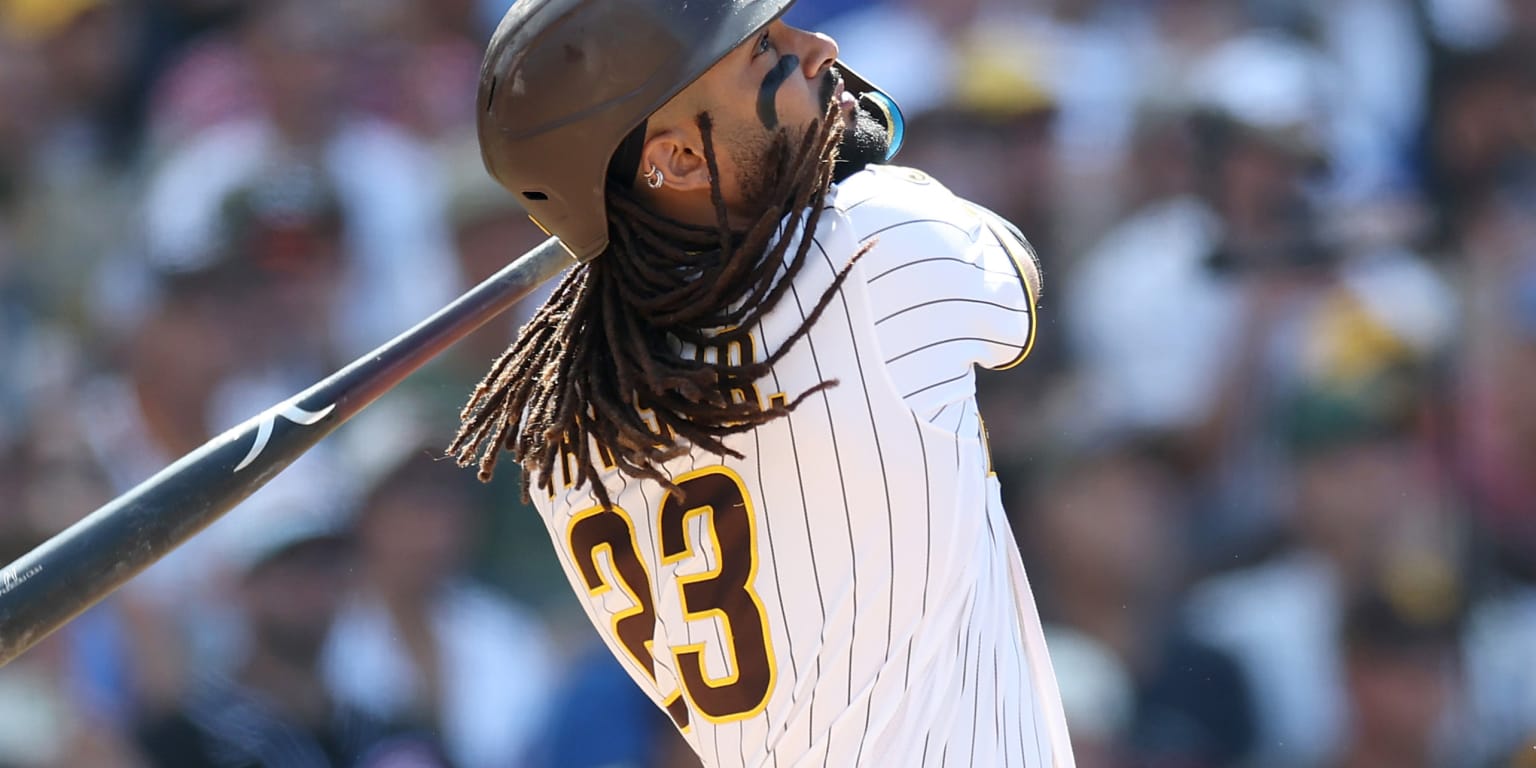




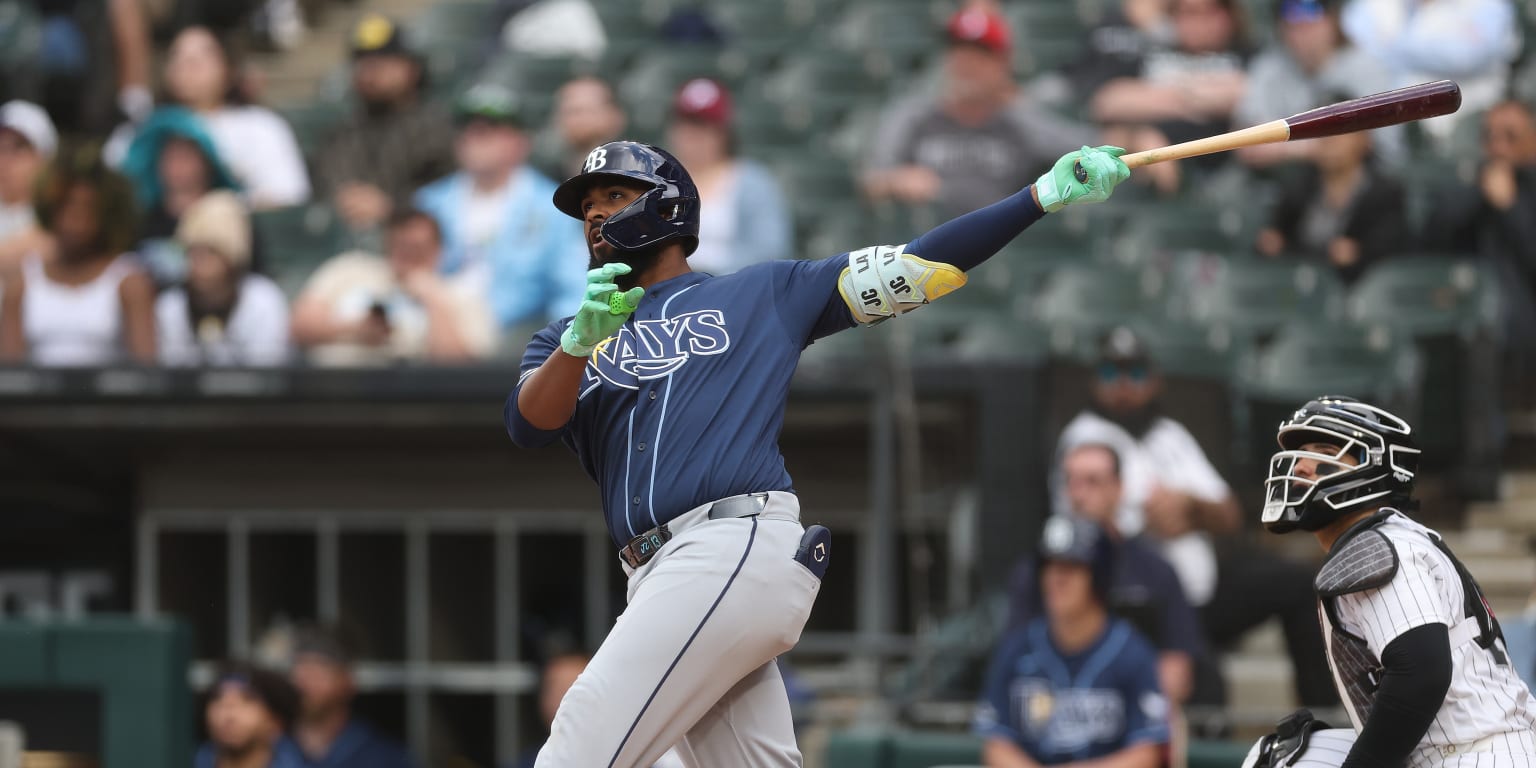
But the swing — the swing itself is just as unique. The Rays star has the most extreme swing in the Major Leagues.
Last season, Caminero had a fast swing and a flat swing. He hit 45 home runs.
This season, Caminero has THE fastest swing and THE flattest swing. How many homers will he hit now?
Caminero’s average bat speed this year is 79.9 mph. That ranks No. 1 out of all the Major League hitters who qualify for Statcast’s bat speed leaderboard, ahead of even giant sluggers like Giancarlo Stanton — a high bat speed, flat swing poster boy — and Oneil Cruz. This is where Caminero’s explosive power comes from.
But you should also watch the shape his swing takes to generate all that bat speed and connect for those monster home runs. The vertical tilt of Caminero’s swing path is just 22 degrees. That is the flattest swing path in the Majors among all qualifiers. (MLB swings range from about 20 to 50 degrees as the bat approaches the ball. Zero degrees would be a bat traveling perfectly parallel to the ground; 90 degrees would be a true golf swing.)
It’s all part of his plan at the plate: Caminero’s elite bat speed gives him his light-tower power potential, and a level swing path, in his mind, helps him square up the baseball.
Caminero’s swing was an outlier before. In 2025, he had a 78.5 mph bat speed and 26-degree swing path, which was the second-fastest and the ninth-flattest. But now he’s in a league of his own. He’s out-Stantoning Stanton.
With that swing, Caminero is on a 40-home run pace again in 2026. He has nine through the Rays’ first 36 games, and his overall offensive production is right in line with last year.
But where did such a unique swing come from?
Interestingly, the origin of Caminero’s fast-but-level swing traces back to none other than Albert Pujols.
Pujols was Caminero’s manager when he played for the Leones del Escogido in the Dominican Winter League a couple of years ago, and again with the Dominican Republic at the 2026 World Baseball Classic. And who better to talk hitting with than one of the greatest hitters of all time?
“I just want to be on plane with the pitch,” Caminero said this week through Rays interpreter Kevin Vera. “And that was one thing that I learned in the Dominican with Albert Pujols. He was telling me, ‘Hey, just get level with the pitch.’ Because the whole point is obviously to hit the ball in the air, but you don’t want to pop it up, you don’t want to fly it up. You want to elevate it [the right amount], so then you’re able to hit home runs.”
If you’ve ever seen Caminero hit a high fastball, you understand the benefit of keeping a level swing path like he does.
This season, he already has four homers off fastballs at or above the top edge of the strike zone, the most of any hitter. Often, those balls are crushed — like Caminero’s 111 mph, 450-foot bomb to dead center at The Trop off a 98 mph high heater from the Twins’ Taj Bradley.
The high fastball is an easy pitch to get under as a hitter, generating tons of whiffs and popups … unless you have a level swing like Caminero’s, and the elite bat speed to turn the heater around before it explodes past you. Pujols had the level swing to crush those pitches, too.
“It wasn’t necessarily a whole focal point of conversation, but it was something that he was like, ‘Hey, be conscious of this in your swing, and then slowly but surely add it,'” Caminero explained. “At times, I’ve tried to be a little bit more exaggerated and try to get under the ball, but that doesn’t always produce the results that I want. So again, the whole point of this is just be as level as possible and go from there.”
Now, there is some risk of flatter swings producing more ground balls, especially against pitch types like sinkers or breaking balls down in the zone that can get underneath the bat. Caminero knows this from experience — early last season, he was grounding into tons of double plays, and he ended up leading the Majors with 31 for the year.
But he also showed impressive adaptability against those pitches as the season went on. Caminero was able to adjust his swing to cover a wide range of pitch types and locations.
He doesn’t only hit high fastballs. Caminero can also crush breaking balls and offspeed pitches — even ones well below the strike zone. Since the start of last season, he’s hit 22 homers off breaking and offspeed pitches, sixth-most of any hitter. He’s hit 32 homers off fastballs … also sixth-most. No matter the pitch type and where it’s located, Caminero’s swing stays relatively flat compared to his fellow big league sluggers, and he still mashes.
Plus, whatever risk there is for ground balls with a flat swing path, there’s also a risk for uppercut swing paths, too. Those can leave a big hole to be exploited at the top of the zone, especially by high fastballs … Just ask someone like Riley Greene, who has the steepest swing path in the Majors and was attacked relentlessly with high fastballs down the stretch last season after his hot start.
And in the end, great swings come in all shapes and sizes. Swing path is more of a reflection of a hitter’s style rather than a purely “good” or “bad” number. There are plenty of great hitters with flatter swings, just like there are plenty of great hitters with steeper swings. Caminero might not want to be so extreme for the entire season, but he can have a flat swing and still be a great power hitter. He’s already proved that.
The Rays are a flat-swinging team. Actually, they’re the flattest-swinging team this season. It’s a signature of theirs. Besides Caminero, Yandy Díaz, Chandler Simpson, Jonny DeLuca, Richie Palacios and Nick Fortes all have swing paths flatter than 30 degrees. (Fortes would actually out-flatten Caminero if he had enough swings to qualify for the leaderboard, with an 18-degree swing tilt this season.) Heck, even former Rays stars like Randy Arozarena have flat swings.
Those flat swings work differently for the various Rays. Yandy, famously, is a high-hard hit, high-ground ball player, who can win a batting title when his swing timing is right but has pounded balls into the dirt his entire career. Simpson’s flat swing is geared toward putting the the ball in play where he can take advantage of his elite speed, as he slashes the ball up the middle and to the opposite field.
For Caminero, much more important than the overall swing path is the top-of-the-line bat speed — that is something he unquestionably wants to be elite at, since the faster he swings, the harder he can hit the ball — and also, what his barrel is doing at the point of contact with the baseball.
Any swing shape can produce a home run if the hitter’s timing is right. The barrel just needs to be traveling in the right direction at the moment it hits the ball — aka, at the optimal upward trajectory to produce a line drive or fly ball. That’s the hitter’s attack angle, and Caminero’s got a lot better as the 2025 season went on. He’s largely carried that forward into 2026.
However your bat got there, at the contact point, you don’t want it to be moving too steeply or too flat. Then you’ll mishit the baseball, whether it’s a popup or a grounder or just weak contact. Caminero thinks his flat bat path helps him get to the right attack angles.
“My whole approach with the swing is I just want to stay as level as possible,” Caminero said. “Because if I feel like I’m getting under the baseball, I’m just gonna miss it, plainly. I’m going to start to swing under it. So when I get on plane with the pitch, I want to obviously hit the sweet spot, or at least square up the ball, because then I elevate it, right? And if I don’t, [there’s also] the issue of rolling over on pitches and getting into double-play situations, just hitting groundouts.”
If a level swing path helps Caminero get the barrel of his bat to the right spot at the right time, then his flat swing is worth it.
“When I’m on plane, when I’m doing everything right, I know that’s when my bat speed is at its best,” Caminero said. “And that’s when I get the results that I want and I’m able to elevate the ball.”
MLB.com’s Adam Berry contributed reporting to this story.