




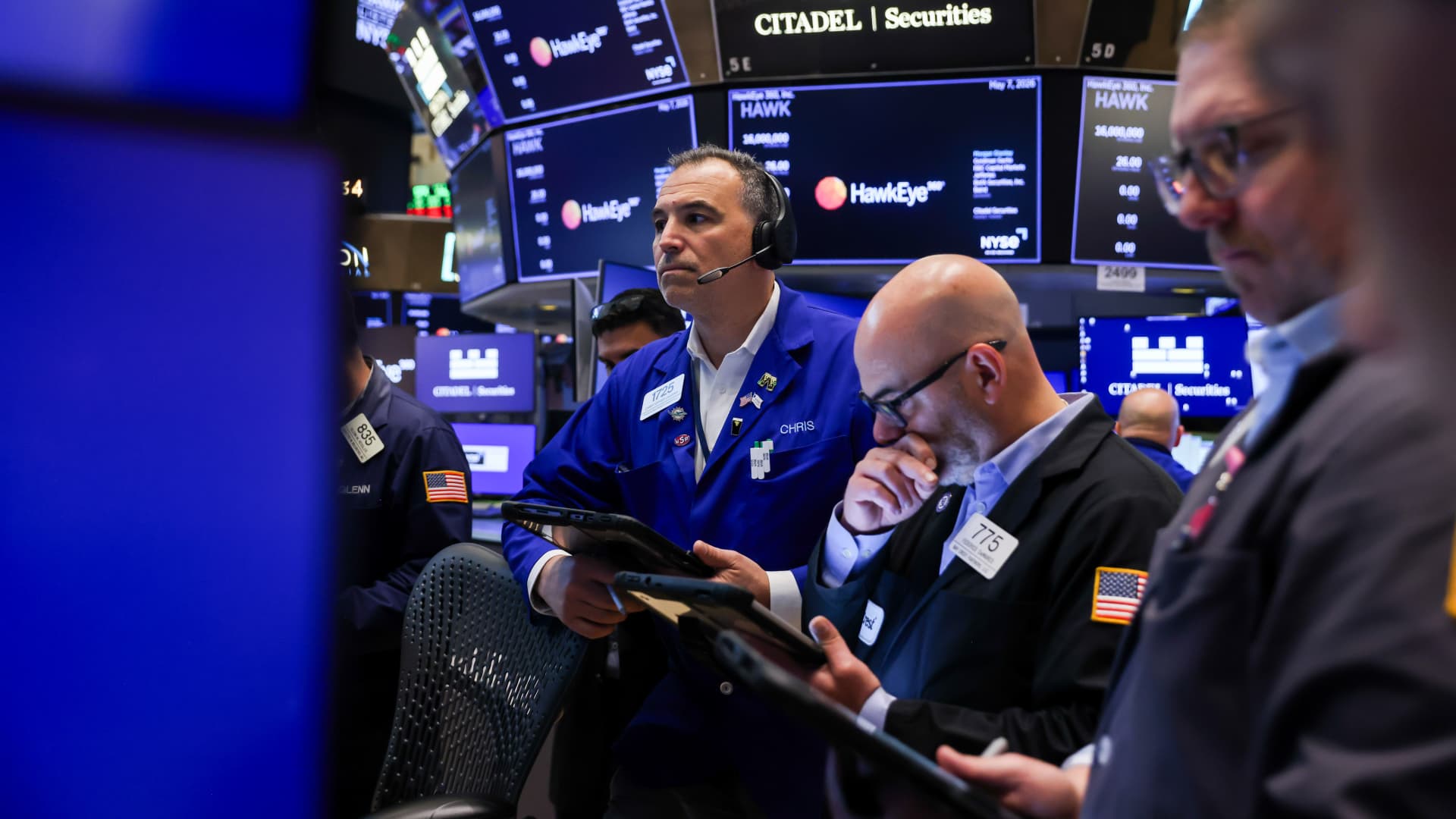
Traders work during the Hawkeye 360 Inc. initial public offering (IPO) at the New York Stock Exchange (NYSE) in New York, US, on Thursday, May 7, 2026.
Michael Nagle | Bloomberg | Getty Images
The Nasdaq Composite and the S&P 500 fell on Monday, bogged down by declines in technology, as traders monitored oil prices and bond yields while awaiting further developments with the conflict in the Middle East.
The broad market benchmark dropped 0.07% to end at 7,403.05, while the tech-heavy Nasdaq slid 0.51% and closed at 26,090.73. It was the second straight day of declines for both indexes. The Dow Jones Industrial Average closed up 159.95 points, or 0.32%, at 49,686.12.
Seagate led a selloff in the memory chip space after the CEO said during a JPMorgan conference that new factories would “take too long.” Seagate fell nearly 7% and dragged peer Micron Technology lower by almost 6%. The comment exacerbated concerns that the memory chip industry doesn’t have the capacity to meet soaring demand.
Alongside Seagate and Micron, shares of Western Digital lost 4.8% and Sandisk dropped 5.3%. Beyond that, fellow artificial intelligence-related stocks such as Nvidia and Broadcom lost 1% apiece.
Those moves come during a delicate time for stocks. The S&P 500 and Nasdaq hit fresh record highs last week, while the Dow briefly reclaimed the 50,000 level.
However, the major averages suffered a setback Friday, as sovereign bond yields around the world rose. The U.S. 30-year Treasury bond yield hit its highest level in around a year. It was last little changed alongside the 10-year Treasury yield. In the U.K., the 30-year Gilt yield had scaled to levels not seen since the late 1990s, along with long-dated Japanese bond yields.
Tech stocks, which had been leading the market to record highs got battered by the spike in yields. The Nasdaq-100 index dropped 1.5% on Friday, marking its worst one-day performance since March 27.
Tensions are still high between Iran and the U.S., keeping oil prices elevated as the path forward for the conflict remains unclear. West Texas Intermediate futures gained roughly 3% to close at $108.66 per barrel, while Brent crude settled up more than 2% at $112.10 a barrel.
The rally in oil prices lost steam after President Donald Trump said in a Truth Social post Monday that he is holding off on an attack on Iran that was planned for Tuesday. The decision was made at the request of Qatar, Saudi Arabia and the United Arab Emirates, whose leaders said that “serious negotiations are now taking place” that could lead to a deal that is “very acceptable” to the U.S.
On Sunday, Trump said Iran had to “get moving” or there “won’t be anything left.”
On top of that, new inflation data released last week makes the Federal Reserve cutting rates anytime soon a long shot.
“There’s truly inflationary problems,” Ben Fulton, CEO of WEBs Investments, said to CNBC, calling elevated oil prices a “watershed” issue. “It’s going to be hard to see that offset.”
This means that stocks could be in a “heavy range trade” from here on out without positive developments out of the Middle East, especially regarding the Strait of Hormuz, he said.
“I could see people starting to protect profits pretty quick,” Fulton added.