



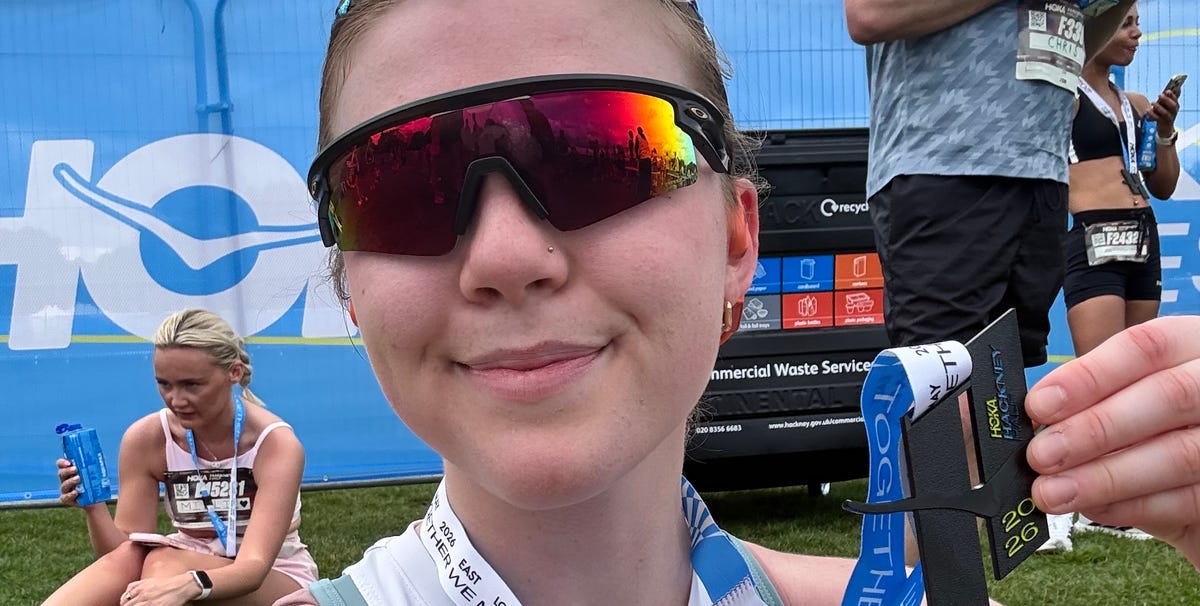
Don’t get me wrong, I love a wearable as much as the next runner, and somehow manage to make every pub conversation about VO2 max stats. But after running my first marathon last month – which I spent a great deal of time looking down at my watch rather than up at the amazing crowds and atmosphere – I was experiencing a touch of data fatigue.
So, when my favourite peanut butter brand, Pip & Nut, asked me to run this year’s Hackney Half Marathon, I was keen to conduct a little experiment: racing without a watch. While I’ve run without a watch before, I’d never raced without one, so it felt strange lining up at the start watch-free amid the ripple of bleeps around me. Nevertheless, off I went to run my second-fastest half marathon time yet.
Here’s everything racing without a watch taught me about pacing – and my own fitness.
I started a lot slower than I thought
Like the majority of runners, my toxic trait is going out too aggressively. Fuelled by vibes and adrenaline, an overly fast opening few kilometres are often the downfall of my race.
Interestingly, though, when I looked back at this race’s splits (I had Strava running on my phone in my pocket… call me a fraud, but I promise I didn’t peek while running), the first kilometre was my slowest. This was likely one of the main reasons I didn’t really hit the wall and my splits stayed relatively even throughout.
While you might assume a watch helps protect you from going out too fast because you can constantly monitor your pace, I actually think the opposite happened here. Because I was worried about not having the data to guide me later in the race, I was much more tuned into my body from the outset.
The result? More conservative pacing that protected the rest of the run.
My breathing was much better
I found it much easier to breathe throughout the race, which I think was partly because I wasn’t constantly distracted by my watch.
As a result, my posture and overall running form felt better, and my breathing improved alongside it – almost becoming my own internal metronome.
I didn’t push myself as hard
As mentioned, racing watch-free for the first time definitely made me run more conservatively – and while that helped slow my start, it also meant I probably didn’t push myself quite as hard as I could have. In hindsight, I likely had enough leftover marathon fitness to PB.
But that wasn’t really the point of the experiment.
Running without data and relying entirely on feel gave me a much clearer sense of where my fitness actually is right now – which will probably help me plan future races better.
And honestly, who needs a watch when you’re running on pure vibes and peanut butter anyway?
Hannah Bradfield is a Senior Health and Fitness Writer for Women’s Health UK. An NCTJ-accredited journalist, Hannah graduated from Loughborough University with a BA in English and Sport Science and an MA in Media and Cultural Analysis. She has been covering sports, health and fitness for the last five years and has created content for outlets including BBC Sport, BBC Sounds, Runner’s World and Stylist. She especially enjoys interviewing those working within the community to improve access to sport, exercise and wellness. Hannah is a 2024 John Schofield Trust Fellow and was also named a 2022 Rising Star in Journalism by The Printing Charity. A keen runner, Hannah was firmly a sprinter growing up (also dabbling in long jump) but has since transitioned to longer-distance running. While 10K is her favoured race distance, she loves running or volunteering at parkrun every Saturday, followed, of course, by pastries. She’s always looking for fun new runs and races to do and brunch spots to try.
Source link
See more: https://theglobaltrack.com/
https://corinthiames.com.br/