


He remembers his coach’s words, back when he was just 12 years old. Back when he was growing up in Giresun, Turkey, a historic city on Turkey’s Black Sea coast.
“You got to be the one.”
Alperen Şengün was only a middle-schooler, but he realized he had to quickly grow up. Become the man his family needed him to be. Which meant leaving everything and everyone behind and pursuing basketball at a renowned Turkish hoops club far away, in a city about 650 miles west of his hometown, on the southern coast of the Sea of Marmara.
If he impressed with the youth team of this club, he could maybe advance to the pro ranks. And if he really played well, maybe he had a shot at someday playing in America. What all of that meant was that his family would no longer have to just survive; maybe one day they, could have enough money to live comfortably.
Things were not easy at home. Living in a modest apartment with his mother and father and siblings, trying to make ends meet, space was scarce. His parents often slept on couches that were propped up in the kitchen. His father worked as a fisherman.
Şengün was his family’s hope. Their dreams were wrapped up in his, tightly bound like the delicious Dolma, or stuffed vegetables or grape leaves, that his mother would make weekly.
“There’s nothing for you here,” his coach said, trying to comfort his anxieties about leaving. “Leave for your family.”
Tears streamed down Şengün’s face as he left. But the decision to leave was warranted. He was an ideal prospect for the youth club. He was tall and had promising skills. The kind of game instinct and future potential that coaches can identify early. His game was more than ready to compete against the other kids his age, and he showed early that the sacrifice to leave was worth it. But a few weeks into his time with the club, he still wasn’t happy. Every night, he’d call his family. “I was crying every day,” Şengün says now, reflecting on this experience. “I was calling them to pick me up from here because I can’t do it. (I’d tell them): ‘I miss you guys.’”
This was the most difficult part of his journey, he says.
“It was hard for me, and it was hard for them, too (my parents),” he says. “But they weren’t really showing me that.”
They tried to show strength. Tried to remind him that one day this would all pay off. That he could make it on his own. It was a lot to carry on a 12-year-old’s shoulders. And even then, he had compassion for his parents’ feelings about the move. He remembered how upset his mother was inside — and how, as hard as she tried, she struggled to hide it on her face. He remembered how his dad tried to keep it together — so strong that he seemed almost “coldblooded, next to my mom,” he says.
About four months in, Şengün began to embrace the sacrifice. Dream of the future.
“I understood what I have to do this for,” he says, “to give my family and for myself a better life. And after some point, you know, you see you becoming someone. You’re making some money. You can take care of your family. You [become] a pro. You can make more money.”
The few times his parents were able to visit him in person, they’d embrace him with a warm hug. Şengün would squeeze tighter, as if by doing so he could prevent them from leaving again, the way he used to do as child when his dad came home after a long day on the water: “I was just hugging him all night.”
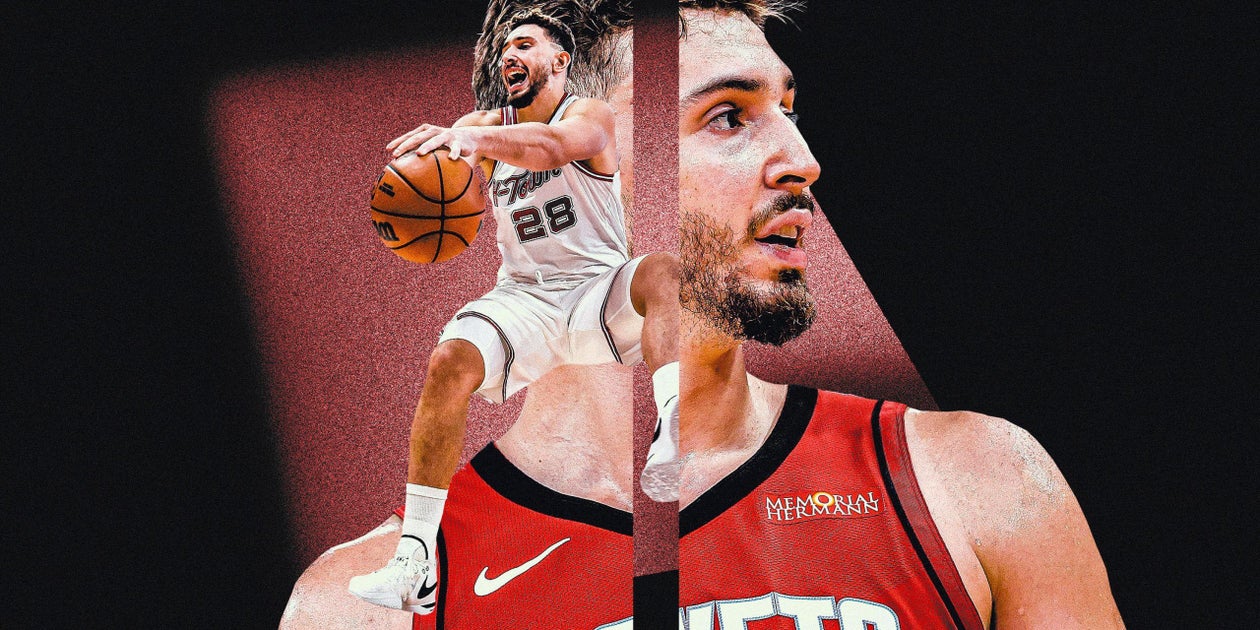
Şengün’s motivation then was the same as it is now, as a fifth-year center for the Rockets: to make his parents proud. To take on any challenges that come his way. And he’s certainly being tested now. The two-time All-Star has struggled mightily in the Rockets’ first-round series against the Lakers. He nearly led them back into the series with a miraculous game Friday that ended in heartache, but now he faces the need for a real miracle: digging Houston out of a 3-0 hole against LeBron James.
You got to be the one.
His struggles throughout his upbringing, throughout those years away from home, have prepared him for this moment of adversity: The Rockets’ abysmal start in the playoffs has Houston on the brink of elimination, a far cry from the hopes for the team at the beginning of the season when it added superstar Kevin Durant. Durant missed Games 1 and 3 with an injury.
On Friday, the Rockets had a chance to pull off a win at home, behind a big performance by Şengün, who finished with 33 points and 16 rebounds. It was badly needed, as he struggled mightily throughout the first two games. So badly, that he has been turned into a meme on social media. But in Game 3, he was everywhere, dropping in fallaways and dunks, scoring 16 points in the fourth quarter and overtime periods.
But Houston collapsed miserably, dropping a six-point lead in the final 30 seconds, and James came up clutch. Houston lost 112-108, despite L.A. being short-handed without its two leading scorers in Luka Dončić and Austin Reaves.
“Horrendous mistakes. I don’t know if you want to say youth or scared of the moment or whatever the case,” Houston coach Ime Udoka said afterward.
Houston now has the daunting task of trying to prevent a sweep on Sunday. Şengün will have to show up big again. To look like the player he was during the regular season. According to the Elias Sports Bureau, Alvan Adams, Larry Bird and Oscar Robertson are the only players to have reached Şengün’s totals in points, rebounds and assists through the first 350 games of a career; Adams is the only player if you add steals and blocks (steals/blocks became official stats in 1973-74, so Robertson didn’t benefit from them).
Until breaking out Friday, Alperen Şengün was the face of the Rockets’ struggles — and fan frustration — in the first round. (Sean M. Haffey / Getty Images)
He is living a life far different from the one he grew up in Turkey. He has made more money than he ever thought possible. In October 2024, he signed a five-year, $185 million extension. But everything seems to remind him of home. What he has, what he didn’t have. Who he was, who he is.
The gulf between his life now and his life then was ever clear on a night in late January, when speaking with The Athletic while in Philadelphia for a road trip. He had just arrived at his room after landing. He’s staying at a five-star hotel. He hears a knock at the door. It’s room service.
“Give me one second,” he says to the attendant. “Yeah, come in here. Just put it there. Thank you. Thank you.”
He ordered steak, spinach and mashed potatoes. The white plates, the silver lids, the way it is wheeled into the room — none of it is lost on him. He doesn’t feel jaded. Because when he sees the warm plates, he is reminded of how different his upbringing was.
“Of course it hits me,” the 23-year-old says. “I talk about this stuff with my family, because they know where we came from. I couldn’t talk about this to my friend, because they don’t know where I came from, you know?”
“Even the cars I have right now, even those, I’m remembering like, we used to be all in the bus, or walking someplace. Now I have whatever I want. And it’s like, really crazy.”
He feels pride every time he gets in his car, touches the wheel, knowing he can transport his brother, sister and parents anywhere they want in Houston when they visit.
“We can go anywhere,” he says. “No need to look for anyone to pick us up. It’s an amazing feeling.”
It is also a complex one. Because acquiring wealth does not erase memories of not having. And the more he makes, the more his old life seems farther and farther away. He thinks about that discrepancy “all the time,” he says. “I’m really grateful. I pray all the time. I think everything as a reason happened to me. And I believed God opened a lot of ways for me. And everything is for a reason, you know?
“My family right now, nobody works,” he continues, “because I don’t want them to. I just wanted them to take care of themselves.”
The room-service attendant returns. He has sweet potato fries for Şengün. A nice surprise. A perk of this new life he has built.
And a memory of his old one.
There was a stand near his home back in Turkey that had the best chicken shawarma. It was so delicious, but unaffordable for him, so only reserved for a special occasion.
“You can’t have it all the time,” he says. It was maybe three, four Turkish Lira. “It was really hard to get that money and go eat that food,” he says.
The rare times he had it, he savored each bite. He’d think of it when walking past it, wishing he could have it.
“It was hard, you know?” he says. “And now I can have all the food in the world. People can make it for me. I have a chef. … When you get more professional … life just gets better … Everything getting easier.”
Remembering, however, keeps him humble. Keeps him grounded. Motivated. Just because you leave one place doesn’t mean it ever leaves you. His upbringing, his joys, his struggles, remind him why he’s doing all of this.
“I always know where I come from,” he says.
Who he comes from.
“I will never give (my parents) any reason to tell me like, get humbled … I would never give a reason like that because I have to know where I come from.”
He talks to his family daily, especially his dad. His dad often tells him he is proud of him. That people back home are, too. And then Şengün realizes his purpose is bigger than himself.
“I gotta do this for everybody,” he says.
His family is in town the same week as the Philadelphia game, staying with him. He’s ecstatic that they are here. But he knows it is also temporary. After the trip is over, they will go home. And some part of him will feel like the 12-year-old who had to leave them. The now pro who feels, in a sense, as if he is always leaving them, no matter how frequently they speak.
“There’s like, some, you know, some broke thing inside of me somewhere, is always missing them,” he says.
It is his wound and his why; the force that keeps him moving.
The night before the flight to Philadelphia, he and his brother were talking late into the night in Houston. It was around 1 a.m. The Rockets had just beaten San Antonio, and Şengün nearly had a triple-double: 20 points, 13 rebounds and nine assists. His adrenaline was still pumping.
“I wasn’t sleeping,” he says.
He and his brother were hanging out on the balcony in Şengün’s home. Somewhere in the conversation, looking out to the deep, dark night, they both had a similar feeling. They looked at each other.
“Even this balcony is bigger than where we grew up.”
They realized how far they had come. How far Alperen had taken them.
“This balcony,” he says, “is wider, and longer wise, if you try to make a house — it can be our old house, you feel me?”
The more they shared memories, the more it seemed as if they were back in the old house. Their parents had slept in the kitchen. The old house had just “one kind of little living room,” he says. “That was where me and my brother used to sleep.” His sister later had her own room, as the only other woman in the family besides their mom.
“In Turkey, it is different compared to America,” he says. “You stay in small apartments or small houses, so you used to live in the living room.”
These days, he often misses his mother’s cooking — especially her Dolma. And her cake. No matter how many times he tries to find the dishes elsewhere, including the several Turkish spots he relied on his first few years in the league, no one ever made them like Anne (an-neh). Mom. She could write down the exact recipes for him, and they still wouldn’t be as good. “Mom’s food, everybody will love it, and we grew up eating those foods,” he says. “You always miss it.”

Şengün struggled to adapt to the NBA so far from his family. “My first two years, I was barely talking English,” he says. (Logan Riely / NBAE via Getty Images)
Missing. It’s a feeling that tugs at him constantly. It’s a feeling that he has felt for as long as he can remember.
“I was away from them, almost, like half of my life,” he says.
Even before leaving at age 12, there were days he didn’t see his father. He was working long hours. “I was with my mom all the time,” he says. But whenever his father came home, he told Şengün how proud he was of him. How he had a bright future.
Young Şengün would beam, wanting badly to make his father proud. He’d envision his dad at future professional games, cheering him on. His dad also coached him in his early years.
“My dad was pushing me all the time,” he says. And he wasn’t afraid to tell his son to pick things up. “Even if I play bad,” Şengün says, “he curse my ass out.”
Şengün would go to internet cafes and search YouTube for basketball highlights, watching clips of LeBron James and Michael Jordan. Studying. Dreaming. Praying. He fell in love with the game. And he clung tighter to his family. He was always aware of what they didn’t have, but that wasn’t his focus.
His mind was on the abundance of what he did have:
Love.
“We’ve seen a lot together,” he says of his family. “We are still happy.”
Being with them, then and now, is his definition of success. Of why life is worth living.
“Whenever I am with my family, I’m always happy,” he says. “Even now, I have all the money in the world, but I still think I can make so much more money. I can work for it, and I can just give them a better and better life, and never think of money ever again in their life.”
Şengün starred on the youth team at 12, but was constantly tested. “The coach,” he says, (was a) really tough guy. He was always tough on me.” That meant playing hurt no matter what. “I was working with broke ribs. You know, like twisted ankles. Everything. He was just always coaching me hard.”
He felt his coach had his best interests at heart, because he cared for his family, too. He knew how lonely, how isolated, Şengün felt, away from his friends and family in pursuit of his basketball dream.
“That stuff helped me growing up,” he says.
The tough coaching style on the floor would also help him adapt to the NBA years later, too: “NBA players, like, we are not normal people, you know? We have to get through a lot of stuff,” he says.
Certainly, he’s experienced that during this playoff series with the Lakers, where the chatter about him online has called him anything from a disappointment to a complete failure. Even his biggest supporters are questioning his abilities. The lessons he learned with his early Turkish coaches about staying calm through adversity have stayed with him.
“If you’re doing this business, you’ve got to be really strong mentally, because it’s not easy,” he says. “There’s a lot of stuff going on on the court. You don’t want to lose. You lose. There’s a lot of games, you can have a bad game. And it’s social media. Even if you say you don’t care, you care at some point. So stuff like that, I think, always make me a stronger person.”
Şengün turned pro at 16 for a team called Banvit. He played with them until he was 18, before signing with the Turkish club, Beşiktas. “I was like, always, ‘I’m going to be in the top level,’” he says, “So my dad can say, ‘My son did this,’ you know? And that was always my goal — and still is my goal. I want to be one of the greatest, and hopefully my dad can see those days with me.”
He was named MVP of the Turkish Super League, one of the top leagues in Europe, at 18. The better he became, the more he realized he could have a future outside of his homeland. Scouts flooded the stands, and he’d say to himself:
I can do more. I can do more.
“This just was making me work harder,” Şengün says.
He was drafted by the Thunder shortly thereafter in the 2021 NBA Draft, 16th overall. His draft rights were traded to the Rockets. He knew he’d have to work even harder. The toughest part of his NBA journey, at first, he says, was the language barrier at first.
“My first two years, I was barely talking English,” he says.

Şengün was drafted 16th overall and would land in Houston, where he developed into a two-time All-Star. (Arturo Holmes / Getty Images)
That was difficult, not just for obvious reasons, but because he’s an outgoing person. He wanted to connect with his teammates. The more he mastered English, the more he found his way on the floor, too. And the tough tactics of his Turkish coaches helped him adapt to the NBA game, too. “When Ime came,” he says, “I’m pushing myself every second. Defense, rebounding, scoring, everything.”
He feels he’s found a home with the organization, in this city, which is one of the most diverse in the country. “I love Houston,” he says. “I can’t think of living somewhere else in the U.S. Even people (are) asking me, ‘Where would you live after you’re retired?’ I still say sometimes it depends on my career, but I love to say Houston … It’s amazing.”
He wants to get to the point where he’s doing something, and in 20 years, someone will say: “That’s a Şengün move.” “[I want] to add different moves every year,” he says. “Get better and better. That’s my goal.”
He thinks back to the internet cafes, the people he saw on highlight reels on YouTube. LeBron James. Someone he now has to guard from time to time in this playoff series. And it hits him, with stunning clarity, that some kid in Turkey right now is watching his highlights, studying his moves.
Dreaming.