


ST. PAUL, Minn. — When Nick Foligno was traded from the Chicago Blackhawks to the Minnesota Wild in March, one of the first texts he received came from Dallas Stars forward Matt Duchene, one of Foligno’s closest friends in hockey.
I hate that I have to hate you for the next few months.
Of course, Duchene followed that text up with another one about how cool it was that Foligno would get to play with his brother, Marcus, and how genuinely happy he was for him. There wasn’t an explicit invite to the cottage this summer, but, hey, that’s always implied.
No, in the NHL, hatred isn’t what it used to be.
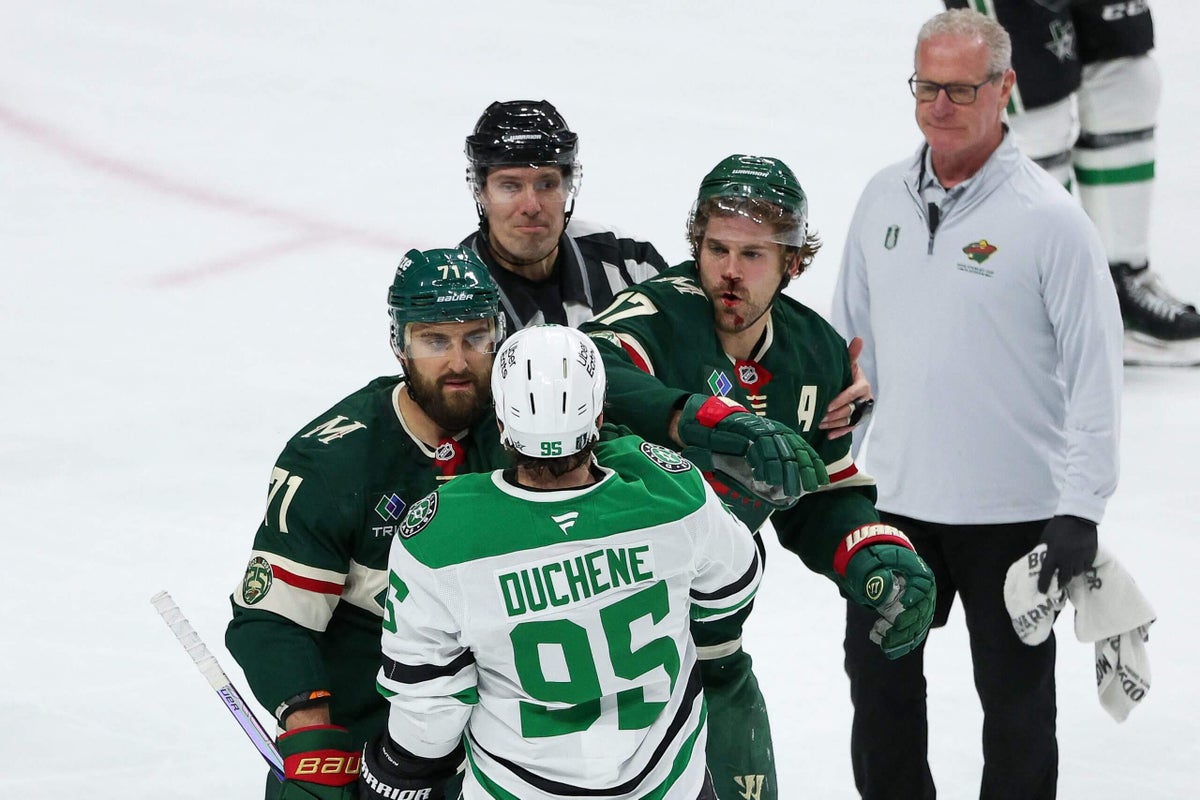
The first-round series between the Wild and the Stars has been fierce and physical, as two of the most talented teams in the league haven’t been shy about showing their uglier sides. In Game 1, Dallas’ Tyler Myers gave Mats Zuccarello an apparent concussion with an elbow to the head, forcing him to miss Games 2 and 3 and leaving him questionable for Game 4 on Saturday. In Game 2, Marcus Foligno rode Thomas Harley head-first into a stanchion, then bulldogged him face-first onto the ice. In Game 3, Dallas’ Jamie Benn delivered a flying cross-check to the back of Matt Boldy’s head, briefly knocking him out of the game, and Wyatt Johnston speared Kirill Kaprizov in the groin after Kaprizov took a swipe at a frozen puck in Jake Oettinger’s mitt. Then there’s Colin Blackwell’s clean-but-bone-rattling open-ice hit that injured Minnesota’s Yakov Trenin in Game 1; Trenin hasn’t played since and is out for Game 4. Not to mention Duchene landing on Marcus Foligno in Game 3, leaving Foligno bloodied and seeing red.
Yet no Wild player went after Benn. Harley went mostly unavenged. Myers hasn’t answered for his elbow. Johnston appeared to apologize to Kaprizov almost immediately, and never even got so much as a facewash for the sneaky stickwork. And while Foligno took an angry swing at Duchene after Duchene went to check on him, both guys essentially apologized afterward over what they saw as a big misunderstanding between friends.
“You could see the look in his eye when he got up, he didn’t care that it was me,” Duchene said. “He was pissed. I don’t blame him after what he thought happened. I don’t take it personally at all.”
Well, OK, but why not?
Maybe 10 years ago, this series gets ugly. Twenty years ago, there are probably suspensions being handed out. Thirty years ago, there’d be retaliatory cheap shots all over the place.
Forty years ago? This series would have been a bloodbath.
But the league is different now. The game has changed. For the better, if you like speed and skill and grace and talent. For the worse, if you’re an old-school fan who used to revel in the hatred. The history of the league, particularly of the Stanley Cup playoffs, is etched in the scars on the faces of the players who lived through those truly heated — and often scarily violent — battles of yesteryear.
Think of how much the Chicago Blackhawks — players and fans alike — hated Minnesota North Stars legend Dino Ciccarelli in the 1980s, and how much Minnesota returned the favor toward Al Secord. Think of the Colorado Avalanche and Detroit Red Wings in the 1990s, with Claude Lemieux always at the center of the malicious maelstrom. Think of Dave Bolland and the Vancouver Canucks in the late 2000s.
It’s just not like that anymore. And it’s almost certainly for the better. We want to see the best players on the ice, not in the penalty box or, worse, on injured reserve. The game is faster, better and more exhilarating than it’s ever been. We’re truly in a golden age of hockey, where superstars, not enforcers, are the focus.
Oh, sure, the league still has its villains — seemingly half of the players on the Florida Panthers roster revel in being despised, particularly Sam Bennett with his convenient penchant for falling on opposing goalies and Brad Marchand with his lifelong knack for stirring up trouble.
But the fact is, everybody knows everybody in the modern-day NHL. They share an agent. Or they work out together in the summer. Or they’ve played on so many teams that they’ve been teammates with half the opposing roster. Everybody’s buddies.
They didn’t used to be.
When Wild radio broadcaster Tom Reid sees opposing players hugging and laughing in the talent corridor between locker rooms before or after a game or chatting amiably at center ice during warmups, all he can do is shake his head. When he was playing for the North Stars in the late 1960s and early 1970s, that would have been unthinkable.
“I can remember being in Montreal, that’s when (enforcer) John Ferguson was there,” Reid said. “Fergie, as one of their leaders, if he saw one of his teammates even talking to one of the opposition in a friendly way, you had to answer to John Ferguson. So nobody talked to each other. But now these players follow the money, wherever the money is, so they have a lot of friends on every team. ‘Hey, tell so-and-so I said hi.’ There’s no animosity between these teams anymore.”
In the regular season, for certain, friends stay friends. It’s quite common for a player to go out to dinner with his former teammates the night before a game against his old team. It tends to get a little frostier as the postseason draws near, and communication is typically cut off entirely between teams once they draw each other in a playoff series. But that’s more to protect the friendship than anything else.
The Wild and Stars “hate” each other. But they don’t really hate each other.
“I haven’t talked to (Duchene),” Nick Foligno said after Friday’s practice. “We both want to win badly, so I’ll put that friendship on hold. And I think he understands the same thing. Fifteen, 20 years ago, just in general, the game was a lot different. A lot more nastiness. It’s not real hate now. It’s more a compete and a want. This team’s trying to take away a dream of mine, and vice versa. So I have enough ‘hate’ there for everyone.”
Duchene called it an “unspoken thing.” It’s not as if opposing players warn each other they’re going to go incommunicado before a series begins. It’s simply understood that, for these two weeks, friends become enemies.
“I’ve played against several guys the last few years in playoffs that I know well,” Duchene said. “I’ve been to their cottage or their house, and they’ve been to mine. Our wives are friends. But that all gets put aside for the couple weeks you’re at war against each other. It can get ugly. Then you get in the handshake line afterward, win or lose. It’s just how it goes. It’s effortless for those two weeks. It’s all about the jersey you’re wearing, and you’re putting the friendships aside.”
But unspoken or not, effortless or not, it’s human nature that you’re not going to attack your buddy the same way you’d attack a mortal nemesis, the way Ciccarelli would attack a Blackhawks player, the way Lemieux would go after a Red Wings player. This Wild-Stars series has been an endless parade to the penalty box, but it’s been mostly for stick fouls — hooks, high-sticks, trips and the like. They’re what Stars coach Glen Gulutzan describes as “trying too hard” penalties.
There have been just five roughing minors — two of them to Marcus Foligno for the Harley incident — and zero fights through three games. Fighting is rare in the playoffs these days because teams are hyper-wary of putting their opponents on the power play. But even the post-whistle skirmishes have been pretty mild in this series, despite all the injurious hits and perceived cheap shots.
“If something happens in the game these days, (the animosity) might build up for a bit, but then it goes away — very quietly, it goes away,” Reid said. “I can’t see friends fighting all the time. That’s not going to happen. If you remember, at the beginning of this series, everyone in the NHL hierarchy said that this was going to be a bloodbath. But it’s not been. It’s been very quiet for the most part. You don’t see the animosity we were all expecting to see. Which is not good for the fans. The fans like it, and I think the players like it, too, when they get into it. But the problem is, they’re friends with everybody.”
Reid said that in his day, players reveled in the vitriol, that “it’s fun to be hated.” No team personified that more than the Broad Street Bullies, the brutal Philadelphia Flyers of the 1970s. Reid admitted to sitting on the bench before a morning skate and chatting with Flyers menace Bobby Clarke once. But he wasn’t Clarke’s friend.
Nobody outside the Flyers locker room was Clarke’s friend.
“Acquaintances, at best,” Reid said with a laugh. “Are you kidding me? We all hated each other. On the ice, this was my livelihood, and they’re coming for it.”
The taming of the playoffs goes beyond player friendships. Goons, guys who played five or six minutes a night and whose primary role was to “protect” the stars and avenge them when necessary, are a long-extinct relic of hockey’s past. Fourth-liners are now typically speedy players who inject bursts of energy and skill into a team or lockdown defenders who can play 12 to 14 minutes a night and be trusted in tight games.
And penalties are too costly, power plays too dangerous. Dallas had three power-play goals in a 4-3 double-overtime win in Game 3. The last thing Minnesota wants to do is give the Stars more opportunities to let Johnston, Duchene, Mikko Rantanen, Jason Robertson and Miro Heiskanen go to work, just to ease their anger at Myers or Benn. Going after either of them might be cathartic, but it could also be seen as selfish.
“With how many penalties are being called, it’s tough to go after a guy in the heat of the moment,” the Wild’s towering, physical, fourth-line center Michael McCarron said. “You’ve got to remember what happened, and when there’s a legal way to do it, the right way to do it, things will get handled. Forty years ago, you could have went after him and nothing would have been called. It would have been even, five-on-five. Now, and it’s not just our games, you can say whatever you want about the refs, (but) every single game is power plays all day long.”
Nick Foligno said the Wild certainly have clocked the Myers elbow and the Benn cross-check. And if there’s an opportunity to cleanly send a message in kind, there’s little doubt they’ll do so. But there’s only so much they can do about it with the way the game is called these days.
“That’s the hard part now,” Foligno said. “That’s where the league has gone, where you’re supposed to be policed that way, right? We get in trouble if we police it ourselves. That’s the s—-y part, is those things used to get sorted out properly, and they haven’t been. That’s the playoffs. You’re not going to complain about it. That’s just the way it goes. So it’s just on us not to focus on those two guys. It’s how do we get back at the Dallas Stars, how do we get back at them and punish them on the scoreboard and in the win column and frustrate them that way? (Otherwise) you’re going to drive yourself crazy, and put energy where it doesn’t belong.”
Of course, in the old days, the Stars might have been looking over their shoulders, might have been playing with a nagging thought in the back of their minds that, at any moment, vengeance could come for them. That might have been enough to throw them off their game.
But not in the modern NHL. Referees no longer look the other way, even if a response might feel warranted. Fringe roster players aren’t expendable thugs, able to do their job by getting themselves tossed from a game. And friends don’t cheap-shot friends — even when they’re on a two-week break.
“Stuff’s going to happen in a series every now and then, and maybe something bad happens,” Duchene said. “When it’s all said and done, we’ll meet up for a beer again or play a round of golf. For now, though, we’re enemies.”
Technically, perhaps. But not spiritually. Not anymore.