



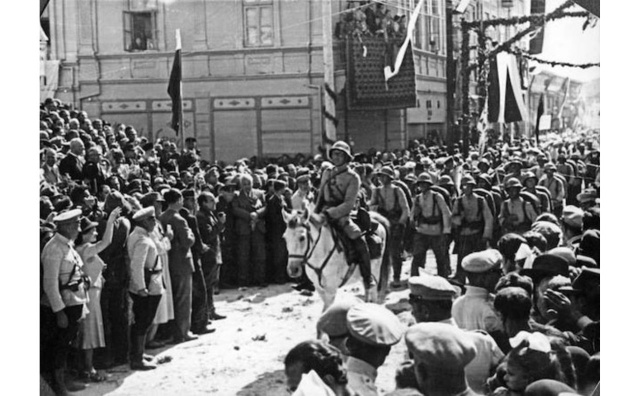
Bulgarian soldiers enter Dobrich, Dobruja, after the Craiova Agreement of 1940 (Wikipedia)
History is rarely as clean as the winners write it. Bulgaria ended World War Two on the losing side, signed a peace treaty as a defeated nation, and yet walked away with more territory than it started with. Bulgaria set a precedent as the only defeated country in World War Two to emerge from the war with a territorial gain. No other country on the losing side can say that.
To understand how that happened, you have to understand what Bulgaria was dealing with before the first shot was ever fired. The Treaty of Neuilly-sur-Seine in 1919 had imposed severe territorial losses on Bulgaria, including the loss of Southern Dobruja to Romania, and left a lasting wound on Bulgarian national consciousness. For two decades, getting Dobruja back was not a fringe ambition, but the central goal of Bulgarian foreign policy. When Hitler came along and started redrawing maps, Bulgaria saw an opening.
On September 7, 1940, Southern Dobruja, lost to Romania under the 1913 Treaty of Bucharest, was returned to Bulgarian control by the Treaty of Craiova, formulated under German pressure. Tsar Boris III got back a territory that generations of Bulgarians had considered rightfully theirs, and he did it without firing a single bullet. From a purely Bulgarian perspective, that was an extraordinary diplomatic achievement.
The rest was harder. Enormous German pressure determined the momentous, but inevitable decision of the Bulgarian cabinet to side with the coalition dominated by the Third Reich in March 1941. Bulgaria was economically dependent on Germany, geographically surrounded, and militarily outmatched. Joining the Axis was the price of survival and the Tsar knew it. He had little room to maneuver and used whatever room he had.
What he managed to do within those constraints is where the story gets genuinely interesting. Bulgaria joined the Axis, but refused to declare war on the Soviet Union, a decision that infuriated Berlin. Bulgarian troops never fought on the Eastern Front. The Bulgarian officer class were mainly pro-German while the population at large was predominantly Russophile, and Boris was shrewd enough to understand that sending Bulgarian soldiers to fight Russians was a line the country would not accept. For a country technically allied with Nazi Germany, holding that line was remarkable.
Then there is the question of the Jews. The full picture here is complicated and deserves honesty. Bulgaria did not deport Jews from its core provinces, but it did deport Jewish residents from the Greek and Yugoslav territories it occupied in 1941. In March 1943, Bulgarian police and military units carried out the deportation of 11,343 Jews from those occupied territories, virtually all of whom were killed at Treblinka.
But within Bulgaria‘s own borders, something different happened. The clandestine deportation of Bulgarian Jews was scheduled for March 1943, but Dimitar Peshev, deputy speaker of the National Assembly, managed to force the government to cancel it. Forty-three members of parliament backed a resolution in defense of Bulgarian Jews, supported by many across the social strata. In late May, despite Nazi pressure, Tsar Boris cancelled the deportation orders entirely. Around 50,000 Bulgarian Jews survived the war. In the context of what was happening across occupied Europe, that stands as one of the more remarkable acts of collective resistance of the entire period.
By 1944, Boris was dead under disputed circumstances, Romania had switched sides, and Soviet troops were at the border. Bulgaria scrambled to exit the war, declared neutrality, then declared war on Germany, then watched a communist coup take power almost overnight. It was chaotic and undignified. But when the dust settled and the Paris treaties were signed in 1947, Southern Dobruja stayed Bulgarian.
The broader point is not that Bulgaria was clever or heroic in any straightforward sense. It is that a small country with no good options managed, through diplomatic skill, popular resistance, and a fair amount of luck, to lose a war and still come out ahead. Most nations in that position lost everything. Bulgaria kept Dobruja, kept its Jews alive, and kept itself largely out of the bloodiest fighting of the century. By the brutal logic of geopolitics, that is about as good as it gets.
***
This text is published as an opinion piece; the title has been added by our editorial team; the article does not necessarily reflect the views of Novinite.com