


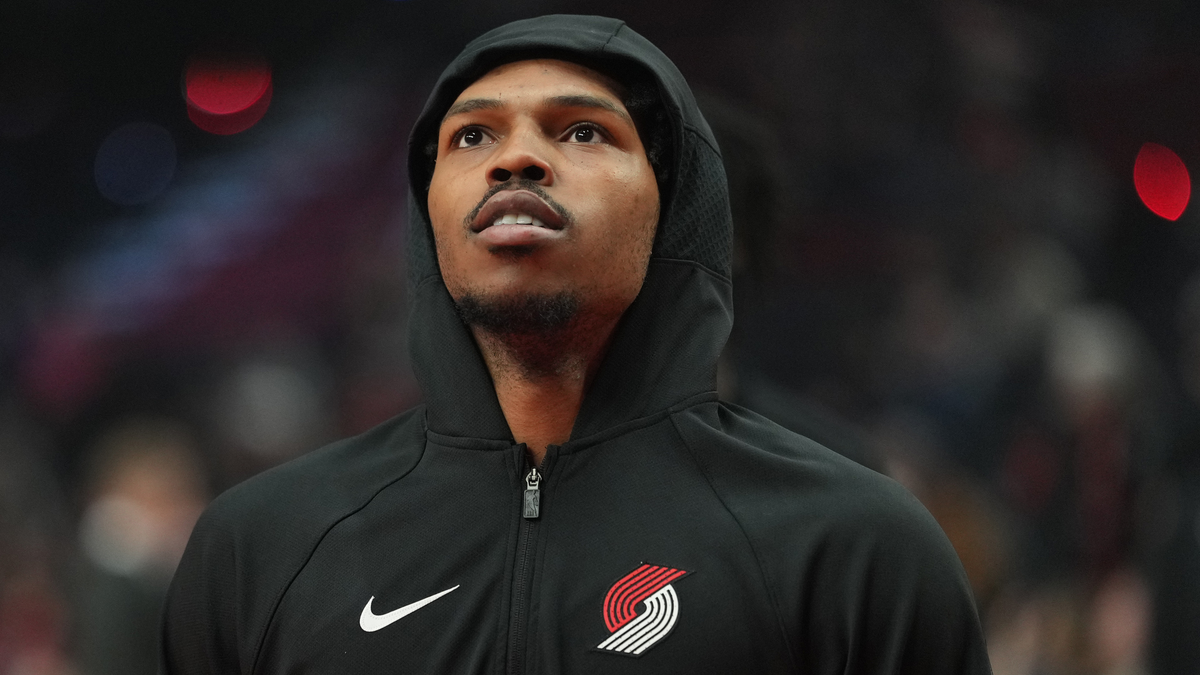
In a departure from NBA norms, Caleb Love, Chris Youngblood and Jayson Kent are not accompanying the Blazers to San Antonio.

The Rose Garden Report is a fully independent publication providing coverage of the Portland Trail Blazers and Portland Fire that you can’t get anywhere else. Purchasing a premium subscription gives you full access to all articles and ability to participate in mailbags, as well as helping to cover travel costs and other expenses to bring you the best coverage possible.
📍SAN ANTONIO — The Trail Blazers had many season-saving wins in an up-and-down year on the way to the first-round matchup against the San Antonio Spurs that begins Sunday night.
Near the top of that list is a Nov. 21 road victory over the Golden State Warriors that snapped a four-game losing skid as injuries started to catch up with the Blazers all at once.
In that game, with the opening-night starting backcourt of Jrue Holiday and Shaedon Sharpe both dealing with calf injuries, it was rookie two-way guard Caleb Love that stepped up. Love played 37 minutes that night, scoring a career-high 26 points and hitting six three-pointers to help the Blazers outlast the Warriors and pick up a much-needed win to right the ship.
It was the first in a string of big performances for Love, who took full advantage of Portland’s bleak injury situation to establish himself as an NBA-caliber player and help keep the team afloat.
The Blazers would not be in the playoffs without Love. Now that they’ve made it, he can’t play because two-ways aren’t eligible for the postseason.
And in a move that could only be attributed to more cost-cutting measures from new owner Tom Dundon, Love and the Blazers’ other two-ways, Chris Youngblood and Jayson Kent, did not travel to San Antonio with the team for Games 1 and 2 and will be watching from home in Portland.
This is well outside of standard practice in the NBA. All seven other road teams on the first weekend this year’s playoffs brought their two-way players to the games even though they can’t play, sources close to those teams confirmed. They may be stuck in street clothes, but they’re still being treated like they’re part of their teams.
Since the Blazers’ sale officially closed on March 31, red flags have popped up all over the place about Dundon’s desire to slash costs, from his well-reported lowballing of head coaching candidates to nickel-and-diming support staff on hotel checkout times on this week’s trip to Phoenix for the play-in.
Leaving players, even ones that aren’t eligible to play, at home during the franchise’s first playoff run in five years is an unprecedented move, though.
And it’s particularly insulting in the case of Love, whose scoring outbursts helped win the Blazers several games in December and January while they were decimated by backcourt injuries—including a 16-point performance in a Jan. 3 road victory over Portland’s current playoff opponent, the Spurs.
Love and Sidy Cissoko were instrumental in getting the Blazers through that stretch of the season, going well beyond the kind of minutes and production that teams with playoff aspirations normally expect from their two-ways.
Two-way contracts were designed for young, developing players to mostly spend time in the G League and play spot minutes when their NBA teams are shorthanded; neither Love nor Cissoko were able to play a single game for the Rip City Remix before the All-Star break because the Blazers needed the bodies.
Cissoko, who started 24 games while on his two-way deal, hit the 50-game limit for two-way players in February and the Blazers converted him to a two-year standard NBA contract to have him available for the rest of the season.
Love wasn’t so lucky. As he approached his own 50-game limit, the Blazers’ other guards began to get healthy, with Holiday, Scoot Henderson, Blake Wesley and Matisse Thybulle all returning to the lineup after missing extended time with injuries. Love played sparingly after the All-Star break as the Blazers conserved his remaining two-way eligibility days in case they needed him. He played 10 games for the Remix down the stretch, averaging 24.7 points, 4.6 assists and four rebounds per game.
Despite finding himself suddenly out of the rotation after playing so well when given the opportunity earlier in the year, Love never complained and continued to be a positive, supportive presence to his teammates on the bench as the Blazers finished the season strong and won Tuesday’s play-in game to lock up the seventh seed in the Western Conference.
“Everybody is happy for each other,” acting head coach Tiago Splitter said Tuesday night of the locker-room scene after their play-in victory in Phoenix. “Even the guys that didn’t play much, it wasn’t about egos and agendas, it was about the team. These guys are going to experience something they’ve never experienced before—the playoffs in the NBA.”
Love, Kent and Youngblood will still get to experience their first taste of NBA playoff action from the bench when the Blazers return home to play Game 3 of the series at Moda Center on Friday. But for the Blazers’ first playoff game since 2021, their three least-known and lowest-paid players will be watching from the couch.
Donations help support independent coverage of the Portland Trail Blazers and Portland Fire.