


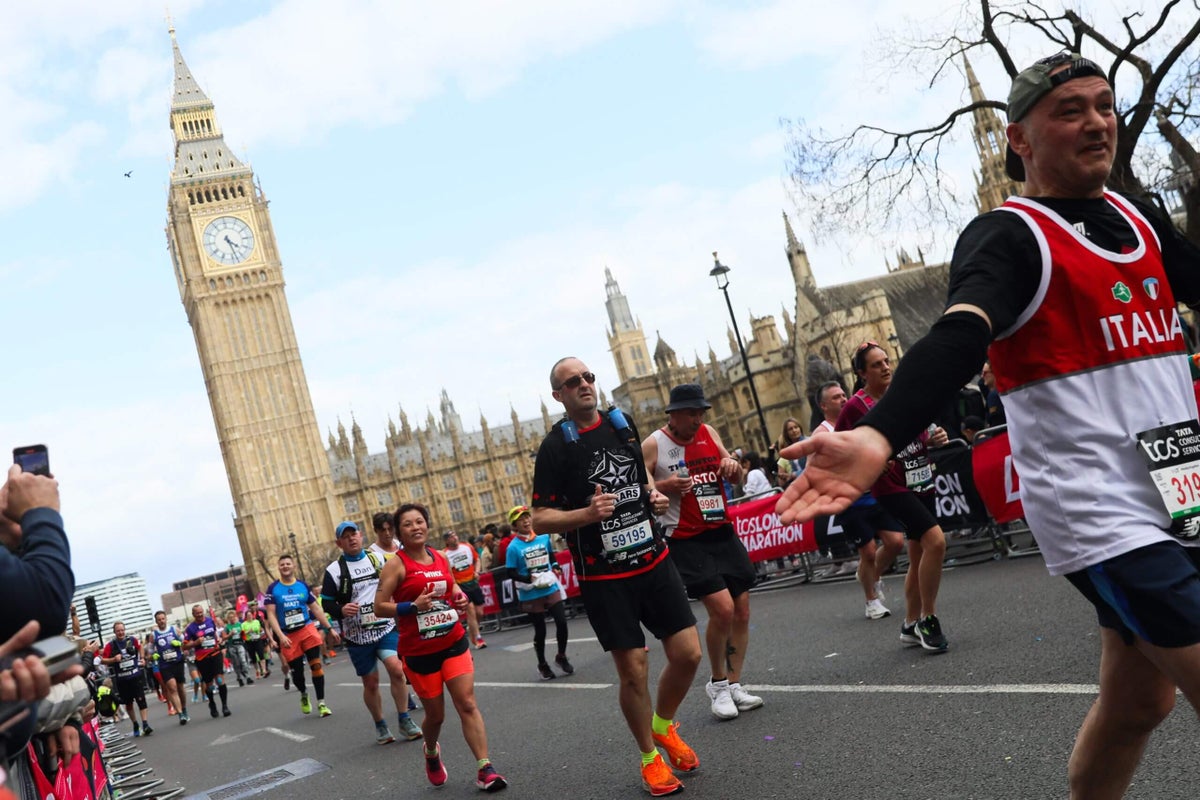
The London Marathon takes place this Sunday, but preparations for the 2026 event began almost as soon as last year’s edition finished.
First, there are the big-name athletes to find and woo into competing on the streets of the UK’s capital, then the pace-makers, the notable debutants, and the tantalising head-to-heads to create; there’s the hotel bookings, the visas, the flights, the prize money and even bonuses to ponder over. It is an exhaustive, months-long to-do list for one of the biggest sporting events held in the city each year.
As the heads of the elite athletes and para athletes sections respectively, it’s up to Spencer Barden and Michelle Weltman to attract the best runners and curate eye-catching fields for what is one of the most prestigious marathons on the global calendar.
“The process starts from almost the day after the race the previous year,” Barden tells The Athletic. “London prides itself in having the best fields.”
Priority one is trying to get the previous year’s champions back. “Because they (runners) can only do one spring marathon, we’re competing against Boston and Tokyo,” he says.
Calls are made following the fall marathons — Berlin, Chicago and New York — to lock athletes in before the turn of the year, allowing the elite fields to be announced in January.
For wheelchair athletes, it works in a slightly different way.
“They can do marathon after marathon after marathon,” says Weltman. “So, for me, the process starts a bit later, but I’m in contact with them throughout the year.”
Sabastian Sawe of Kenya won the men’s race in London last year. (Justin Tallis / AFP via Getty Images)
Barden spends a lot of time speaking to agents and other athlete representatives. Jacob Kiplimo’s marathon debut in the 2025 race — the Ugandan half-marathon world-record holder finished second in 2 hours, 3.37 minutes — had been sealed years prior, after a handshake agreement with his agent.
Roughly speaking, organizers try to build balanced fields with four different athlete types: the big names, standout head-to-head battles, significant debutants and top-ranking British runners.
Barden cites Hellen Obiri of Kenya, who is making her London debut this year, as a significant get: “She’s won (the marathons) in New York and in Boston, but hasn’t had the chance to run as fast in a women’s-only race, where we’re looking at 2:15-type pace (close to the world record).”
Another recruit is Yomif Kejelcha, an Ethiopian athlete with incredible range — he has set world records for the half-marathon and the indoor mile — who will compete over the full 26.2 miles for the first time tomorrow.
Where London differs from other major marathons is that the women’s and men’s races are run separately, the former setting off 30 minutes earlier. Tigst Assefa of Ethiopia ran 2:15:50 in warm conditions last April, which made for the second time in two years that the women’s-only world record was broken in the race (after Kenyan runner Peres Jepchirchir’s 2:16:16 in 2024).
Weltman says the wheelchair races market themselves.
“Everyone wants to come to London,” she says. “We always have the most competitive field” — something she attributes to the athletes enjoying a “technical” course with plenty of turns. “It changes how they race and how they work as a pack.”
Some wheelchair athletes skip the Boston and New York events because they do not feel comfortable with the high speeds they can reach down the hillier sections of the routes in those cities, Weltman says.
Weltman was shocked in 2023 when Marcel Hug won the men’s wheelchair race in 1:23:44, just two seconds off the world record. The Swiss has now claimed five straight London titles, while his compatriot Catherine Debrunner has taken three of the past four women’s crowns — she retained her title last year with a course-record time of 1:34:18.

Marcel Hug pictured competing in last year’s London Marathon. (Getty Images / Getty Images)
There are no plans for tweaks to make the London course faster, though very minor adjustments sometimes have to be made.
For that, organizers turn to the same technology used when Eliud Kipchoge of Kenya broke the two-hour-marathon barrier in 2019, overlaying data onto potential routes to find the optimal one.
“London is quick,” Barden says, believing the elite women are “likely to run quicker” than 2:16 this year. “All these things are weather-dependent. Is it possible to run sub-two hours on the London course? Maybe.”
Collaboration has been key for Weltman and the wheelchair races. They partnered with organizers of the Boston event, creating a challenge whereby athletes who competed in both — always held just six days apart — became eligible for extra prize money. “It used to be that athletes would choose between London and Boston,” Weltman, who also helped recruit athletes for that U.S. race, says.
She and Barden are proud that, since 2024, they have offered equal prize money for placed finishes across the four elite races. “It’s something that I’ve been passionate about working towards,” Weltman says.
Winners of the four elite races (men’s and women’s runners and the equivalent wheelchair athletes) receive $55,000 (£40,800). Second and third place take home $30,000 and $22,500 respectively, scaling down to 12th place ($1,000).
There is a separate pot of British-only prize money, and discussions happen yearly about bonuses for breaking time thresholds. This is pertinent given this super-shoe era, in which road-running times and records continue to be obliterated. The sport has moved on since Barden’s own days as an international athlete in the late 1990s and early 2000s. “We could probably be bankrupt now if we kept the same time bonuses,” he laughs.
They will pay out $50,000 for any man who wins in under 2:04, likewise sub-2:17 for the women’s champion. The maximum on offer is $150,000 for victors quicker than 2:02 (men) and 2:15 (women).
One key cog to race day is pacers and pacing groups, which Barden sorts out in January, once the competitors are confirmed. “We could have three, four, five, even six pace groups within any of the races,” he explains. Wheelchair athletes, Weltman says, “use each other” and do not suit the use of dedicated pacesetters. Instead, they have devices attached to their chairs which track speed and splits.
Barden has his methods for picking pacers: “They’re either people I’ve used in the past (or) athletes from other races who have done a really good job. We have (had) British athletes who were interested to run in the future, on the basis that I know they’re probably going to race in a year or two.”
He namechecks Mo Farah, Eilish McColgan and Emile Cairess, all Brits who paced before later running strong marathons in London.
Jess Warner-Judd, who will compete this weekend in her second-ever marathon, is another in that group, and Olympic champion triathlete Alex Yee returns this year to pace after running 2:11:08 on his full London debut in 2025.
“It gives opportunity and experience, the chance to take drinks on the personal drink station — because that’s a new thing for some athletes,” Barden says of British pacers. “Also, communication is really key within pacing groups. Having British athletes in there does help, especially as the first 5km (just over three miles) is slightly downhill and a bit quicker. You almost need to hold the athletes back a bit.”
There are multiple meetings to initially group athletes and then “fine-tune” strategies once it gets to race week and weather conditions for Sunday are known. “We give them pace charts; all the information about if they’re going to drop out at certain points, how to get picked up and brought back to the finish,” Barden says.

Recreational runners cross Tower Bridge during the 2024 London Marathon. (Henry Nicholls / AFP via Getty Images)
All pacers are contracted at least to halfway, he adds. Many complete 15.5 (25km) or 18.6 miles (30km). They have a “big network” of communication and vehicles to pick the pacers and any DNFs (did not finish) up once they stop.
A dedicated team sorts everything for athletes, from transport and documentation to booking flights and sorting visas. They ensure the race-spec wheelchairs are transported safely, while athletes are fast-tracked through immigration and chauffeured to their west London hotel — all elements of what Barden calls “performance-first” treatment.
There are doctors, physios and massage therapists, plus check-in for athletes as soon as they arrive at the hotel, where there are specific, exclusive areas for them to eat, with “bespoke menus” provided full board. “Wheelchair athletes are coffee-crazy, and there’s a coffee shop in the hotel so they don’t even have to go out,” Weltman says.
“We’re talking the best part of 800 bed nights in the hotel. It’s a big operation to manage,” Barden adds, which is why they start to make bookings six months in advance.

Hellen Obiri, winner of last year’s New York Marathon, is making her London debut this weekend. (Ishika Samant / Getty Images)
As race day approaches, Barden and Weltman cross their fingers that everyone makes the start line. “You anticipate dropouts. It’s all part of the process,” Barden says. Late injury or illness can rule athletes out. “There may be one in 10 years that everybody stays in — that’s a bonus.”
He remembers the year when legendary Ethiopian marathoner Kenenisa Bekele scratched the day before. Weltman cites Swiss athlete Manuela Schar, a three-time London winner, who was told by a doctor at the race start that she was not well enough to compete.
Last week, home favourite Cairess and 2024 women’s champion Jepchirchir pulled out. Reigning women’s Olympic marathon champion Sifan Hassan of the Netherlands had already withdrawn at the end of March.
Barden and Weltman know how they will be feeling come the start at around 9am local time tomorrow: helpless.
“Once the race starts,” Weltman says, “it’s out of our hands. It’s down to the athletes.”