



Jeopardy has returned to Scottish football. It is an integral part of any sporting competition but, for 41 years, the title has been shared between only two clubs, Glasgow’s dominant duo of Celtic and Rangers.
This season, the usual two-horse race finally has a third runner. Hearts, short for their full name Heart of Midlothian, hailing from the capital Edinburgh and without a league triumph in 65 years, are top of the Premiership with four games to go. They are three points clear of Celtic and four ahead of Rangers, on the verge of upending the duopoly known as the ‘Old Firm’.
Since Alex Ferguson retained the trophy with Aberdeen (Manchester United, domestic and continental domination and a knighthood would follow) in 1984-85 — the last time a non-Old Firm team were champions — Scottish football has become increasingly uncompetitive.
As the financial power of the league was left behind by the commercialisation of the English Premier League after it was founded in 1992, the gulf in budget between Scotland’s top two and the rest has dramatically diverged.
Between 1975 and 1995, the Glasgow sides only finished first and second in four separate seasons. Dundee United and Aberdeen both topped the table in that time, with Hearts and Motherwell placing second. Only in 2006, and then again in 2017 and 2018 — two seasons when Rangers were rebuilding from four years in the lower divisions as a result of a financial crisis — has a team managed to break up the two teams from Glasgow when they were both in the top flight.
Rangers are the third team in the Scottish title race (Ian MacNicol/Getty Images)
This sort of polarisation has afflicted many domestic European leagues, but Scotland may be the most extreme example.
Upsets can happen in individual games. Knockout competitions and their definitive nature can help inspire David to beat Goliath. Doing so often enough to matter over a 38-match league campaign is another matter. The wage budgets of both Celtic and Rangers — who spent over £40million on transfer fees, let alone wages, since the 49ers Enterprises takeover last year — are between four and five times as large as that of Hearts.
This season was billed as another straight shootout between Celtic and Rangers, who are tied on 55 league titles, to determine who would make it to 56. Both have won nine in a row in the past 30 years, but Celtic have taken 14 of the last 15 championships.
As with Aberdeen last season, who won 10 of their opening 11 games before form fell off a cliff, the expectation was that Hearts’ challenge would run out of steam.
Brighton & Hove Albion owner and data analytics guru Tony Bloom invested £10million in the club last summer, declaring that he wished to win the league within five years. He had already disrupted the footballing hierarchy in Belgium with Union Saint-Gilloise — taking them from the second division to their first championship in 90 years — but it was still seen as fanciful.
Yet the Moneyball-esque signings of Claudio Braga and Alexandros Kyziridis from the Norwegian second tier and Slovakian top flight respectively have sprinkled enough quality on the organisation and spirit of manager Derek McInnes to propel Hearts to the front.
There are further twists and turns guaranteed, in large part thanks to the league’s format.
Unlike the Premier League, in which all 20 teams simply play each other home and away, the 12 clubs in the Premiership meet three times before the table splits in half, with the top six playing each other once more to create a best-versus-best scenario. Hearts beat city rivals Hibernian 2-1 away in the first of their nerve-racking final five games, with the latter having two players sent off.
Hibernian occupy an unusual position as the potential kingmaker in this race. Naturally, they do not want their fiercest foes to be able to lord it over them, having not won the league themselves since 1952, but three-time tennis Grand Slam winner and Hibernian fan Sir Andy Murray has admitted that a Hearts title this season would be the healthiest outcome for the league.
These conflicting emotions are likely to repeat in the coming weeks.
Hibernian host Celtic tomorrow (Sunday) and visit Rangers 10 days later, knowing that winning those matches could inadvertently hand the trophy to their neighbours.
The same is true for Rangers. Having been beaten by Motherwell at home last Sunday, they travel to Tynecastle, home of Hearts, on Monday evening, knowing that if they win, it will open the door for Celtic, who they then host in the Old Firm derby the following weekend.
It has led to fan concerns about sporting integrity and whether a team could conceivably lie down in a match if it meant denying their big rivals a route to glory. The final-day meeting in Glasgow between Celtic and Hearts, expected to be played in front of a 60,000 crowd, could put that to the ultimate test. Should Celtic take points off Hearts in that one, could they gift the title to Rangers?
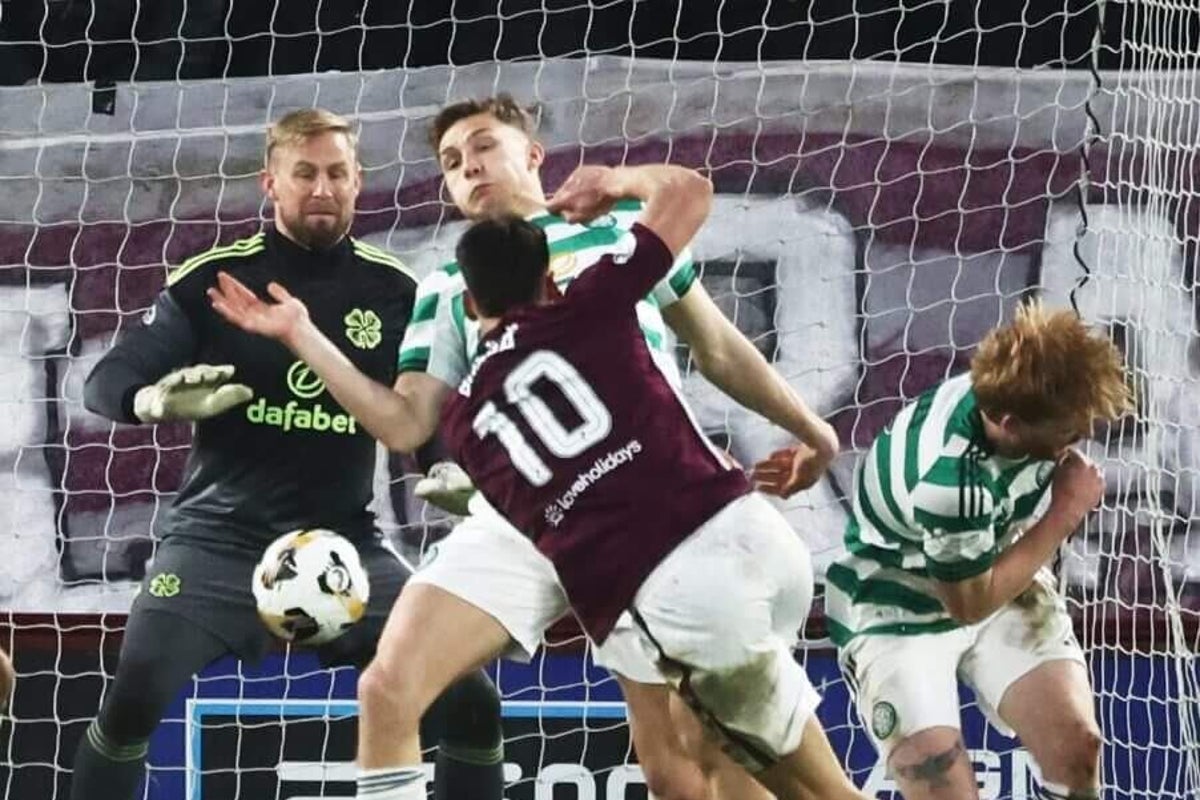
Those concerns aside, Hearts have a simple scenario: beat Rangers, Motherwell, Falkirk and Celtic in their remaining games and they will be champions for the first time since 1960.

Hearts are pushing to win the league for the first time since 1960 (Zak Mauger/Getty Images)
Scotland has had dramatic endings to seasons before.
In 2002-03, Rangers won the title ahead of Celtic only on goal difference, +73 to +72; two years later, Celtic conceded twice in the final few minutes of their last league match against Motherwell, were beaten 2-1 and so lost the league to their arch-rivals by a point. It came to be known as Helicopter Sunday as a helicopter, carrying the trophy, was circling between two stadiums as it awaited the outcome.
The hope is that, two weeks today (May 14), the chopper will be buzzing around somewhere between the east end of Glasgow, for that Celtic-Hearts match, and Falkirk, who are hosting Rangers, with all those clubs — barring Falkirk — still capable of being crowned champions on the final day.
It will be a fittingly dramatic final episode to the most unlikely of seasons — and perhaps the gateway to a TV deal far more lucrative than those that have held Scotland’s clubs back for decades.